

Interactive Brokers IMPACT app makes it easy to find and invest in companies that share your values, helping to better align your portfolio with the kind of world you want to create. The IMPACT app automatically scans your investment portfolio and ranks your position on an ethical basis. It will even suggest more ethical alternatives with a similar investment profile and let you switch with a single click. *Minimum dealing commisssions are £1 in the UK or 0.05% of the deal size.

- Experts commend Interactive Brokers for its unmatched market access, diverse account types, and low trading costs, highlighting its institutional-grade tools and innovative features. However, they note that customer service can be slow, particularly for smaller clients, which may detract from the overall experience.
- Across 1375 user reviews on Good Money Guide, averaging 4.6/5, customers frequently praise the platform’s low fees, extensive market access, and advanced trading tools. While many appreciate the user-friendly interface and comprehensive resources, some express frustration with the complexity of the platform and slower customer support responses.
Interactive Brokers Expert rating
Our expert rating is the average of the areas listed here, each scored out of 5 by our team.Our experts have rated Interactive Brokers across five key areas of our review framework.
- Pricing5.0
- Market Access5.0
- Apps & Platform5.0
- Customer Service4.0
- Research & Analysis5.0
Pros
- Very low dealing fees
- Wide market range
- Direct market access
- Complex order types
Cons
- Customer services can be slow
- No financial spread betting
See full expert review
Our verdict
Interactive Brokers is an exceptional trading platform that offers institutional-grade trading capabilities to private clients around the world. IBKR has some of the lowest trading and investing fees and the widest market range in the industry. Interactive Brokers is a major US online automated electronic broker company. The financial broker is listed on the Nasdaq Exchange with ticker IBKR. The firm operates in 150 electronic exchanges in 34 countries, and offers trading in 28 currencies. Interactive Brokers has more than 3.19 million institutional and retail customers.
Is Interactive Brokers any good?
 Yes, Interactive Brokers is simply unmatched in terms of market access, account types and execution options for retail traders. It always has been and remains one of the cheapest trading and investing platforms globally.
The proof they say is in the pidding and IBKR, has increased it’s market share in the UK dramatically over the past few years. In 2024 alone, they increased the number of accounts by 142%. An amount I suspect will continue to rise, of all the brokers we cover, they provide the most updates, most platforms and are always looking to offer new markets, that investors actually want.
2025 Awards: Best Professional/DMA Broker 2025
Pricing: Top marks as IBKR don’t charge a custody (account) fee and commission are the cheapest around
Market Access: Top marks again for the widest selection of markets available
App & Platform: Hard to beat – excellent range of institutional grade execution tools and simple apps for beginners
Customer Service: IBKR let themselves down a bit here. If you are a big customer you get an account manager, otherwise online support is slow
Research & Analysis: Some of the best education, screeners and market data for free on their website and integrated into IBKR platforms.
I’ve used Interactive Brokers for about 20 years now. I’ve interviewed their founder (Thomas Peterffy), their UK MD (Gerry Perez), they’ve been a competitor (when I was a broker myself), a customer and a partner over the years. I’ve traded live with real money when thoroughly testing their platforms.
This included an in-depth conversations with their Head Of Product (Steven Sanders) to get inside insights on the best parts of the platform and services that some clients may not know about. In this review, I lay out my verdict on Interactive Brokers as an industry expert so you can decide if they are the right investing and trading platform for you.
There is one thing that Interactive Brokers gives you above all other brokers, and that is control. You can invest and trade in pretty much anything you want, in pretty much any account type, pretty much how you want.
If you are not familiar with Interactive Brokers (IBKR) they are American, but global, as most American things are, with the notable exception of their news, which always seems to be local. But I digress, IBKR was one of the first brokers to offer electronic trading to the masses. They were founded in 1978 and if you want to know more about the man who founded them and is still running the show, read my interview with Thomas Peterffy, the founder and chairman.
Highlights: The key things to focus on if you are considering opening an account with Interactive Brokers is that:
They are cheap: No other investment or trading platform can match their discount commissions, FX rates and zero account charges
Huge market range: IBKR offer by far the best access to global stock exchanges around the world
They innovate and create :You can invest in so many different ways through IBKR, from their beginner IBKR LITE apps, to their institutional-grade desktop workstation trading platform. They have some of the most advanced and easy-to-use features available to private investors.
Interactive Brokers Account Types: IBKR offer by far the most types of accounts globally including regular investing account, active trader accounts, direct market access, futures, options and fractional stock trading
You can also earn money on your cash, you can buy bonds (high and low yielding), buy warrants, partake in placings, vote on company corporate actions. You can convert currency at 0.2%, which is cheaper than most specialist currency brokers or money transfer apps.
Foreign Exchange: Which actually segues me nicely to prove my control point. With most brokers you have to choose an account base currency (if you are in the UK that is probably going to be GBP) and when you trade, no matter what currency an asset is traded in your P&L will be converted to that base currency. But with Interactive Brokers you can run your account in multiple currencies.
So, if you put in GBP and trade the S&P for example, your P&L will be in USD. If you buy USD stock you get the option to attach a currency conversion to the transaction so you can convert exactly the right amount to cover the purchase, or you can choose to run a deficit in USD.
It’s not such an issue for small traders, as currency exposure, whilst important to be aware of, isn’t the most pressing matter. But if you are running a net flat long/short global macro portfolio, then keeping on top of your currency exposure could be the difference between making money or not.
Desktop Trader: Through ScaleTrader, (one of the founder’s favourite features) IBKR also gives you some very advanced order functionality, the sort you usually only get with professional trading systems like Fidessa (for stocks) or TT (for futures).
If you’re building a big position and don’t want the market to know you’ve got a big order to work, IBKR’s order ticket will let you gradually feed that into the market (but only charge you for the single order).
You can automatically drop bids and offers into the market based on time and price to take advantage of volatile markets. You can also set it to scalp for quick profits in choppy markets.
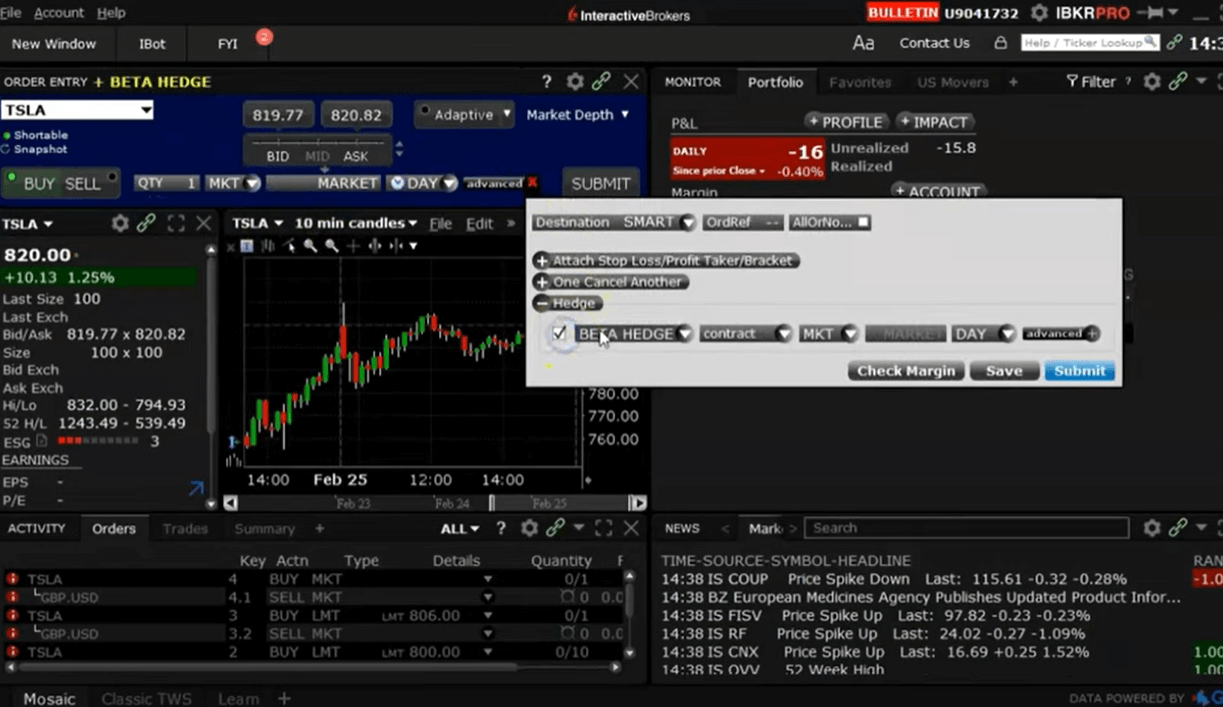
Pairs Trading: You can trade one stock against another automatically by spread, percentage or price.
Why is that important? Because it can help you build a market-neutral portfolio and when we asked the boss of IBKR the habits he saw in his most profitable customers, (referring back to our interview with him for the third time) he said the ones that traded one stock against another, often did well.
Interactive Brokers Universal Account: You can of course do these things with other brokers, but what you can’t do is do them all in one place.
For this review, I spent a while talking to Steven Sanders, IBKR’s head of Marketing & Product Development, and he said in the twenty years, he’s worked for Interactive Brokers the thing he’s most proud of (other than it being founder lead and therefore very little red tape when you want to get things done) is the implementation of the Universal Account, where everything is done from one account.
What’s amazing to me is that nobody else really offers it. Ten years ago when I was a derivatives broker at Man Financial, we offered everything that IBKR did, but all on separate platforms. We have a couple of big accounts, £20m upwards, that we were always trying to lure back from IBKR with our personalised voice brokerage where you could phone us up we’d take care of your complicated orders for you.
But times change, there is still demand for bespoke voice brokerage, but not as far as Interactive Brokers are concerned. They do offer it from specialists desks if needed, but most trading and investing is done online.
Demo Account: Interactive Brokers does have a demo account, but they call it a free trial instead. This is odd, because you don’t actually have to pay to have an account with IBKR. In fact, Interactive Brokers is one of the only trading platforms that does not have a custody fee for investing in a GIA, SIPP and ISA.
If you want to know more about that, you can listen to my podcast with Gerry Perez, the UK MD, who explains, how they offer such amazing market access for such little cost.
You get a cool $1m to paper trade with on the Interactive Brokers demo account or ‘Paper Trading version’ as they call it. You get access to the easy-to-use investors portal and the more complex IBKR TWS provides delayed market data, simulated trading and access to all of our unique tools and offerings, including the IBKR Risk Navigator, the Volatility and Probability Labs, Portfolio Builder, Research and News.
But, to be honest, I didn’t find the demo account very good. Lots of information was missing and I couldn’t place a trade. I’m not sure why, and actually, that’s going to be a bit of an issue for Interactive Brokers because demo accounts are a great way to get client’s interest. In a world where so many brokerages a vying for the same business, even small hiccups like that can cause a massive drop off rate in opening an account.
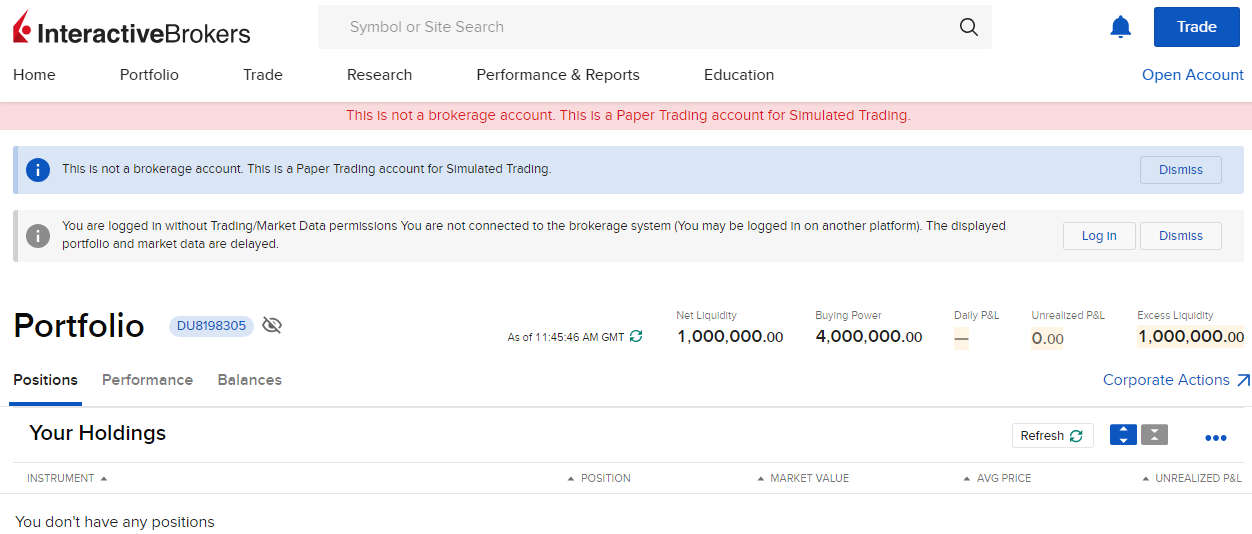
Usually, IBKR’s technology is first-rate, but the demo account isn’t up to scratch. I didn’t use the paper trading account, just the live trading platform with real market orders.
Customer Service At Interactive Brokers: It’s not all great, it takes a while to get through on the phone to customer service, and it has a slightly outsourced feel about it (if you know what I mean).
The desktop trading platform, despite its exceptional functionality, is also a bit ‘Windows 95’. But if you don’t need all the bells and whistles, the web based platform, or app has a more modern feel to them.
Options Strategy Builder: Options trading is gaining in popularity in the UK, mainly because of the press attention they derived from meme stocks (where US traders punt via options). But they are still a very complicated product. So what Interactive Brokers has down is create a Strategy Builder product, that essentially reverse the process of putting on options strategy trades.
You tell Strategy Builder what you think the market is going to do. For example, either, go up, stay still, not move for a while, or volatility will increase and it will create an options strategy around that. Instead of you having to know what strategy to put in place or working out the individual options legs.
IMPACT Ethical Investing: In tune with moving with the times, Interactive Brokers has also released the IMPACT app to help people investing in ESG and impact sectors, so they can put their money to good.
You can see the IMPACT dashboard on desktop, but it also operates as a standalone app that connects directly to your IBKR account and scores your portfolio based on how ethical the stocks you hold in it are. Ratings come from FactSet and Refinitiv, and there is this excellent feature that allows you to swap into more ethical stocks.
If one of your holdings is flagged as not that ethical, the app will suggest another one and at the click of a button, it will sell your shares and calculate how many new shares of a more ethical but similar company to buy and do it all for you. If you’re in the US, you can also make charitable donations directly on the app.
Interactive Brokers For Beginners: There is no doubt that Interactive Brokers is a proper trading platform, for those who know what they are doing and cater mainly to the more sophisticated investor. But they are making an effort to open their services up to the newer breed of investor and trader.
It’s standard now among many fintechs, but IBKR were actually the first to offer no commission trading. They also offer fractional shares through IBKR LITE and IBKR Pro accounts and have removed the monthly minimum account charge.
The hope of course is that by onboarding investors when they just start, they can look after their investments for the next 40 years, just as they have been doing for their existing clients for the last 40.
Interactive Brokers runs a Student Trading Lab where students from 600 schools and universities take part in a $1m paper trading account for the purposes of getting a better understanding of the markets. No broker these days can tell you what to buy or sell, but IBKR GlobalAnalyst helps you hunt out undervalued opportunities, across the world, not just in the US.
IBKR offer a Trading Academy, podcasts, webinars and blogs for beginners and experienced traders so that new customers survive the markets to become long-term clients.
Plus, they are cheap.
24-Hour ETFs At Interactive Brokers:Interactive Brokers has a list of 24 selected ETFs available to trade around the clock from Sunday evening, east coast time, through to the close on Friday, by adding these funds to its US overnight trading facility.
Clients who are permissioned to deal in US stocks, are able to trade these ETFs 23.50 hours a day, five days per week, allowing them to react to news stories, macroeconomic and geo-political events as they happen, rather than waiting for US markets to open.
The trading hours and ETFs are available to both retail and institutional clients alike and are traded via the firm’s IBEOS system. Trades can be submitted using multiple order types.
The range of ETFs is pretty broad and includes firm favourites such as SPY, QQQ, DIA and IWM, which track the S&P 500, Nasdaq 100, Dow 30 and Russell 2000 indices respectively. You can also short those indices by trading the SH, PSQ, DOG, and RWM inverse ETFs.
Interactive Brokers Customer reviews
Customer ratings come from reviews left on this site. Every review is read and approved before it is published.Based on 1,375 reviews
- Excellent74%
- Very good14%
- Basic7%
- Poor2%
- Bad2%
Read customer reviews
IBKR
I’ve had a good experience with Interactive Insurance Brokers with the platform giving full access to many options for the US stocks
frequency and quality of improvement has taken IBKR further ahead of the pack
i noticed IBKR improving its Trading Platforn – IB Trader Work Station frequently and it keeps getting better and better.
Great and Valuable guidance
Research based guidances are provided without considering any own benefits
ibkr is all in on trading platform
with 3 platforms differs in experience level it is best for all trading activity
Investing is simple
There is no minimum investment and the costs of investment are very low, so my profits will be bigger
Best Broker Ever
I have been using IBKR for 7 years and will use it for the rest of my life. They helped achieved my financial independence which is priceless
Great Platform
Interactive Brokers is a great platform to invest in many markets worldwide. It is fast, works well and competitive in its fee structure
Solid and comprehensive service
Everything I wanted from a trading platform
Best Trading App
Very good trading app. Easy to learn and easy to trade. Has all it needs
Very Happy Customer
I’ve been using Interactive Brokers for my trading and investing, and I’m genuinely happy with their service. The platform is robust, reliable, and transparent, offering access to a wide range of markets and instruments that few other brokers can match.
I especially appreciate their competitive fees and tight spreads, which make a real difference for active traders. The research tools, charting options, and order execution speed are excellent, and I’ve always found the system stable even during volatile market sessions.
Their customer service has also been responsive and professional whenever I needed support. It’s clear that IBKR is focused on providing value to serious investors and traders.
Overall, I highly recommend Interactive Brokers for anyone looking for a professional-grade trading platform. They’ve earned my trust, and I look forward to continuing my journey with them.
Safe & Big
Very safe and biggets platform for investment in global ETF.
Accessibility
Low fees, variety of services
Best Rates.
Very good and reliable broker. Beside wide choice of instruments, they pay US Fed Current Rate% – 0.75 (service) straight to your account daily on your free money. That means 3% now and up to 5+% when the Fed rate was 5.75%. There in no other broker like this.
Value for money and time
Great app with all latest features and instruments
Great option for Dubai based expats
Interactive brokers is very reachable, moreover very cheap to execute the orders and reports are very detailed and simple to understand, you have access to several stock and etf much better than my former german banks or turkish bank. My second investment account at SAXO is way primitive to compare to IB
Amazing service
In my opinion, Interactive Brokers is the best online Brokerage available in UAE. I started with them 1 year ago. Lowest buy and sell fees back then but also the best marginal interest rates for both AED and US dollars. In addition if you need to exchange money to any other currency, you are achieving it on the best rate at the minute on the international market. Bravo !
USING FROM 2021
USING FROM 2021, Best research reprots available
Best commission scheme
IBKR has almost the lowest commission scheme for trades and has a friendly platform with no hidden fees
Excellent broker
Excellent service
Wide range of exchanges and trading products. Awesome Trading.
I have used Interactive Brokers for many years. Traders workstation on PC is complex but extremely powerful and informative (charting, company information, market prices, news, financial reports / ratios, analyst information). The iPad platform is very convenient for trading on the go. Bonus features beyond stock trading include trading options; Broker Interest on Cash Deposits; Automatic currency conversion on fx trades; and the Managed Securities – Stock Yield Enhancement Program. Other trading platforms which I have used have only have a fraction of the information and features.
Leave a review

AJ Bell is the cheapest ethical investment platform for shares, funds and ETFs in sustainable sectors. They provide a wide range of research and analysis on who to invest ethically, as well as constantly update their AJ Bell Favourite funds list with ethical investing choices. *Share account fees are capped at £3.50 a month. Dealing costs are £1.50 for funds and £9.95 for shares but drop to £4.95 where there were 10 or more online share deals in the previous month.

- Experts commend AJ Bell as an excellent full-service stock broker, highlighting its wide range of investment options and low account costs. They note the platform’s strengths in pricing, market access, and customer service, all rated at 5.0/5, while pointing out high charges for phone dealings and foreign exchange fees for smaller transactions as drawbacks.
- Across 1103 user reviews on Good Money Guide, averaging 4.2/5, customers frequently praise the platform’s user-friendly interface, responsive customer service, and transparent fee structure. However, some users express concerns about the app’s functionality and occasional platform stability issues, indicating a need for improvement in these areas.
AJ Bell Expert rating
Our expert rating is the average of the areas listed here, each scored out of 5 by our team.- Pricing5.0
- Market Access5.0
- Online Platform5.0
- Customer Service5.0
- Research & Analysis4.0
Pros
- Wide range of investments
- Low account costs
- Discounts for frequent investors
Cons
- High charge when you deal over the phone
- High FX charges below £10k
See full expert review
Our verdict
AJ Bell is an award-winning, low-cost online investing platform for UK DIY investors. Founded in 1995, AJ Bell has grown to become one of the UK’s leading investment platforms. Today, it has more than 488,000 customers and assets under administration (AUA) of over £180 billion as of January 2026.
Is AJ Bell good for investing?
AJ Bell is an excellent full-service stock broker that offers a wide range of services for investors, including share dealing, fund investing, cash-saving services, and mobile dealing. It also offers a range of accounts including Stocks and Shares ISAs, Lifetime ISAs, Self-Invested Personal Pensions (SIPPs), dealing accounts, and investment accounts for children.
AJ Bell Customer reviews
Customer ratings come from reviews left on this site. Every review is read and approved before it is published.Based on 1,103 reviews
- Excellent46%
- Very good35%
- Basic15%
- Poor3%
- Bad2%
Read customer reviews
Ok
Ok
Good value, investments are limited
Good value, investments are limited
Reliable investment platform
Reliable investment platform
Cost are very reasonable and…
Cost are very reasonable and choice of shares is very good
Easy to use, efficient investment…
Easy to use, efficient investment platform, responsive customer service. Rarely any issues.
Good
Good
ok
ok
Good quality
Good quality
Excellent service; a little on…
Excellent service; a little on the expensive side with average coverage of international stocks
Pretty good online broker, share…
Pretty good online broker, share dealing costs have reduced as well
Cost effective
Cost effective
Full range of products; excellent…
Full range of products; excellent support; reasonable fees.
Good
Good
Competitive fees, not always easy…
Competitive fees, not always easy to use App and website
Good investment. Good returns….
Good investment. Good returns. Reasonable fees.
I think AJ BEll is…
I think AJ BEll is a good invest platform. With many newsletters to help you on the journey..
OK not as easy as…
OK not as easy as dodle
Good value but research tools…
Good value but research tools more limited and platform more difficult to navigate
ok
ok
good value
good value
Leave a review
Interactive Investor provides a specific tax-efficient stocks and shares ISA for ethical investing. As well as being able to pick your own ethical companies, funds and ETFs to invest in they have created an ethical growth portfolio, a long list of ethical companies to invest in their II ACE 40 is a list of sustainable investment funds. *Dealing commissions are a free trade every month, then UK Shares and Funds, US Shares charged £7.99 or upgrade to a £19.99 “Super Investor” account 2 free monthly trades and deal for £3.99. Regular investing is free.

- Experts commend interactive investor for its fixed account fee structure, which is particularly beneficial for medium to large investors, potentially saving them significant costs over time. The platform is noted for its excellent usability and comprehensive research offerings, although it is considered expensive for smaller accounts and lacks certain investment options like derivatives.
- Across 1125 user reviews on Good Money Guide, averaging 4.3/5, customers frequently highlight the platform’s ease of use, reliable customer service, and the attractive flat fee structure, especially for high-volume trading. However, some users express dissatisfaction with rising fees, clunky platform navigation, and issues with missing funds, indicating a mix of positive experiences alongside notable frustrations.
interactive investor Expert rating
Our expert rating is the average of the areas listed here, each scored out of 5 by our team.Our experts have rated interactive investor across five key areas of our review framework.
- Pricing4.5
- Market Access5.0
- Online Platform5.0
- Customer Service5.0
- Research & Analysis5.0
Pros
- Fixed account fees
- Easy to use
- Good research
Cons
- No Lifetime ISA
- Expensive for very small accounts
- No derivatives for hedging
See full expert review
Our verdict
interactive investor (ii) offers fixed fee investing on a wide range of investments with a fixed fee account structure make them one of the most cost effective ways for people with large portfolios to manage their investments, ISAs and pensions. ii are expecially good for high value portfolios and those wanting access to small cap stocks.
What does interactive investor do?
Interactive Investor or II as its known is one of the UK’s largest self-determined investor platforms. II can trace its roots back to 1995 and the startup floated on the London stock exchange back in the year 2000 before being bought by the Australian business Ample in 2002. Today, Interactive Investor is a owned by abrdn with assets under administration of more than £50 billion and 400,000 customers to whom II offers share trading and investment services including, ISAs SIPPs and share dealing, alongside research and analysis. Including model portfolios, selected funds and thematic investments.
Interactive Investor differs from other investment platforms as it charges a fixed account fee, rather than a percentage of the funds you have on account. Which, over time, could save you thousands in costs.
As a low-cost provider ii competes directly with the likes of Hargreaves Lansdown and AJ Bell offering general investment accounts, ISAs and pensions.
Pricing: Brilliant for medium and large investors, expensive for small accounts.
Market Access: You’ll be hard-pressed to find something you can’t invest in.
Platform & Apps: Very good, excellent data and usability.
Customer Service: They are massive and mostly online, but you can call them directly, generally good.
Research & Analysis: Loads, daily and weekly updates across all the asset classes they cover, with lots of analysts and opinions. No advice service though.
Does interactive investor pay interest on cash?
Yes, but only 2% for under £10k and you need at least £100k in your account to get their best rate of 3.25%. There are other brokers that offer better rates on uninvested cash, though.
interactive investor versus Interactive Brokers
interactive broker and interactive investor may sound similar but cater to different investor profiles and operate under different jurisdictions and cater for different types of investors.
interactive brokers is a US‑based global brokerage offering a wide spectrum of asset classes and advanced trading tools, often targeting active traders and professionals. interactive investor, by contrast, is a UK‑focused subscription‑based platform offering a fixed‑fee structure suited to medium‑to‑long‑term investors primarily in equities, funds, bonds, Gilts, ISAs, and SIPPs.
interactive investor employs simpler platforms with relatively basic charting tools, while interactive brokers features a more complex interface and lower per-trade costs but with more variable fees. interactive investor is better for large longer term investment accounts because of its simplicity, flat monthly fee and broad UK offerings, whereas Interactive Brokers suits users seeking global market access and sophisticated execution tools.
Can you buy Gilts on interactive investor?
Yes, ii supports investment in government bonds, including UK Gilts, via its platform. This is confirmed on the site, which lists bonds and Gilts as available investments .
interactive investor Customer reviews
Customer ratings come from reviews left on this site. Every review is read and approved before it is published.Based on 1,125 reviews
- Excellent51%
- Very good33%
- Basic10%
- Poor4%
- Bad2%
Read customer reviews
Good value, comprehensive platform
Good value, comprehensive platform
Trusted great service
Trusted great service
Very good value
Very good value
Excellent platform with great services…
Excellent platform with great services at an ecellent fixed price.
Very good. Clear and easy…
Very good. Clear and easy to use.
Goid
Goid
Good affordable trading platform. Not…
Good affordable trading platform. Not a particularly good or intuitive interactive experience though.
Receive regular emails on stocks…
Receive regular emails on stocks and funds, links to vote on companies held. Reasonable trading charge, usually better trade price and quick. Easy to use.
No issues
No issues
Very good set up
Very good set up
Safe, easy to use and…
Safe, easy to use and not expensive.
Good value paltform for holding…
Good value paltform for holding and trading shares
Excellent value
Excellent value
So so
So so
does what it says.
does what it says.
Great for managing all Accounts…
Great for managing all Accounts in 1 place. Good value.
In my experience this platform…
In my experience this platform has worked well and is reasonably priced.
Very good
Very good
Fairly easy to navigate the…
Fairly easy to navigate the app. Charges are reasonable and customer response times good
Simple, low cost, stable, reliable,…
Simple, low cost, stable, reliable, foreign stocks not so good
Leave a review
Hargreaves Lansdown lets you invest in a wide range of large and small cap ethical companies as well as investment funds and investment trusts with an ethical bias. You can also build your own portfolio of ethical ETFs with the help of HLs in-house expert research. *There is no account charge for shares. Funds are charged at 0.45% for the first £250,000. There is no charge for buying funds, but shares are charged at £11.95 per deal or £5.95 if you do over 20 deals per month.

- Experts rate Hargreaves Lansdown highly, noting its extensive range of investment options and excellent customer service. The platform is praised for its user-friendly online interface and comprehensive research tools, although some experts point out that it may be pricier compared to other fund investing options and lacks advanced portfolio hedging tools.
- Across 1775 user reviews on Good Money Guide, averaging 3.8/5, customers frequently highlight the platform’s intuitive app, responsive customer service, and the wide range of investment accounts available. However, there are notable criticisms regarding high fees, particularly for buying shares, and some users report frustrations with account management and customer support responsiveness.
Hargreaves Lansdown Expert rating
Our expert rating is the average of the areas listed here, each scored out of 5 by our team.Our experts have rated Hargreaves Lansdown across five key areas of our review framework.
- Pricing4.5
- Market Access5.0
- Online Platform5.0
- Customer Service5.0
- Research & Analysis5.0
Pros
- Wide range of investments and accounts
- Top-notch customer service
- Excellent research and analysis
Cons
- There are cheaper options for fund investing
- Limited portfolio hedging tools
See full expert review
Our verdict
Founded in 1981 Hargreaves Lansdown is one of the largest investment platforms in the UK. They offer investing, savings, ISAs and SIPP account to over 1.8 million clients with 142bn in assets under management.
Is Hargreaves Lansdown a good broker?
Yes, Hargreaves Lansdown is one of our best-rated stock brokers and investment platforms. HL offers access to a huge range of investment types, through a wide range of general and tax-efficient accounts and is suitable for almost all types of investors.
I always think of Hargreaves Lansdown as the Waitrose of the investing world. Yes, it may be a bit pricier sometimes, but I think it’s just a nicer, safer place to shop for stocks.
Hargreaves Lansdown Customer reviews
Customer ratings come from reviews left on this site. Every review is read and approved before it is published.Based on 1,775 reviews
- Excellent27%
- Very good38%
- Basic24%
- Poor7%
- Bad4%
Read customer reviews
They are not the cheapest…
They are not the cheapest but v good support
fairly dear – could use…
fairly dear – could use faster payment system
Good site easy use friendly…
Good site easy use friendly staff will always help if you need it
x
x
Offer all services easy to…
Offer all services easy to use and trustworthy
No thoughts
No thoughts
Very good & easy to…
Very good & easy to use
Good service, expensive for funds,…
Good service, expensive for funds, less so for individual shares
Excellent for varied investment ways
Excellent for varied investment ways
Bit expensive but sound
Bit expensive but sound
Easy to use online platform….
Easy to use online platform. Reasonable costs.
The McDonald's of investing
The McDonald’s of investing
Platform is good but messaging…
Platform is good but messaging service is lacking. Does not allow submission of scanned documents. Does not respond to all messages.
Very clear and easy to…
Very clear and easy to use platform
Works well for buying, selling…
Works well for buying, selling and holding a great variety of investments
Great for building a portfolio
Great for building a portfolio
No
No
Efficient and Effective
Efficient and Effective
Good.
Good.
Meets my share dealing needs
Meets my share dealing needs
Leave a review

Moneyfarm’s ethical investment plans and socially responsible portfolios are designed using funds invested in some of the most forward-thinking and impactful companies in the world – along with many others working hard to improve. *Moneyfarm investing account fees are scaled between 0.75% for accounts between £500 and £50,000, then above £100k are 0.45% to 0.35%. Average investment fund fees are 0.2% and the average market spread when buying and selling is 0.10%.

- Experts highlight Moneyfarm as a digital wealth manager that combines automated portfolio management with the ability to invest in individual shares and ETFs. They commend its user-friendly platform and competitive fees, while noting the relatively high minimum investment requirement and account fees as potential drawbacks.
- Across 248 user reviews on Good Money Guide, averaging 4.3/5, customers frequently praise the platform’s ease of use, responsive customer service, and solid investment performance. However, a significant number of users express frustration over issues with fund transfers and a lack of accountability from the company, indicating a divide in overall satisfaction.
Moneyfarm Expert rating
Our expert rating is the average of the areas listed here, each scored out of 5 by our team.- Pricing5.0
- Market Access5.0
- Online Platform5.0
- Customer Service5.0
- Research & Analysis5.0
Pros
- Easy to use with low fees
- The ability to buy shares, bonds, ETFs & funds
- Diverse managed portfolios
Cons
- High £500 minimum investment
- 0.45%* account fee is relatively high
See full expert review
Our verdict
Moneyfarm is a digital wealth manager that aims to make personal investing simple and accessible. It was launched initially in Italy in 2012 by Italian bankers Paolo Galvani and Giovanni Dapra and entered the UK in 2016 and has big-name financial backers such as Allianz Global Investors, Cabot Square Capital, United Ventures and Poste Italiane.
Is Moneyfarm any good for wealth management?
Yes, Moneyfarm is more of a digital wealth manager rather than a robo-advisor as the portfolios are put together by investment managers, rather than automatically. The automation, as it were, is fine-tuning your portfolio to match your risk/reward choices. Unlike with other robo-advisors, with Moneyfarm you can also top up your portfolio with individual shares and ETFs.
Fees: Moneyfarm charges 0.75% to 0.6% up to £100k then 0.45% to 0.35% over £100k. Moneyfarm investing account fees are scaled between 0.75% for accounts between £500 and £50,000, then above £100k are 0.45% to 0.35%. Average investment fund fees are 0.2% and the average market spread when buying and selling is 0.10%.
Market Access: You can invest in 7 pre-made portfolios, but also (unlike a lot of other digital wealth managers and robo-adviors) also buy individual shares, ETFs, bonds and mutual funds online. It’s a bit of a shame you can’t buy US stocks, But Moneyfarm is best really for setting up regular investments in a GIA, ISA or SIPP, then letting them grow over time without too much tinkering and speculating on Tech stocks.
App & Platform: It’s really easy to use, plus it puts you through your paces to make sure you understand what you are investing in. Apparently, my Moneyfarm investor profile is “pioneering”, which means I want to take on more risk for potentially better returns.
Customer Service: This is mostly online as you’d expect but solves all issues – I’ve had some good calls with Moneyfarm about how its products work over the years, and its people really know their stuff. If you want to find out more about the ethos, you can read my interview with the CEO Giovanni Daprà on how they are so much more than a robo-advisor.
Research & Analysis: Not much to speak of other than a few guides, but that’s ok, as I don’t really want Moneyfarm spamming me with stock trading ideas.
Moneyfarm Customer reviews
Customer ratings come from reviews left on this site. Every review is read and approved before it is published.Based on 248 reviews
- Excellent63%
- Very good19%
- Basic9%
- Poor3%
- Bad6%
What customers like
- Helpful customer service
- Clear communication
- Good investment performance
What customers dislike
- Poor transfer handling
- Lack of accountability
- Misleading fees and returns
Read customer reviews
Impressive
Impressive
Easy
Easy
Very user friendly.
Very user friendly.
Great value for the customers
Great value for the customers
Brilliant in every regard. Exceptional…
Brilliant in every regard. Exceptional service and customer support as well as investing strategy for a reasonable fees.
Very good at contact and…
Very good at contact and reviews. Comparativly low fees
A good investment platform. …
A good investment platform. .
Great service cheap and excellent…
Great service cheap and excellent returns
excellent service and trustworthy
excellent service and trustworthy
ok
ok
I’ve held an ISA here…
I’ve held an ISA here for a long time, managed by MoneyFarm. The growth has been good and the dividends far outweigh the fees. They provide regular updates on market news and regularly rebalance the portfolio based on forecast trends. They also periodically check on my risk appetite to ensure my investments are allocated accordingly
Easy to navigate and understand
Easy to navigate and understand
Excellent customer service & performance
Excellent customer service & performance
Very Good
Very Good
Simple, accessible, transparent investing.
Simple, accessible, transparent investing.
great app with good info
great app with good info
Good
Good
Confident that my Investment is…
Confident that my Investment is in good hands and Im delighted with my Returns
Easy to use and user…
Easy to use and user friendly
Easy to talk with someone…
Easy to talk with someone -good app and website so you can always see your account
Leave a review

Wealthify, part of the Aviva Group, lets you invest in either an original portfolio of investments from the UK and overseas or choose an ethical investment plan made from a blend of environmentally and socially responsible investments. *There are also investment costs of on average 0.14% for original plans and 0.46% for ethical plans.

- Experts highlight Wealthify as a user-friendly robo-advisor that simplifies the investment process, making it accessible for individuals who may have previously found investing daunting. They commend its low fees compared to traditional wealth managers and the ease of setting up an account, although they note limitations such as the inability to purchase individual shares and a minimum deposit requirement.
- Across 2571 user reviews on Good Money Guide, averaging 4.6/5, customers frequently praise the platform’s ease of use, efficient customer service, and the clarity of information provided. Many appreciate the ability to start investing with small amounts and the diverse range of investment options available, while some express concerns about the waiting time for investment credits and the limitation to in-house portfolios.
Wealthify Expert rating
Our expert rating is the average of the areas listed here, each scored out of 5 by our team.- Pricing4.5
- Market Access4.5
- Apps & Platform5.0
- Customer Service5.0
- Research & Analysis4.0
Pros
- Easy regular investing
- Simple investment options
- Low-cost simple price structure
Cons
- Cannot buy individual shares
- Limited to in-house portfolios
- £5000 minimum deposit for general investing and pension accounts
See full expert review
Our verdict
Wealthify won best “Robo-Advisor” in the 2025 Good Money Guide Awards as they offer simple, low-cost investment accounts made of pre-made diverse Original or Ethical investment plans. Owned by Aviva, customers can set their own risk/reward threshold and invest through a general investment account, stocks and shares ISA, junior ISA or pension.
Capital at risk
Wealthify Tested: Investing Isn’t A Sprint, Or Even A Marathon Anymore, It’s A Triathlon…
 For years people have been trying to make investing interesting, but it’s not, it’s dull. Trading is fun, high-risk, fast, dangerous and like sprinting. But, like trying to run too fast, especially when you hit 40, you’ll probably injure yourself just as in trading, you’ll probably lose money.
Investing used to be like a marathon, you’d have an annual four-hour meeting with a wealth manager who would recite your fund prices from the back of the FT, before rolling your portfolio over for his annual commission, but now it’s even harder work.
To make investing interesting, robo-advisors like Wealthify (or ‘digital wealth managers’ as they prefer to be called) have been trying to democratise it and make investing open for everyone. They say, “Look, investing can be fun, if you don’t want it to be a marathon, we’ll make it a triathlon instead.”
Which, as you know takes roughly about the same amount of time as a marathon, but is a swim, a bike ride and then a run. This closely translates into investing similes as, “it’s still a massive slog, but we’ll make it more interesting by giving you an app (like Strava) so you can track your performance in real-time and give you variety by risk and region”.
So, by democratising investing, robo-advisors have actually made it harder. You have to make more decisions, be more involved, and you’ve now got an app so you’ll constantly be looking at (and therefore tweaking), your ISA and pension. When actually, what you should be doing is investing, then do nothing.
Or should you?
The Value of Compounding
A while ago I interviewed the then Wealthify CEO, Andrew Russell, and one thing we discussed was how important it is to encourage people to start investing, instead of just saving. Because without the benefit of compounding returns in the long-term if you just save and don’t invest, your money will be worth less.
He told me:
Currently, with such low interest rates on savings products, people are walking past their own money really as they are missing out on that opportunity for greater fund growth.
Clearly, if you tried to convince the young to start investing by explaining how compounding works, you’d have no customers at all. But one, thing Wealthify does really well is straight off the bat tell people how much their money “could” be worth in the future, particularly for regular investing.
Which is a very powerful message to send, and one that should always be front and centre.
Generally, the earlier you start investing, no matter how small, the better off you will be.
When I was setting up an account, I said I would invest £1,000 initially, then £250 a month with one of their Confident plans, which Wealthify said after 25 years could be worth £122k (or £173k if the market performed better than expected). Think of the rubbish you spend £100 a month on. When I retire, I might be able to buy a Caterham, although I’ll be too old to drive it then.
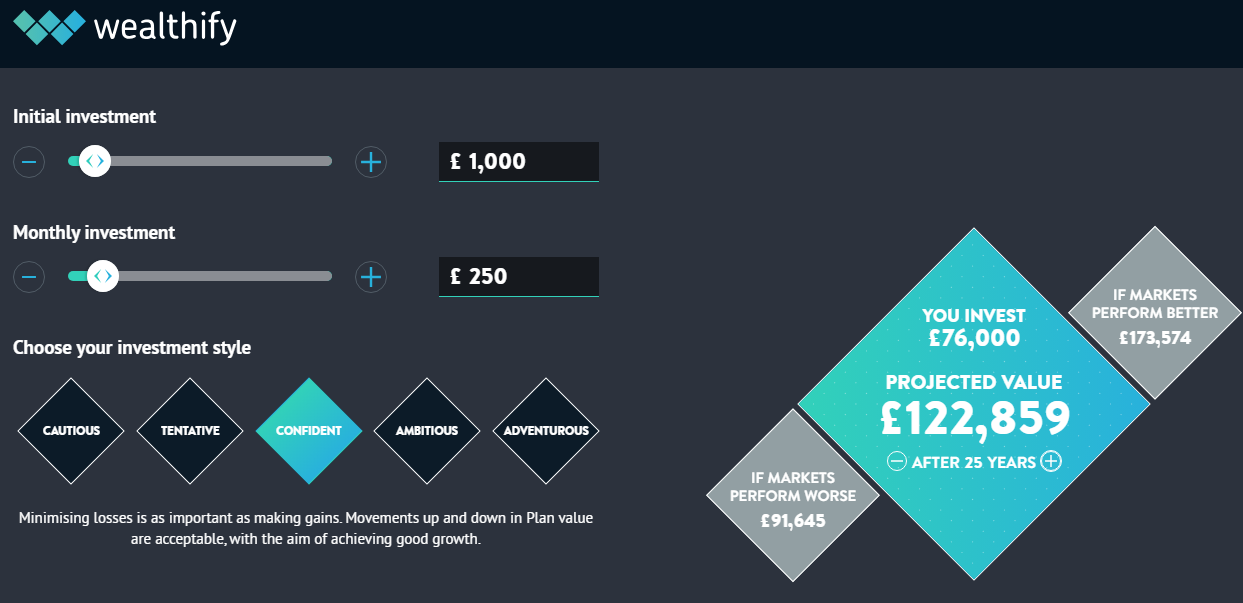
It’s not entirely clear where this prediction comes from when they give it to you, but presumably, it’s based on historic returns from the various plans.
Obviously, “Past performance is not indicative of future results.” If the market tanks (which it always does at some point) you’re going to be sitting on a loss. But before robo-advisors came along, if you wanted to open an account and invest with low-to-medium risk you had to go to the bank and sit down with an advisor, fill in a load of forms, and nod in bemusement as they explained why the Asia ex-Japan emerging markets fund would potentially make you more money than a treasury based fund of funds. I remember doing it, and it was exhausting, and I had just come back from working on the NYMEX oil trading floor in New York, so was in the business even back then.
Thankfully now though, it’s so easy to open an account and invest, and that’s where the real democratisation of investing is.
The way people are invested is basically the same, with diverse portfolios spread across asset classes and regions, albeit cheaper, with the use of low-cost funds instead of active fund managers. People have always been able to invest monthly, with even very modest amounts. But what makes investing accessible is not how it’s done, but how easy it is to get started. Even up to a few years ago, if you wanted to open an ISA account with Hargreaves Lansdown, you had to fill in a paper application and post it back.
Simple Apps & Platforms
Both are very easy to use with good portfolio projection tools.
When setting up my Wealthify account, I didn’t even have to put in a password to get started. I managed to fund my account without getting my debit card out of my pocket, by directly linking my bank account, another massive bonus for regular investors (because if you pay by debit card and it expires, your contributions stop). I think overall it took less than five minutes to get a plan set up and funded.
It’s a very slick app and website, and everything is where you expect it to be. There will always be a debate around active versus passive fund management, but the performance difference between wealth managers is generally very slim as there is a fairly standard way to create risk and region-based portfolios. Plus, if you want to beat the market, you have to take on more risk. If you just want to beat inflation, you probably won’t beat the market.
Wealthify Fee Comparison
One of the main advantages of robo-advisors is how cheap they are compared to traditional wealth managers (because you don’t get personal advice) and Wealthify is one of the cheapest of the bunch. Wealthify account fees are 0.6% a year of your portfolio, versus Nutmeg & Moneyfarm’s 0.75%.
So if you have £100k on account, you’ll be paying Wealthify £600 as opposed to £750 for the other accounts. Over a 23-year period, that is a saving of £3,450 (and that doesn’t take into account compounding returns if you reinvested that saving).
Wealthify pensions are a little cheaper, as Wealthify fees reduce to 0.3% on the portion of your pension balance over £100,000.
You do, of course, have to pay fund fees on top, which are actually quite cheap with Wealthify. Wealthify say their average fund fees are 0.14% p.a. Fund fees are the costs of the assets in the Wealthify plans, which are managed by investment professionals. These are higher for Ethical Plans, where the average investment costs are 0.46% p.a.
Wealthify updated its minimum deposit amounts in January 2026. For the GIA, the minimum is £5,000.
Market Access
You are limited to their own pre-made portfolios, but they are suitably diverse, and you can set your risk level. You can invest through a GIA, Stocks and Shares ISA or Private Pension. Unfortunately, there is no Lifetime Investment ISA to take advantage of the Government’s 25% top-up bonus. But you can invest for your children as well with a Junior Stocks and Shares ISA.
Wealthify plans are made up of funds from Vanguard, L&G, HSBC, Fidelity and Mercer. All those funds charge a fee for choosing and managing the assets that the funds are invested in. If you want to know what is in the funds, you can look it up on Trustnet, see for example the HSBC America Index Fund (which is currently 28% of the Adventurous plan). So actually, just like everyone else, your investments are quite heavily linked to US tech stocks like Apple, Microsoft, Alphabet, Amazon, Tesla and Warren Buffet’s Berkshire Hathaway.
Ethical Investing
For the more ESG and ethically minded, you can still invest in an Ethical Adventurous plan, but assets include funds with “sustainable” in the title, like the Liontrust Sustainable Global Fund that contains stocks like 3i, a British company worth around £33bn takes a pragmatic approach to sustainable investing by influencing company boards to ensure that they assess their material environmental and social impacts and dependencies and, where relevant, support them in developing plans to mitigate ESG risks and invest in value creation opportunities that may arise. Despite that, 3i has generally performed well in recent years.
Wealthify as a Business
I also really like Weathify as a business. It seems there are new investing apps being set up every week, all with different USPs. But most are woefully underfunded and you have to wonder how many times they will be going back to Seedrs and Crowdcude to tap up investors because their burn rate is extortionate as they have yet to onboard a meaningful number of customers to generate revenue, or even, god forbid, make a profit.
Wealthify has gone through that, but come out the other side. It was founded by Michelle Pearce-Burkestarted with £500k from Richard Theo in 2015, then a further £1m from crowdfunding on Seedrs in 2016, followed by £15m from Aviva in 2017.
Wealthify was then fully bought out by Aviva in 2020. Which, if I were to have founded a new fintech, would be my dream roadmap.
Even though I have invested with Wealthify, I wish I had also invested in Wealthify, but that’s a whole other story and one with a completely different risk appetite.
Aviva Backed for More Security
Being Aviva owned is great for clients because it offers a huge amount of financial security, and of all the robo-advisors out there only Wealthify and Nutmeg (JP Morgan), have the backing to ensure that they may still exist in twenty years time. This is important because investing isn’t like using a credit card or buying car insurance, where you can switch every year. When you invest, you may well be with that provider for 50 years.
When I interviewed Linsey Rix, the head of UK Savings and Retirement at Aviva, one of the reasons they were so interested in Wealthify was it gives them a chance to get people investing, who may have been put off by the established and grown-up nature of Aviva.
She told me:
Wealthify plays a very important role for certain types of savers, which means we offer a broad range, both of digital journeys that customers can invest in, but also, we think it important for many of our pension customers to have the opportunity to talk to people as well.
You can tell Wealthify is owned by one of the bigger boys like Aviva as well, because even though it is very easy to set up an account, they are still heavy on the compliance. I actually failed the suitability test. I filled it in as though I was a beginner investor and was told I couldn’t invest because I didn’t understand the risks of stock market investing. Although, I re-took it with a greater appreciation for risk and was granted permission to create a plan. But it’s a good example, of how whilst everyone should be able to invest, not everyone should actually invest.
After all, just like training for a triathlon, if you do it with friends it is easier, and just like investing if you take an active interest in your health you will be healthier and wealthier in the long run.
Customer Service
Wealthify is rated highly for support from real people in Wales, so you can handle most issues online, but also have the ability to phone straight through for more complex issues.
Research & Analysis
Some good analysis around portfolio rebalancing, although it’s mainly passive commenatry updating on performance rather then ideas on what to invest in. But this is not surprising as Wealthify is very much a “invest and forget platform”. So much so that When I tested the platform and set up some regular investments, I am genuinely surprised when I log on and see them. The way a long term investing account should be.
Wealthify Customer reviews
Customer ratings come from reviews left on this site. Every review is read and approved before it is published.Based on 2,571 reviews
- Excellent68%
- Very good24%
- Basic6%
- Poor1%
- Bad1%
Read customer reviews
Good advice with regular updates
Good advice with regular updates
Wealthify is easy to use,…
Wealthify is easy to use, has a great App and insights into the markets it keeps you informed, I’m impressed
Easy, understandable, value for money…
Easy, understandable, value for money
Easy to use and clear…
Easy to use and clear information
Easy to use platform with…
Easy to use platform with lots of information about the investments. Really like the monthly reviews of why investments have behaved in a particular way and what the outcome is
Clear information, simple language, to…
Clear information, simple language, to the point sith their comments and great newsletters, again, to the point
Easy to use and practical…
Easy to use and practical to have my savings account and stocks and shares ISA in one place. I love the option to have an ethical overlay and the articles they release so you understand the market enviornment
Easy
Easy
very good returns and so…
very good returns and so easy to use
Awful, still not transferred my…
Awful, still not transferred my pension after months
Wealthify is clear, easy to…
Wealthify is clear, easy to understand and navigate and are trustworthy.
Good all round.
Good all round.
App easy to use and…
App easy to use and provides very clear information. Excellent customer service too
Easy to invest and understand…
Easy to invest and understand the rates and returns
Clear, straightforward, informal, competent
Clear, straightforward, informal, competent
Good Value and efficient
Good Value and efficient
Good
Good
No issues
No issues
Brilliant robot service
Brilliant robot service
Average
Average
Leave a review
Yes. Ethical investing is a growing financial phenomenon that could last for years. Public companies, with increased public scrutiny, can no longer shy away from their public responsibilities. Those firms that showed leadership in this area may benefit from higher investment ratings.
However, from the investor standpoint, it is better to buy into a ‘ethical’ fund that can diversify into multiple holdings and regions. Maintaining a ESG framework is difficult and so it should be outsourced to professional financial firms. Even some newcomers, such as Nutmeg, are latching on to ethical investing. You should do so too.
Similar to ESG investing, ethical investments are growing in popularity because of the rise in social awareness and transparency. For example, many investors are asking: “Do I want to be associated with firms that thrive from gambling/addictions?” Probably not.
As the popularity of ESG investing continues to rise, more banks will likely offer more choice in ESG investment products, like HSBC.
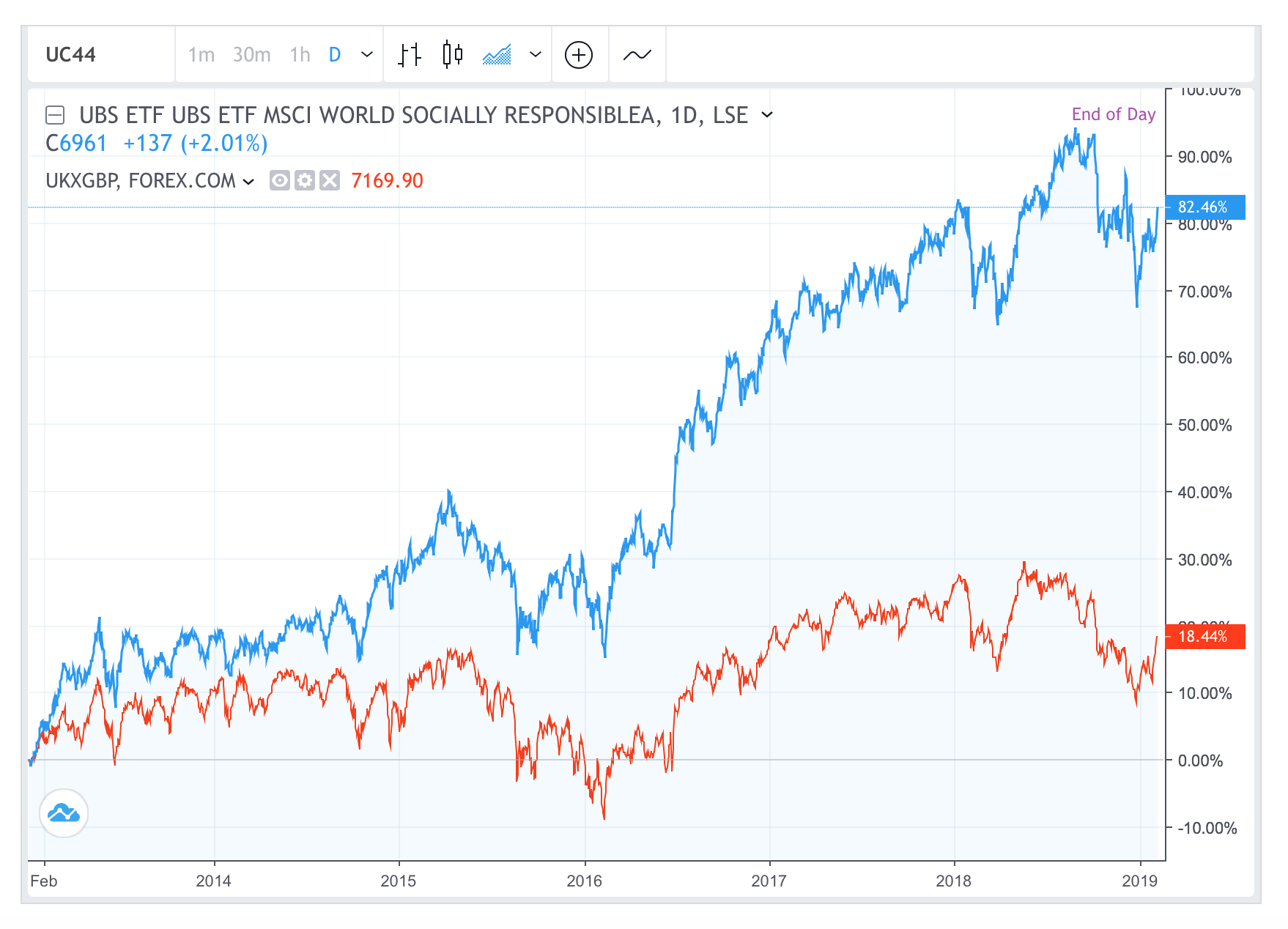
Yes. Although with all types of investing you can also lose money. If you compare the 5-year performance to 2019 of this ETF and the FTSE 100 Index, the return difference is stark (see below). If you compare MSCI SRI and MSCI World Index, there are some improvements too over traditional investments.
Yes, if you invest with an FCA-regulated ethical investment platform as your money is protected by the FSCS.