
IG does not currently offer fractional share trading and investing services to its clients, but you can trade CFDs and spread bets which give you more control over position size.

- Good Money Guide experts commend IG for its comprehensive trading and investing services, highlighting its pioneering role in online trading and financial spread betting. The platform is noted for its deep liquidity, extensive market access, and high-quality trading tools, although some drawbacks include occasional slow customer service and higher costs for ETFs.
- Across 746 user reviews on Good Money Guide, averaging 4/5, customers frequently praise IG for its user-friendly platform, reliability, and extensive range of products. Many users appreciate the seamless integration of crypto trading with other investment options, while some express concerns about occasional technical issues affecting trade execution.
IG Expert rating
Our expert rating is the average of the areas listed here, each scored out of 5 by our team.- Pricing4.5
- Market Access5.0
- Online Platform5.0
- Customer Service4.0
- Research & Analysis5.0
Pros
- Vast range of markets
- Excellent liquidity & DMA equities
- Listed on the London Stock Exchange
Cons
- Customer service occasionally slow
- No DMA futures trading
- Not the cheapest for ETFs
See full expert review
Our verdict
IG is one of the largest and best brokers in the world and offers the full suite of investing and trading accounts for all types of investors. Highly recommended. Founded in 1974 as Investors Gold Index, then IG Index, and now just “IG”, it’s one of the world’s largest margin trading brokers. IG offers contracts for difference (CFDs), FX and spread betting (in the UK) alongside share trading and prime brokerage to over 400,000 clients, and covers 15,000 tradeable markets. IG also offers physical share dealing and smart portfolios for longer-term investors.
Spread bets and CFDs are complex instruments and come with a high risk of losing money rapidly due to leverage. 70% of retail investor accounts lose money when trading spread bets and CFDs with this provider. You should consider whether you understand how spread bets and CFDs work, and whether you can afford to take the high risk of losing your money.
Is IG a Good Trading Platform?
 Yes, IG provides an excellent all-round trading and investing brokerage service. IG pioneered online trading and financial spread betting for private clients and remains not only one of the largest online trading platforms, but also one of the best. IG stands out through deep liquidity, high market range and excellent added value such as trading tools and analysis.
First up, I must disclose that IG is my default broker. When I review brokers, I ask: “Why would you trade here rather than at IG?” It was my first trading account – I’ve had it for about 20 years and I remember the first online trading platform when it was basically a messaging system through to the dealing desk. When I was interning on the NYMEX and IPE trading floors in London and New York as a ticket checking clerk, I’d tap away on IG on my Ericsson R380. Along with Trading Places (my dog is even called Winthorpe #notobsessed) I hold IG accountable for the path my career has taken.
Who is IG?
Stuart Wheeler, IG’s founder, basically invented financial spread betting in the attic of a Chelsea townhouse in 1974. It was first called Investors Gold Index, then IG Index and then just IG. As the product range grows, the name shortens.
His biography (Winning Against the Odds, My Life in Gambling and Politics) makes clear IG was founded for the love of the business (that business being gambling and investing).
One of the things that makes IG stand out is that it’s good at what it does, and seems to want to be the best.
I certainly gathered from my interview with the former IG CEO, June Felix, that the company wants to be on the client’s side, believing it’s better to try to help the client win, and give them good service, so they’re still a client 20 years later, rather than the churn and burn approach.
Index & Forex Trading
IG was one of the first brokers to let private individuals trade the financial markets, and IG clients can now trade a market-leading 80+ indices.
You can also trade forex on the platform. But unlike most other forex brokers, which see the largest percentage of their volumes in the forex markets, IG’s most popular asset class is indices, followed by currency trading.
Quality Service
IG has always taken the view that clients trade with it because of the service it offers, rather than because of any incentives.
No B-Book
One draw for big clients is that whilst IG does internalise orders, it has symmetrical exposure limits, so it doesn’t take a view on the markets. This means that IG is not betting against you with a B-Book. And, if you’re a big trader, because of IG’s liquidity there may actually be bigger volume on IG’s bid and offer than there is in the underlying market. You get positive slippage, so if you place a limit order and the market suddenly moves in your favour you get filled at a better price than your limit.
Spread Betting & CFD Trading
With IG you can trade CFDs or spread bet 24 hours on major indices, forex and commodities markets. There are extended hours on global equities, where some fairly significant volume goes through, particularly on US equities when company announcements are made after the main market shuts.
IG is one of the few brokers to allow trading during the weekend, so you can still take a view or limit your exposure if something big comes out politically.
IG is one of the best CFD trading platforms as it offers a huge range of markets to trade and DMA access for more sophisticated traders. Also, because IG offers CFDs globally (with the exception of the US) it has a huge amount of volume and liquidity meaning that sometimes you can place bigger orders via IG’s order book than you could do on the underlying exchanges like the LSE or NYSE. Because of the sheer volume of CFD trades, IG is able to internally match up orders for quicker and larger fills.
One key disadvantage of trading CFDs through IG is that you have to pay tax on profits. However, CFDs are not the only product that IG offers. You can also trade financial spread bets, where you do not have to pay capital gains tax on profits as this is classed as gambling.
IPO Grey Market
One feature that’s now unique to IG (lots of other brokers used to do it) is the “grey market”, where it will offer you a price in unquoted stocks that are due to come to market. You essentially take a bet on what the market cap will be of a company when it lists. Or you can just apply for shares in the IPO through PrimaryBid, which will deliver them to your IG account.
Global Differences
IG is good at knowing what customers in each region want. The UK, for example, is the only country that is offered financial spread betting, and the rest of the world trades on margin with CFDs. That’s with the exception of the Americans, who trade on margin by taking out a loan to buy stock (from their broker) or trade options, which are much more popular on equities. Japan has knockouts and Europe has barrier options and Turbos Warrants.
What Does the Trading Platform & App Look Like?
IG’s trading platform is DIY online, but still with phone support if you need it.
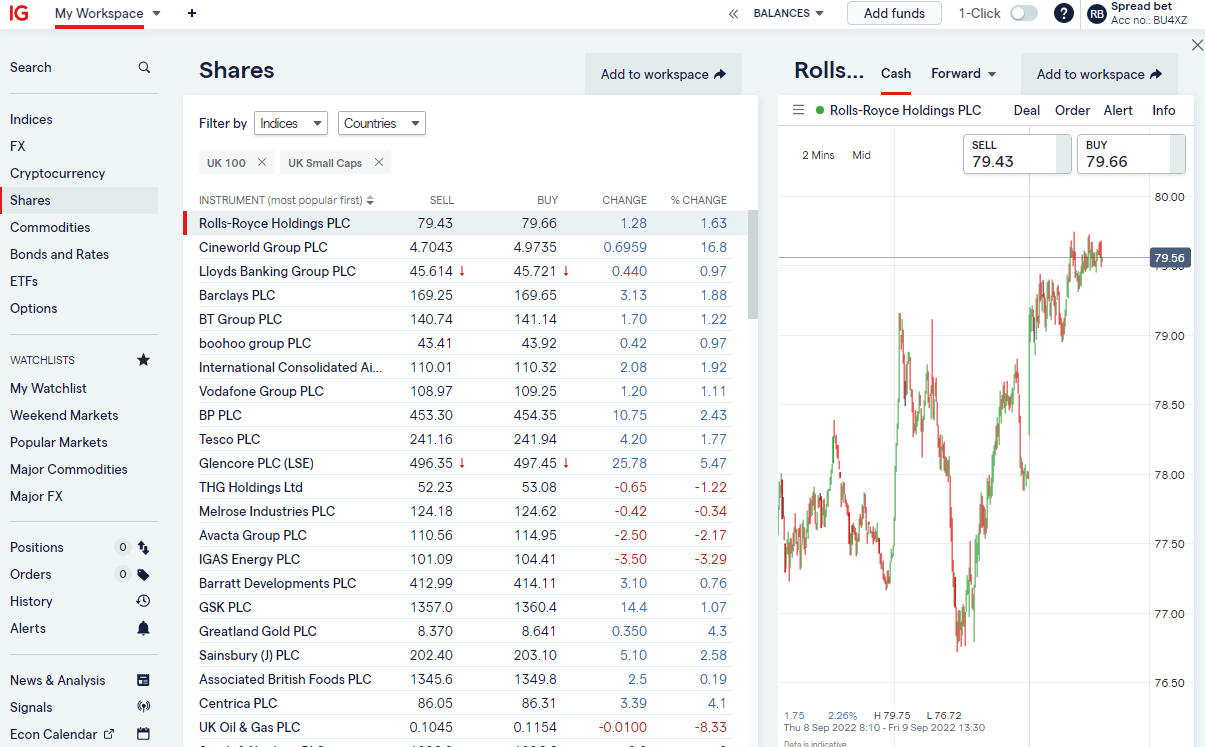
IG is keen to push its added value; the platform tries to integrate as much as possible. IGTV is based on the platform analytics of what people are trading, and IG creates programmes around what markets and assets traders are looking for information on. The news and analysis comes from Reuters, with snapshot videos and a series of IG market commentary videos.
We rate IG’s trading app as extremely safe because of IG’s regulation and reputation. However, it’s important to note that while trading on the app itself is financially secure, the products on offer are high risk and IG does offer investments that are not safe for capital preservation. IG offers financial spread betting and CFDs which are high risk, potentially high reward products.
High Net Worth Accounts
If you are a high-volume trader, you can also trade DMA with ProRealTime, and you can get level 2 pricing and trade directly on the exchange order book. This can be done on the IG trading app or by downloading the L2 dealer software. There is a cost, of course, but if you do a few trades that is rebated back. Brokers have to pay the exchanges for providing level 2 data to their clients, so the charge is there to dissuade everyone signing up without trading. If you are really clever and have developed your own trading algorithm, you can plug that into IG’s platform too. Or MT4/MT5 which it also offers, if you’re into that sort of thing.
Sticky Clients
A problem all brokers are desperate to address is people losing money. It’s always been the case that only around 20% of people made money. A few brokers have implemented post-trade analytics, to help their clients try and win more. IG’s Trade Analytics tool does just that. Its sole purpose is to try and help traders win more by getting a better understanding of where they profit and lose in the markets. It’s been developed in-house by IG, based on analytics and to provide clarity.
James Perry, a former IG Client Experience Manager, told me “We desperately want our clients to win, as the more they win, the longer they are going to be a client, and the more they are going to trade.” And the more commission IG will make.
I know this to be true from my own trading, when you’re on a winning run you trade more, and when you can’t call the market right you step away until another day.
Investing, ETFs & Share Dealing
IG also offers longer-term investing products, where you can buy and hold stocks, ETFs and funds in a stocks and shares ISA, or IG Smart Portfolio. It has a trading academy so you can learn through video and interactive courses. IG can see from its analytics that clients that use these become better traders. IG bought DAILY FX (for $40m) and offers live webinars to provide analysis and trading strategy.
You can invest and trade ETFs with IG. You have the option of either investing in the long term by buying ETFs in the general investment account, SIPP or ISA. Or you can speculate on them going up or down by going long or short via CFDs or financial spread bets.
IG is not the cheapest place for investing in ETFs, (that is probably Interactive Brokers) but it does have very good customer service and is a really easy-to-use ETF platform.
Ratings Explained
- Pricing: Industry leading spreads and with DMA you can get inside the bid/offer.
- Market Access: Best around for spread betting and CFD trading.
- Platform & Apps: Loads of added value, signals and execution features.
- Customer Service: IG is very big, but still managed to score well here.
- Research & Analysis: Superb, news, analysis, social feeds, plus free premium subscriptions for active clients.
Overall, if you are going to trade, I would be surprised if you didn’t have an account with IG.
IG Customer reviews
Customer ratings come from reviews left on this site. Every review is read and approved before it is published.Based on 746 reviews
- Excellent38%
- Very good36%
- Basic18%
- Poor5%
- Bad3%
Read customer reviews
supportive
Educational content that really benefit my trading skills
Efficient
Great service and a wide range of products. Competitive on price.
Convenient
Clean UX for beginner
Value
Easy to understand, good tutorials
Efficient
Great app
Great
Trust worthy broker
Seamless
IG have made it easy for me to manage my whole portfolio, including trading, all from one place.
Excellent
It has a great user experience
Industry leading
Giving me multiple markets to trade on demand
Incredible
Having everything wrapped up in one product
breadth
prices and tech UI
Innovative
easy to use apps
Good when it works
Fast at filling trade but does not always work often can’t always trade that’s why I only gave them 4 stars
credible
Adjusts to the fast pace changes of the investment market
Amazing
Costumer service, trading platform design, trading instruments.
Serious
Education
Reliability
Good support and good charting software
Professional
The trading platform, desktop and mobile, is excellent.
Fantastic platform
Everything is clear and transparent
exceptional
access to 1000s of markets. Stable and involving platform. customer service.
Leave a review

Interactive Brokers are one of the biggest online brokers and operate globally. They have offices and operations around the globe including an FCA-regulated business in London. Interactive Brokers offers fractional share trading and investing. The firm claims to offer fractional trading on more securities than any other broker, existing clients can simply enable fractional share trading on their account whilst new customers will need to apply for a share trading account with the firm.

- Good Money Guide experts commend Interactive Brokers for its unmatched market access, diverse account types, and low trading costs, highlighting its institutional-grade tools and innovative features. However, they note that customer service can be slow, particularly for smaller clients, which may detract from the overall experience.
- Across 1375 user reviews on Good Money Guide, averaging 4.6/5, customers frequently praise the platform’s low fees, extensive market access, and advanced trading tools. While many appreciate the user-friendly interface and comprehensive resources, some express frustration with the complexity of the platform and slower customer support responses.
Interactive Brokers Expert rating
Our expert rating is the average of the areas listed here, each scored out of 5 by our team.Our experts have rated Interactive Brokers across five key areas of our review framework.
- Pricing5.0
- Market Access5.0
- Apps & Platform5.0
- Customer Service4.0
- Research & Analysis5.0
Pros
- Very low dealing fees
- Wide market range
- Direct market access
- Complex order types
Cons
- Customer services can be slow
- No financial spread betting
See full expert review
Our verdict
Interactive Brokers is an exceptional trading platform that offers institutional-grade trading capabilities to private clients around the world. IBKR has some of the lowest trading and investing fees and the widest market range in the industry. Interactive Brokers is a major US online automated electronic broker company. The financial broker is listed on the Nasdaq Exchange with ticker IBKR. The firm operates in 150 electronic exchanges in 34 countries, and offers trading in 28 currencies. Interactive Brokers has more than 3.19 million institutional and retail customers.
Is Interactive Brokers any good?
 Yes, Interactive Brokers is simply unmatched in terms of market access, account types and execution options for retail traders. It always has been and remains one of the cheapest trading and investing platforms globally.
The proof they say is in the pidding and IBKR, has increased it’s market share in the UK dramatically over the past few years. In 2024 alone, they increased the number of accounts by 142%. An amount I suspect will continue to rise, of all the brokers we cover, they provide the most updates, most platforms and are always looking to offer new markets, that investors actually want.
2025 Awards: Best Professional/DMA Broker 2025
Pricing: Top marks as IBKR don’t charge a custody (account) fee and commission are the cheapest around
Market Access: Top marks again for the widest selection of markets available
App & Platform: Hard to beat – excellent range of institutional grade execution tools and simple apps for beginners
Customer Service: IBKR let themselves down a bit here. If you are a big customer you get an account manager, otherwise online support is slow
Research & Analysis: Some of the best education, screeners and market data for free on their website and integrated into IBKR platforms.
I’ve used Interactive Brokers for about 20 years now. I’ve interviewed their founder (Thomas Peterffy), their UK MD (Gerry Perez), they’ve been a competitor (when I was a broker myself), a customer and a partner over the years. I’ve traded live with real money when thoroughly testing their platforms.
This included an in-depth conversations with their Head Of Product (Steven Sanders) to get inside insights on the best parts of the platform and services that some clients may not know about. In this review, I lay out my verdict on Interactive Brokers as an industry expert so you can decide if they are the right investing and trading platform for you.
There is one thing that Interactive Brokers gives you above all other brokers, and that is control. You can invest and trade in pretty much anything you want, in pretty much any account type, pretty much how you want.
If you are not familiar with Interactive Brokers (IBKR) they are American, but global, as most American things are, with the notable exception of their news, which always seems to be local. But I digress, IBKR was one of the first brokers to offer electronic trading to the masses. They were founded in 1978 and if you want to know more about the man who founded them and is still running the show, read my interview with Thomas Peterffy, the founder and chairman.
Highlights: The key things to focus on if you are considering opening an account with Interactive Brokers is that:
They are cheap: No other investment or trading platform can match their discount commissions, FX rates and zero account charges
Huge market range: IBKR offer by far the best access to global stock exchanges around the world
They innovate and create :You can invest in so many different ways through IBKR, from their beginner IBKR LITE apps, to their institutional-grade desktop workstation trading platform. They have some of the most advanced and easy-to-use features available to private investors.
Interactive Brokers Account Types: IBKR offer by far the most types of accounts globally including regular investing account, active trader accounts, direct market access, futures, options and fractional stock trading
You can also earn money on your cash, you can buy bonds (high and low yielding), buy warrants, partake in placings, vote on company corporate actions. You can convert currency at 0.2%, which is cheaper than most specialist currency brokers or money transfer apps.
Foreign Exchange: Which actually segues me nicely to prove my control point. With most brokers you have to choose an account base currency (if you are in the UK that is probably going to be GBP) and when you trade, no matter what currency an asset is traded in your P&L will be converted to that base currency. But with Interactive Brokers you can run your account in multiple currencies.
So, if you put in GBP and trade the S&P for example, your P&L will be in USD. If you buy USD stock you get the option to attach a currency conversion to the transaction so you can convert exactly the right amount to cover the purchase, or you can choose to run a deficit in USD.
It’s not such an issue for small traders, as currency exposure, whilst important to be aware of, isn’t the most pressing matter. But if you are running a net flat long/short global macro portfolio, then keeping on top of your currency exposure could be the difference between making money or not.
Desktop Trader: Through ScaleTrader, (one of the founder’s favourite features) IBKR also gives you some very advanced order functionality, the sort you usually only get with professional trading systems like Fidessa (for stocks) or TT (for futures).
If you’re building a big position and don’t want the market to know you’ve got a big order to work, IBKR’s order ticket will let you gradually feed that into the market (but only charge you for the single order).
You can automatically drop bids and offers into the market based on time and price to take advantage of volatile markets. You can also set it to scalp for quick profits in choppy markets.
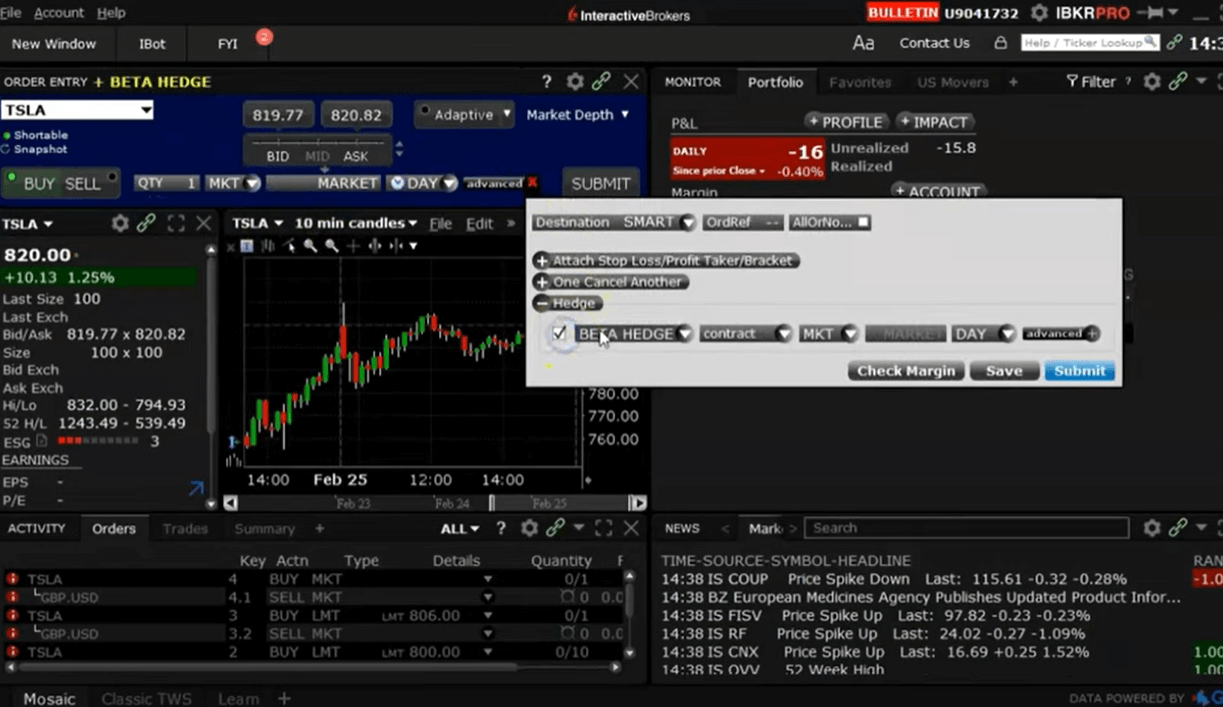
Pairs Trading: You can trade one stock against another automatically by spread, percentage or price.
Why is that important? Because it can help you build a market-neutral portfolio and when we asked the boss of IBKR the habits he saw in his most profitable customers, (referring back to our interview with him for the third time) he said the ones that traded one stock against another, often did well.
Interactive Brokers Universal Account: You can of course do these things with other brokers, but what you can’t do is do them all in one place.
For this review, I spent a while talking to Steven Sanders, IBKR’s head of Marketing & Product Development, and he said in the twenty years, he’s worked for Interactive Brokers the thing he’s most proud of (other than it being founder lead and therefore very little red tape when you want to get things done) is the implementation of the Universal Account, where everything is done from one account.
What’s amazing to me is that nobody else really offers it. Ten years ago when I was a derivatives broker at Man Financial, we offered everything that IBKR did, but all on separate platforms. We have a couple of big accounts, £20m upwards, that we were always trying to lure back from IBKR with our personalised voice brokerage where you could phone us up we’d take care of your complicated orders for you.
But times change, there is still demand for bespoke voice brokerage, but not as far as Interactive Brokers are concerned. They do offer it from specialists desks if needed, but most trading and investing is done online.
Demo Account: Interactive Brokers does have a demo account, but they call it a free trial instead. This is odd, because you don’t actually have to pay to have an account with IBKR. In fact, Interactive Brokers is one of the only trading platforms that does not have a custody fee for investing in a GIA, SIPP and ISA.
If you want to know more about that, you can listen to my podcast with Gerry Perez, the UK MD, who explains, how they offer such amazing market access for such little cost.
You get a cool $1m to paper trade with on the Interactive Brokers demo account or ‘Paper Trading version’ as they call it. You get access to the easy-to-use investors portal and the more complex IBKR TWS provides delayed market data, simulated trading and access to all of our unique tools and offerings, including the IBKR Risk Navigator, the Volatility and Probability Labs, Portfolio Builder, Research and News.
But, to be honest, I didn’t find the demo account very good. Lots of information was missing and I couldn’t place a trade. I’m not sure why, and actually, that’s going to be a bit of an issue for Interactive Brokers because demo accounts are a great way to get client’s interest. In a world where so many brokerages a vying for the same business, even small hiccups like that can cause a massive drop off rate in opening an account.
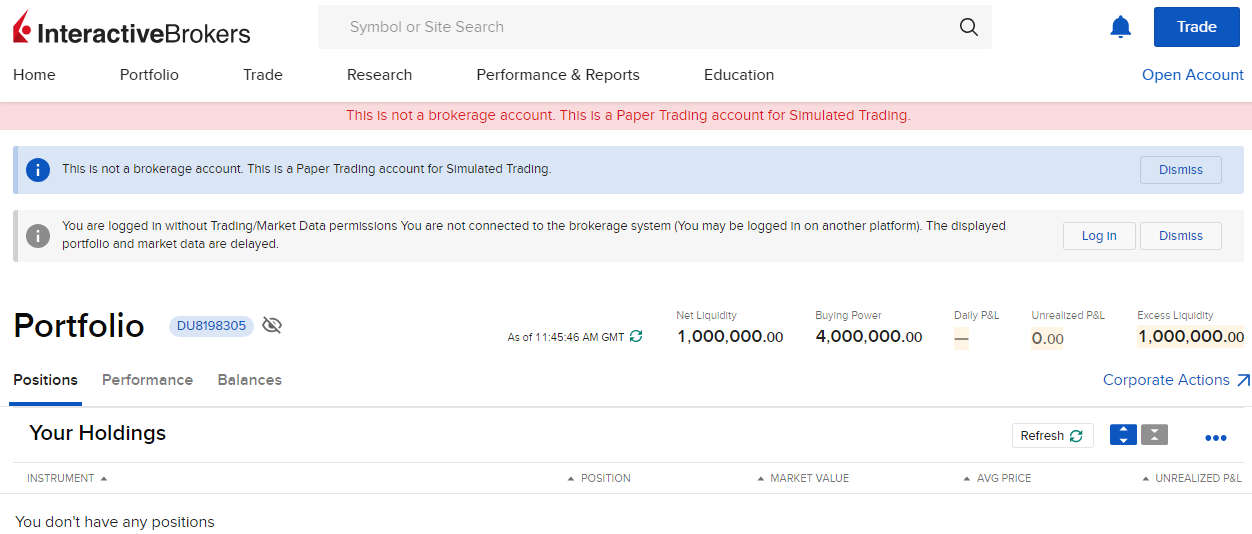
Usually, IBKR’s technology is first-rate, but the demo account isn’t up to scratch. I didn’t use the paper trading account, just the live trading platform with real market orders.
Customer Service At Interactive Brokers: It’s not all great, it takes a while to get through on the phone to customer service, and it has a slightly outsourced feel about it (if you know what I mean).
The desktop trading platform, despite its exceptional functionality, is also a bit ‘Windows 95’. But if you don’t need all the bells and whistles, the web based platform, or app has a more modern feel to them.
Options Strategy Builder: Options trading is gaining in popularity in the UK, mainly because of the press attention they derived from meme stocks (where US traders punt via options). But they are still a very complicated product. So what Interactive Brokers has down is create a Strategy Builder product, that essentially reverse the process of putting on options strategy trades.
You tell Strategy Builder what you think the market is going to do. For example, either, go up, stay still, not move for a while, or volatility will increase and it will create an options strategy around that. Instead of you having to know what strategy to put in place or working out the individual options legs.
IMPACT Ethical Investing: In tune with moving with the times, Interactive Brokers has also released the IMPACT app to help people investing in ESG and impact sectors, so they can put their money to good.
You can see the IMPACT dashboard on desktop, but it also operates as a standalone app that connects directly to your IBKR account and scores your portfolio based on how ethical the stocks you hold in it are. Ratings come from FactSet and Refinitiv, and there is this excellent feature that allows you to swap into more ethical stocks.
If one of your holdings is flagged as not that ethical, the app will suggest another one and at the click of a button, it will sell your shares and calculate how many new shares of a more ethical but similar company to buy and do it all for you. If you’re in the US, you can also make charitable donations directly on the app.
Interactive Brokers For Beginners: There is no doubt that Interactive Brokers is a proper trading platform, for those who know what they are doing and cater mainly to the more sophisticated investor. But they are making an effort to open their services up to the newer breed of investor and trader.
It’s standard now among many fintechs, but IBKR were actually the first to offer no commission trading. They also offer fractional shares through IBKR LITE and IBKR Pro accounts and have removed the monthly minimum account charge.
The hope of course is that by onboarding investors when they just start, they can look after their investments for the next 40 years, just as they have been doing for their existing clients for the last 40.
Interactive Brokers runs a Student Trading Lab where students from 600 schools and universities take part in a $1m paper trading account for the purposes of getting a better understanding of the markets. No broker these days can tell you what to buy or sell, but IBKR GlobalAnalyst helps you hunt out undervalued opportunities, across the world, not just in the US.
IBKR offer a Trading Academy, podcasts, webinars and blogs for beginners and experienced traders so that new customers survive the markets to become long-term clients.
Plus, they are cheap.
24-Hour ETFs At Interactive Brokers:Interactive Brokers has a list of 24 selected ETFs available to trade around the clock from Sunday evening, east coast time, through to the close on Friday, by adding these funds to its US overnight trading facility.
Clients who are permissioned to deal in US stocks, are able to trade these ETFs 23.50 hours a day, five days per week, allowing them to react to news stories, macroeconomic and geo-political events as they happen, rather than waiting for US markets to open.
The trading hours and ETFs are available to both retail and institutional clients alike and are traded via the firm’s IBEOS system. Trades can be submitted using multiple order types.
The range of ETFs is pretty broad and includes firm favourites such as SPY, QQQ, DIA and IWM, which track the S&P 500, Nasdaq 100, Dow 30 and Russell 2000 indices respectively. You can also short those indices by trading the SH, PSQ, DOG, and RWM inverse ETFs.
Interactive Brokers Customer reviews
Customer ratings come from reviews left on this site. Every review is read and approved before it is published.Based on 1,375 reviews
- Excellent74%
- Very good14%
- Basic7%
- Poor2%
- Bad2%
What customers like
- Low fees and competitive pricing
- User-friendly platform
- Fast execution and reliability
What customers dislike
- Poor customer service
- Confusing account management
- Slow response times
Read customer reviews
Great service provided at nominal fees
Great UI, Analysis tools, Reasonable fee structure
Best
Trading permissions are not easy but user friendly so I can recommend to friends to get them open a IBKR account to get them started 🙂 I use almost all features
Speed and good tools
Fast execution
Comprehensive
Advanced tools. Professional platform. Excellent value
Professional
Fundemental information, technical analysis and educational material
Efficient
It provides efficient access to a wide range of financial markets & products with very low fees.
Simply perfect
Provides a widespread access to trading from the comfort of my home or while I’m the road.
Global Excellence
Trading platform ease and usability
I Steven Talewa already have been selected for the reasons
I Steven Talewa have been with capital.com online trading but I am now using interactive brokers because capital.com never showed my five years dividends funds, and went missing don’t know where are my future funds in… and I’m not sure what happened to my future and past dividends paid into which company or people.. to me I Steven Talewa of Tari Hela Province of Papua New Guinea have been missing out and waited for so long years and now I’m using or selected interactive brokers to my online trading or can pay into my personal bank account and manage my assets and tradestation trading
Excellent
Superb comprensive app that is genuinely easy to use and navigate even as a new user. The lowest fees, that they revisit to keep competitive. Comprehensive investment fund choices. Excellent UK based customer services that are responsive & knowledgeable. It is rare that I cannot find an answer to what I need on the II App though as it is genuinely exceptional compared to others.
I have no affiliation to II other than having been a customer for my SIPP, SS ISA & GIA for circa 8 years.
easy site to navigate
easy to trade options
Full range service
Offers many trading options and best cost structure
Perfect
Everything
Great value and service
Cost
Tuned in.
Provides a customer focused investment service that offers good value for money and is tuned in to customer needs vis SIPP, ISAs, equity investing etc.
Interactive Brokers it's the best for retail investors
I never had a margin call from them; they’re really caring for retail investors.
Straightforward
Interactive Investor stands out because it combines flat‑fee pricing, a wide range of global investments, and strong regulatory protection. It has a modern design that feels more like a fintech than a traditional broker. Its straightforward messaging – using terminology the average person can actually understand, and accessible platform gives it a youthful, fresh feeling, while still offering the depth and tools experienced investors expect.
cost efficient
a
Best international shares dealer
I Steven Talewa was been with Capital.com and my online stock market trading ID number is 21444883 and I’m enjoy capital.com,s weekly education and Monday market news updates but I find their dividends reports lacks transparency for long-term holders and now 2026 I votes for interactive brokers because I’m moving from a CFD platform to a professional broker to ensure my dividends from Microsoft and Apple are paid correctly and transparently
Value
Keeps costs down but offers a wide range of funds
Leave a review

Lightyear is a new app founded by some of the original Wise employees. Costs are very low and market access is getting better everyday.

- Good Money Guide experts commend Lightyear for its low-cost investing model, highlighting its competitive FX fees of 0.1% and the absence of account fees. The app is praised for its user-friendly design, extensive market access, and features like limit orders and recurring investments, although it currently lacks a pension or SIPP account.
- Across 676 user reviews on Good Money Guide, averaging 4.9/5, customers frequently highlight the app’s simplicity and intuitive interface, making it accessible for both novice and experienced investors. Users appreciate the low fees and transparency in pricing, while many also mention the platform’s fast performance and the variety of investment options available, including US stocks and ETFs.
Lightyear Expert rating
Our expert rating is the average of the areas listed here, each scored out of 5 by our team.- Pricing4.5
- Market Access4.0
- Online Platform4.5
- Customer Service4.5
- Research & Analysis3.5
Pros
- Low-cost investing account
- Low FX fees of 0.1%
- International market access
Cons
- No pension or SIPP account
See full expert review
Our verdict
Lightyear is one of the better free investing apps as it provides access to US stocks and local markets with FX fees as low as 0.1%. Lightyear is a new investment app that offers low cost investing in UK, European and US shares. The company was founded by one of the first Wise (Transferwise) employees, Martin Sokk with a similar objective of making investing as cheap and easy as possible.
Capital at risk.
Is Lightyear Good for Investing?
Lightyear was voted best investing app in the 2026 Good Money Guide Awards and is a simple and approachable way to invest in stocks and ETFs without unnecessarily large fees. A very well-designed low-cost investing app with discounted FX charges, limit and recurring orders for investing in local and international markets.
Special Offer: Sign up with the code GOODMONEYGUIDE to get up to £100 in fractional share to your GIA. Capital at risk.
– – Terms apply: https://lightyear.com/en-gb/signup-promotion-terms. You must be a new user and deposit at least £100 within the first 15 days after signing up. The reward can be withdrawn 6 months after it’s credited.
Fees: Lightyear is cheap for investing. The GIA has no account fee and charges only £1 commission for UK trades and up to $1 for US stocks but free for trading ETFs. If you are investing in a stocks and shares ISA, there is no commission on buying and selling stocks and shares. Much like the founders’ alma mater, Lightyear makes its money from FX fees which it adds to the interbank rate, so conversion costs are transparent.
When I interviewed Martin Sokk, he told me Lightyear planned to expand internationally fast so that its users could invest in both their local and the US markets, since many people want to invest in US stocks.
And rightly so: US shares are all household names, and one of the key drivers for investing is to buy companies you love and use. Lightyear will make money charging 0.1% per trade (or $1, whichever is bigger) and converting GBP, HUF & Euros, etc. into USD when people buy US stocks.
Lightyear charges 0.1% for converting money into USD and EUR, which is higher than Interactive Brokers’ 0.03% but much lower than the 0.5% charged by AJ Bell, Saxo Markets and IG, or the 1% from Hargreaves Lansdown and Interactive Investor.
FX must be a key part of Lightyear’s monetisation strategy: if you charge very low commission and account fees, you have to make money somehow. So Lightyear aims to make its money in the background, initially from foreign exchange fees. FX is a good way to make money because a) no-one really understands how the pricing works and b) you don’t see the charge, it’s built into the buy/sell spread.
You can see in the example below what the fees were when I bought some Tesla shares while testing the app for this Lightyear review.
Quite a nice touch is that you get the option of making purchases repeat orders, a great way to build good investing habits. Just by investing small amounts each month, the genius of compounding returns will help you build a larger portfolio over time. Check it out with our investing returns calculator.
Market Access: Lightyear constantly adds new instruments, bringing the total up to almost 6,500. These include well-known UK names such as Rolls-Royce, easyJet and IAG; to defence ETFs, US stocks. This is great because one of my concerns about new investing apps is that they normally just cater to the most heavily traded stocks, which means they are not great for more adventurous investors. It’s great to see Lightyear providing wider market access.
Plus, it’s proactive. Lightyear says it has put live 98% of non-complex US instruments asked for by customers in just 3 months.
One of the other really cool things about Lightyear is that you can listen to earnings calls directly on the app.
As well as being able to buy fractional US shares, ETFs though limit orders and regular investing, you can also quickly see which shares pay the highest dividends or make the most money relative to their share price to help you pick stocks.
Multicurrency account & order types
Another point to make here is that you also get a multi-currency account, where you can hold foreign currency. The advantage of this is that you don’t need to do as many FX conversions which can help keep costs down.
Related guide: Compare FX rates for buying US stocks from the UK.
Progression to servicing local customers and local markets
When Lightyear first started, you could only invest in a handful of UK stocks, and they were ADRs listed in the US denominated in USD, rather than the local listings on the LSE. So, you were paying an FX fee when you really shouldn’t have to. Admittedly, there is no stamp duty so technically paying 0.1% on FX rather than 0.5% to HMRC is cheaper.
Lightyear has a cash (money market fund) and investment ISA, but no SIPP account, but I suspect that is next on the “product roadmap”.
Are your investment safe with Lightyear?
Yes, it’s safe to invest with Lightyear. Lightyear U.K Ltd is authorised and regulated by the Financial Conduct Authority (FRN 987226). Lightyear is protected by the Financial Services Compensation Scheme (FSCS). FSCS protection applies to client money only where held with banks, not where held in QMMFs.
In the unlikely event of anything happening to Lightyear, there’s no way for creditors to get hold of the investments or cash that customers hold with us.
Keep in mind, though, that your investments are not safe from losing money with Lightyear. Overall, the market generally goes up, but there are peaks and troughs along the way.
Like Transferwise, like Lightyear
To draw on one final Transferwise comparison, it is very easy to use app-as-a-tool to help you start investing as cheaply as possible. The thing is though is that, transferring money is like car insurance. No-one really has any loyalty to their insurer, they just do it and move on. Investing is different. Investing is not like insurance, when you open an investing account, you could be using it for the next 30 years.
I think there will always be a place for traditional investment platforms because they provide excellent customer service and brand loyalty, they are mature platforms for mature investors and fees will eventually come down, as they have done in the past. Same as with Simpsons Tavern, it may not be as good for you as veganism, but if it survives, people will continue to go because they like it.
But, if low-cost investing apps are a gateway to getting more people to invest for their future, then they are the future too and will hopefully mature along with their customers, and Lightyear, in particular, is a great place to get started.
Lightyear Customer reviews
Customer ratings come from reviews left on this site. Every review is read and approved before it is published.Based on 676 reviews
- Excellent92%
- Very good6%
- Basic1%
- Poor1%
- Bad0%
Read customer reviews
Fast
Clear, easy to use
Very good
There are some etfs that cannot be found in other brokers.
Simple
The UX and UI are amazing, helping you make conscious decisions. The instrument selection is also broad and pricing for that is one of the best in the market.
Transparent
Lightyear has always been transparent about the product offerings and fees.
Easy like Sunday morning
They make investing understandable and available for an ordinary person. They look up the country-specific tax laws to remember.
easy to use
present investment data
User-friendly
Easy to use, transparent, user friendly interface and reporting
love, peace
Lightyear does well to exist
Innovative
Easy to use
smooth and good overview
They seem to know what investors actually need and they are ready to provide it.
easy and friendly to use
Very good app, all clear, friendly to use
Amazing
Easy, inturive, good rate, and mazing app
Ahead
The sleek design makes it so easy to make yourself successful
Accessible!
This app is so transparent and so easy to use! I have been nervous about investing for years, and Lightyear has knocked down so many barriers – it’s a great product!
easy to use
Transparent, easy to use. Up-to-date informations, guidance, reminders.
Innovative
They have quickly become a leading investment app. They incorporate changes very fast and make investing easy for the users.
Convienience
User friendly and easy to use
Client oriented
Adding features what clients need with affordability
Professional
Good range of investment options.
Straightforward
Variety of products which allows you to diversify and gives exposure to different markets. Straightforward app, the best!
Leave a review

Revolut is one of several disruptors in the payments and personal finance space. The company which made its name in payments processing and money transfers has expanded into trading and investing services including fractional share trading in a list of US stocks via its smartphone app, across all of its account categories.

- Experts rate Revolut highly for its user-friendly interface and low-cost services, noting it as a solid option for investors interested in major shares and cryptocurrencies. However, they highlight the lack of FSCS protection due to its e-money institution status and mention a limited range of investment options as a drawback.
- Across 539 user reviews on Good Money Guide, averaging 4.6/5, customers frequently commend the app’s ease of use, innovative features, and competitive exchange rates. While many appreciate the seamless banking experience and customer service, some express concerns about account access issues and the lack of traditional banking protections.
Revolut Expert rating
Our expert rating is the average of the areas listed here, each scored out of 5 by our team.- Pricing5.0
- Market Access4.5
- Online Platform5.0
- Customer Service5.0
- Research & Analysis4.0
Pros
- Easy to use
- Low cost
- Innovative product
Cons
- New company
- Limited Range of investments
- App only
See full expert review
Our verdict
Revolut is an all-in-one banking and investment app loved by millions. Revolut offers banking, saving, spending, investing, foreign exchange and cryptocurrency services to 50 million individual customers and 500k businesses around the world.
Is Revolut good for investing?
Revolut is a good choice for investors that want to buy and sell major shares and cryptocurrencies. No funds, or smaller cap stocks, but a good entry-level account for most investors.
One of the most commonly asked questions about new banks and fintech is if they are a safe place to keep your money. The answer is generally, yes, if they are regulated by the FCA as funds are protected by the FSCS up to £85,000. But, Revolut, is regulated as an e-money institution and not as a bank so you do not get the FSCS protection.
Revolut says that if they were to go bust, client funds would be paid out of a “safeguarding” account which is a type of ringfenced account where client funds are held. When funds are in this type of account, Revolut cannot (in theory, at least) lend them out or use them to run the business. This is how banks traditionally made money, they pay you a smaller amount of interest than they receive on the money they lend out and make a profit from the difference (among other things).
For small money transfers, Revolut is safe enough, but as with all currency conversions if you are sending over £10,000 abroad you should be using a currency broker. You’ll get much better rates, more control over when you buy and sell, help with all the AML (anti-money laundering) issues that may come up, and the ability to lock in the currency exchange rate for up to a year in advance (if you think it will move against you).
- Sending a small amount of money abroad? Compare the best money transfer apps
Revolut Customer reviews
Customer ratings come from reviews left on this site. Every review is read and approved before it is published.Based on 539 reviews
- Excellent73%
- Very good16%
- Basic6%
- Poor2%
- Bad3%
Read customer reviews
Avoid keeping your money with Revolut
My account has been frozen since 29 May 2025 because of a £164 transfer from my own bank account in Kazakhstan to my own Revolut account in UK. The transfer was made over 13 months earlier.
I provided everything they asked for: bank statements, proof of income, and clear evidence that these were my own funds. Despite this, my account remains blocked, leaving me without access to money I use for my children’s activities, phone bills, and everyday expenses.
Customer support is useless – they only send automated, copy-and-paste replies and never provide any meaningful updates. A £164 transfer between my own accounts should not result in months of being locked out of my money.
If this can happen over such a small, fully documented transfer, it can happen to anyone. Think twice before trusting Revolut with money you may need.
THIEVES
THIEVES
Refusing to let me sell an investment which is not suspended on the exchange or on other trading sites. So effectively they have stolen my funds . BEWARE using this company is dangerous to your finances .
The reply from Revolut is disengenous as I have only listed the review after exhaustive chats , email and a complaint. They still refuse to take responsibility. Now as of a week later I still cannot close my account or gain access to my funds . They dismissed my complaint and suggested I contact the ombudsman. In the meantime they have my funds. THIEVES and SCAMMERS
Fraudster Bank
FUNDS NOT SAFE WITH THIS BANK. THIS BANK INDULGES IN FRAUD
Excellent
Everything
Multiple way to grow money
Always the best exchange offer
Seamless
Disgusting company
Absolutely sick of this company not closing an inactive account from over 3 years ago. Just send rude, blunt emails. So unhelpful and zero customer compassion or care
Unaccredited nonsense
Please just enter into your Google search “revolut scam” and educate yourself before joining. Read BBC, Guardian, and Reddit articles/posts. Selfie camera doesn’t work, and they refuse to offer an alternative login method, so I can’t access my money. Keep getting same automated response(do some work you twits). They heavily spam my email, though. No customer service so imagine being stuck abroad with these absentee idiots as your lifeline, best learn to beg or busk in the local language. Check these articles for more info:
www.bbc.co.uk/news/articles/c9wkzv1zk91o
www.theguardian.com/money/2024/apr/10/im-a-victim-of-scammers-but-revolut-says-no-to-a-refund
www.bbc.co.uk/news/articles/cj6epzxdd77o
Very good digital service provider
Easy to use app and banking experience, recommended.
Best bank I've been with
Amazing banking features and customer service
Super prilojenie nice
Super prilojenie nice
Currency made easy
Love how clear and easy to use the app is !
Easy transactions
Best app so far
Reliable and friendly banking
Revolut is one of the best online bank in UK is reliable, efficient and effective in all there financial aspects both in security, investment and management of financial services to general public. It worth recommending.
Great, everything works really well
Easy process to apply, app works really well, great features.
Revolut este tot ce ai nevoie❤️
Cu un cont revolut poți primi salariul poți face schimb în ori ce monedă simplu și rapid respect👍👍👍👍❤️
Love this account
Love revolut easy to use just brilliant
Easy to use. Quick to set up
Easy to get along with. Has made working aboard a lot easier being able to manage my own money transfers in one place.
Best bank
Best bank
Leave a review
Industry Experts Told Us
“The key takeaway to fractionalised shares is not necessarily that people want to buy less than one share. It’s that they want to invest a fixed sum of money into certain shares, irrespective of the share price. E.g. they want to buy $2000 worth of Tesla.”

Richard is the founder of the Good Money Guide (formerly Good Broker Guide), one of the original investment comparison sites established in 2015. With a career spanning two decades as a broker, he brings extensive expertise and knowledge to the financial landscape.
Having worked as a broker at Investors Intelligence and a multi-asset derivatives broker at MF Global (Man Financial), Richard has acquired substantial experience in the industry. His career began as a private client stockbroker at Walker Crips and Phillip Securities (now King and Shaxson), following internships on the NYMEX oil trading floor in New York and London IPE in 2001 and 2000.
Richard’s contributions and expertise have been recognized by respected publications such as The Sunday Times, BusinessInsider, Yahoo Finance, BusinessNews.org.uk, Master Investor, Wealth Briefing, iNews, and The FT, among many others.
Under Richard’s leadership, the Good Money Guide has evolved into a valuable destination for comprehensive information and expert guidance, specialising in trading, investment, and currency exchange. His commitment to delivering high-quality insights has solidified the Good Money Guide’s standing as a well-respected resource for both customers and industry colleagues.