

USDJPY trading platforms let you speculate on the strength of the US Dollar versus the Japanese Yen through spot FX, CFDs, financial spread betting or futures & options. We have compared and reviewed what we think are the best USDJPY trading platforms.
You can use our USDJPY comparison table to rank brokers by how much commission they charge and what it costs to hold a USDJPY position overnight. You can also see which USDJPY trading platforms let you trade via CFDs, spread betting, have DMA access through futures and options and what the minimum deposit is for each account.
| Name | Logo | USDJPY Spreads | Forex Markets | GMG Rating | Customer Reviews | CTA | Feature | Expand |
|---|---|---|---|---|---|---|---|---|
 |
USDJPY Spreads 0.9 |
Forex Markets 182 |
GMG Rating |
Customer Reviews |
Visit Platform 69% of retail investor accounts lose money
City Index Reviews |
Account Types:
|
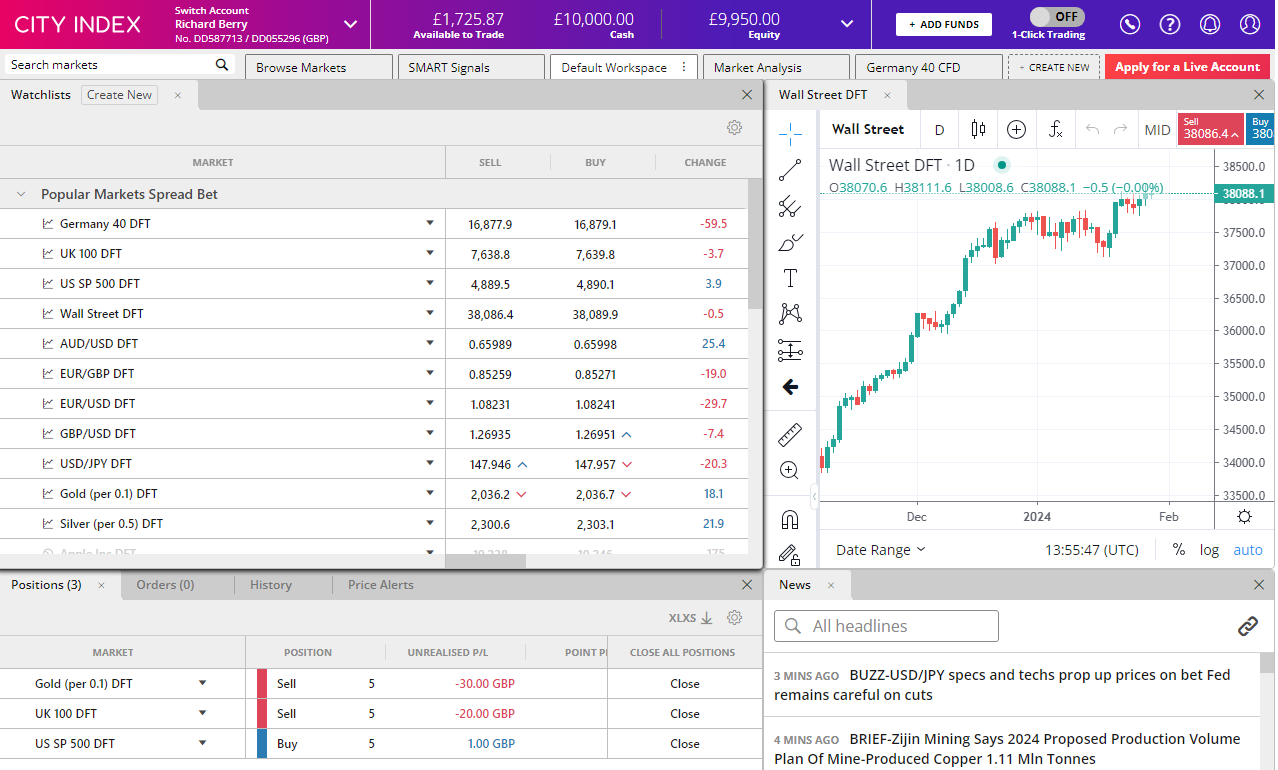
City Index's trading platform has some of the best post-trade analytics so traders can improve their performanceAccount: City Index Trading Platform Description: City Index’s platform won has best trading app in our 2024 awards for their added value. The trading platform has grown considerably since the acquisition of Gain Capital by StoneX and includes some excellent added-value features like Performance Analytics and trading signals. When I was testing the trading platform, there were enough signals to discover some additional trading opportunities I wouldn’t have otherwise come across. Is City Index a good trading platform? Yes, on City Index’s trading platform, you can trade more than 13,500 markets, including 40 equity indices, over 10,000 UK and international shares and ETFs, 19 commodities, and 183 FX pairs. This means they offer more markets than most of the other online trading platforms regulated by the FCA in the UK. Founded in 1983 City Index has a solid and longstanding presence in online trading; its trading platform is a genuine rival to IG and CMC Markets. In major UK markets, City Index pricing is competitive and often market-leading, but can be expensive for Asian markets. City Index’s free desktop trading platform is web-based, so there is nothing to download you simply log in and trade on your internet browser. You can create and customise your own workspaces and layouts, adding quotes, charts, news and trading signals. However, you can also use City Index’s Market 360 feature to create a top-down view of an instrument in a single click, which contains charts, quotes, news and product information all in one place. You can trade or place limit orders directly from a chart or you can click on the bid-ask quote at the top of the page in the 360 view. You can instantly access technical analysis, calendars, and newsflow by clicking on the market analysis, but one of the trading platform’s stand-out features is Performance Analytics which provides constantly updated reports on how to improve your trading, based account history. Overall, the City Index trading platform is very intuitive to use and it has a clean, clearly laid out interface making it suitable for beginners who want a simple platform with trading signals. It is also advanced enough for experienced traders executing large orders and needing post-trade analytics or voice brokerage as backup. What does the City Index trading platform look like?
Pros
Cons
Overall4.9 |
|
 |
USDJPY Spreads 0.9 |
Forex Markets 80 |
GMG Rating |
Customer Reviews |
Visit Platform 74%–77% of retail CFD accounts lose money.
FOREX.com Reviews |
Account Types:
|
FOREX.com Won Best Forex Broker in our 2025 AwardsProvider: FOREX.com Verdict: FOREX.com is one of the largest forex brokers operating globally and owned by Nasdaq-listed institutional broker StoneX. Forex.com offers traders access to 7,000+ assets including 80+ currency pairs, thousands of stocks, popular commodities, indices and cryptocurrencies (pro accounts only in the UK & EU). Pricing is competitive, especially for those on the RAW spread account or active trader programmme.
Is FOREX.com a Good Trading Platform? FOREX.com won Best Forex Broker in the 2025 Good Money Guide Awards. 24-Hour FOREX.com Test I took FOREX.com out for a 24-hour test drive, to trade with real money and try out some of the key features on the streets of the City of London. Here’s what happened… “For FX sake”, I thought to myself when faced with writing a review about a forex broker. Firstly because all these brokers do is offer access to the forex market (or so I believed). Secondly, because I’ve never had much success with forex trading. I find the nuances of intra-day technical analysis too complicated. I’m an old-fashioned trader – I like to look at the market and think it’s either overvalued or undervalued and, in my mind anyway, that’s easier when looking at a company’s share price, an index or even a commodity. But for some reason, with forex trading, I’ve never really got the hang of it. Having said that, I have dealt currency for about 20 years now, but more as a broker rather than as a trader. For instance, I used to do some prime brokerage for institutions that would hedge their currency exposure when buying aeroplanes. But I was so frustrated with how opaque pricing was in currency trading, that I decided to start up my own currency brokerage specialising in high-value currency transfers (£250,000 upwards) and undercutting everyone. It was called Berry FX, you can still see the demo on YouTube. Basically, personal service with the best rates anywhere ever. But now I just let other currency brokers compete for clients by trying to offer the best exchange rates. But you want to know what I think of FOREX.com. 24 Hour Test I took FOREX.com out for a 24-hour test drive around the City of London, putting some real trades on whilst going about my business to see if I could make any money. I started out at the Bank of England with £10,000 on account at 11:30am. Lunch was a few minutes’ walk from the tube station, so I took the opportunity to put some trades on using FOREX.com’s trading signals. I’ve used these for years; back in 2018, they were known as GetGo and it was a standalone forex trading app. When I reviewed it then, I said these were the future of forex trading signals but are they still? There are a couple of things that make these signals better than the rest.
When I was walking down King William Street to L’Antipasto to meet some contacts for lunch, I put a few trades on. First, I looked at the traders that had a historic success rate of over 50% and followed them. Then I looked at trading signals that had a success rate of less than 50% and traded against them. It’s a pretty simple strategy that generally works (not always, though). I used the classic stop/limit risk/reward ratio, aiming for twice the potential loss as a potential win. Again, simple forex trading strategies. The market is not hard to call, but if you get a trade right, it often pays to let it run for longer, but if it’s wrong, close it sooner. Trading Central On the way to my next meeting, I took a few moments on London Bridge to look at some of the other signals on FOREX.com: Trading Central. Now, Trading Central has been providing technical analysis to brokers for decades and supplies a constant stream of manually and automatically updated trading ideas throughout the day to give traders an indication of where the markets may go. It’s not as fluid as the trading signals, as you have to put the trades in manually, but still gives you a bit of stimulus. This is great for someone like me because I generally have an idea of what I want to do from eyeballing a chart (I did, after all, run a technical analysis division for 5 years), but it’s nice to get confirmation of your thoughts one way or another. Execution When you are actually trading there are some great other features on the app:
Post-Trade Analytics Once you’ve done a bit of trading, you can review your trading history and see where you do well and where you can improve. This is a great feature as it can break down how well you trade by time of day, markets or volatility. You can also set up “Play Maker” if you have a trading strategy and want to stick to it. Obviously, you can’t get that sort of data in a 24-hour test drive, so I’ll have to revisit that another time. Demo Account FOREX.com has a pretty good demo account. In fact, it’s hard to tell the difference between the demo and live trading platform. You get the same functionality and as trades are OTC, the same prices. However, when I opened a demo account to test it, I already had a real account. So after I got my demo account login details, I clicked through to the “Webtrader” portal and (funny or alarming, depending on how you look at it) my live account details were auto-filled in by Google Chrome. Now, had I not been checking my email, to ensure that the platform had sent me through my credentials, I might not have noticed that I was logging into a live account. It could have been disastrous if I’d started trading away thinking it was paper money. Even more so as you get £10,000 in demo funds and I’d deposited £10,000 in my live account when I took FOREX.com on a 24-hour trading signal test drive. It reminded me of when a trader thought that he was trading on a demo account and put $1bn worth of orders through and then sued his broker because it voided his €10m profits. TradingView & MetaQuotes I had a good play about with TradingView, as it’s now the go-to destination for traders. TradingView is a sort of social network for traders where you can view charts (they are excellent) and post trading ideas (take with a pinch of salt). As TradingView has grown, it has also become an execution venue, so you can link your FOREX.com trading account and deal straight from the charts. This shouldn’t be too much of a stretch for most traders as the charts on the app and web-based platform are provided by TradingView (which, incidentally, is one of the largest financial-based websites in the world now). You can also trade on MT4 or MT5 (but only MT5 in the EU), if you are into that sort of thing… Am I a Forexpert? I did make money on day one, mainly thanks to putting on a GBP-USD trade that covered most of the losses from some of the other trades. When I used the trading signals 5 years ago, I also made money. Day 2 wasn’t so good. On my way to an investor show, I gave back a few pennies but still ended up on top. But I have to admit my traders were calculated guesses rather than heavily researched positions. I don’t like holding positions overnight, as day trading reduces not only your margin requirements but also increases the amount of sleep you get because you don’t wake up with cold sweats in the middle of the night worrying about Asian interest rates. Overall would I recommend forex.com? Yes, if you are going to trade forex and don’t know where to start, as it’s a massive brand with global reach and owned by a listed brokerage with an institutional pedigree. As far as box-ticking is concerned, it ticks the lot. Or should I say pips the lot… Pros
Cons
Overall4.6 |
|
 |
USDJPY Spreads 0.75 |
Forex Markets 95+ |
GMG Rating |
Customer Reviews |
Visit Platform 62% of retail investor accounts lose money |
Account Types:
|
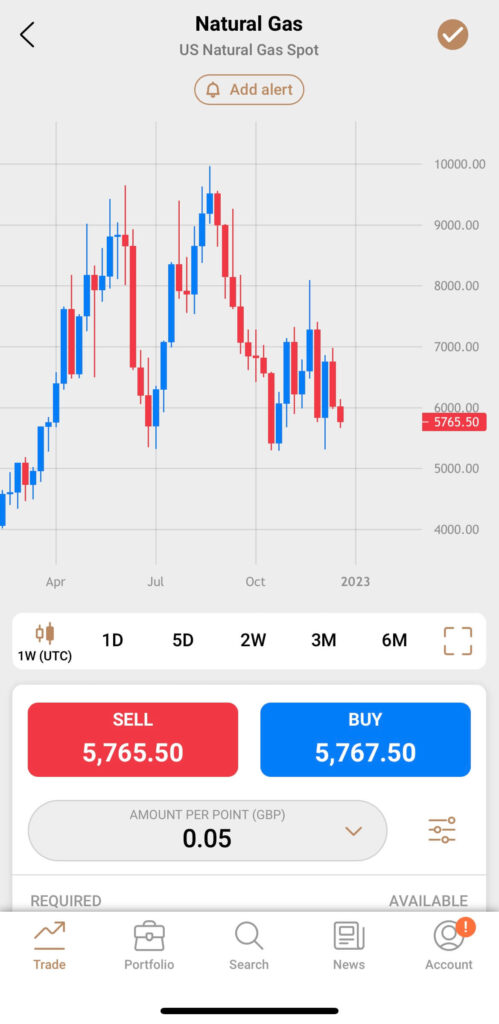
Capital.com Voted Best Trading Account In 2025 Provider: Capital.com Verdict: Capital.com won the People’s Choice vote for “Best Trading Account” in the 2025 Good Money Guide Awards and “Best Trading App” in our 2023 awards as they have one of the most intuitive apps for trading the most popular markets globally. Capital.com was founded in 2016 and is a CFD trading platform broker with offices in the UK and around the world. Since then, they have grown to offer over 3,000 tradable assets to 100,000 monthly active clients. Is Capital.com any good for trading? Capital.com has a user friendly and intuitive trading platform and app, that gives access to the most popular financial markets with competitive spreads with the ability to reduce risk by decreasing your leverage. Trading via the app has always been capital.com’s forte, and in 202, it won our award for “best trading app” not in part due to the fact that the company CTO has extensive experience in building engaging apps like Candy Crush. What makes Capital.com different? Thumbs up, literally Do you know what one of the most impressive thing about Capital.com is? They put the buy and sell buttons at the bottom of the app. I don’t mean that in a facetious way, it’s genuinely a brilliant feature. This may not sound like much but it’s a good example of how Capital.com has integrated decades of analytics, experience, feedback and customer data into creating a very easy-to-use intuitive trading app from scratch. When Capital.com first became authorised by the FCA back in 2018, I visited their offices in London to have a chat about what they offer. The two main things we discussed were button placement and AI. Trading App But anyway, if you’ve updated your iPhone to the latest iOS you’ll notice that Apple has started moving things to the bottom of the screen, the search bar for instance. This is because, phones are getting bigger, and your thumb can’t reach the top of the screen if you are holding it with one hand. This is something that Capital.com figured out would make trading easier 5 years ago. I’ve just been through a bunch of other trading apps on my phone and still, amazingly enough, none of the other brokers have done this yet.
Capital.com was also the first to integrate artificial intelligence to help you improve your trading, they say, based on the Martingale theory. When I spoke to Chris Demetriou, the head of sales in the UK, he said that the system should give you prompts based on your previous trades. So for example, if you are about to do a trade that is similar to ones you have constantly lost on before, you should get a “are you sure you want to do this” notification. Leverage Control Everybody knows, that one of the main reasons people lose money when trading is overleverage. This could be either from not having enough free cash on account to give your position breathing space, or simply putting on trades that are too risky. One really good feature is that you can change your leverage based on asset class. The default leverage is the max that retail traders in the UK are permitted, but you can change this to 1:1 so you need to fully pay up for positions. A sensible thing to do if you are just getting started, which can help reduce excessive losses. As your experience grows you can increase your leverage accordingly. Hedging You can also set the platform to put on hedging positions, so you can be long and short the same thing at the same time. Why you ask? Well, it can help you run longer-term positions and short-term hedges. This in fact is the very point of CFDs. They were originally hedging tools, and still a good way to protect your long-term investment portfolio against short-term market corrections without having to close off your positions. Customer Support Customer support is pretty good too, you can get in touch via the chat widget on the platform, whatsapp or telegram. When I tested it I got a response within a minute and the issue I had was dealt with quickly (uploading ID to verify my account if you must know). TradingView You can’t trade from the charts, but when you have open positions they are overlayed along with your stops and limits, which you can move by dragging and dropping. But, if charting is your thing, you can join the other 78,000 Capital.com customers using and trading from TradingView. Proprietory Tech One thing I quite like though is that instead of relying on third-party software, the Capital.com trading platform is built in-house, and if you want something you can ask for it. For example, previously on the app you could see where an asset is as a percentage relative to the daily range. But, a customer asked, if you could see it in points too. So, that was quickly integrated so that you can now toggle between percentages and points. A small thing, but indicative of a broker that can do things and does do things, rather than just logging a helpdesk ticket. Refinitiv There are no trading signals on the platform or app, but you do get access to Refinitiv reports on US stocks, which give you a good overview of historic and potential future financial health. A good feature for those looking at slightly longer-term positions. Overnight funding Talking of long positions, or longer long positions, Capital.com also display quite clearly what your overnight financing rates are going to be on a daily basis. I’m sure this is a regulatory obligation anyway, but it’s done in a way that you can actually see what the price is, rather than an opaque formula. It gives a bit more transparency about how much a position is going to cost you. Investmate If you are new to trading, they have a stand-alone app called Investmate, which puts you through a series of bitesize courses that explain the financial markets. Capital.com also own currency.com if you fancy a punt on crypto, and shares.com so we can expect to see more comprehensive physical investing options soon. Pros
Cons
Overall4.5 |
|
 |
USDJPY Spreads 1 |
Forex Markets 64 |
GMG Rating |
Customer Reviews |
Visit Platform 76% of retail investor accounts lose money |
Account Types:
|
Plus500 Expert Review 2026: A user-friendly platform with access to global marketsProvider: Plus500 Verdict: Plus500 is one of the largest online trading platforms and operates in more than 50 countries worldwide. Founded in 2008, it has more than 26 million customers today.
Plus500 is headquartered in Israel, however, it’s listed in the UK on the London Stock Exchange (it’s a member of the FTSE 250 index). Here in Britain, its platform is operated by Plus500UK Ltd, which has offices in London.
In the UK, you can only trade CFDs with Plus500. CFDs are financial instruments that allow you to profit from the price movements of a security without owning the underlying security itself. 76% of retail investor accounts lose money when trading CFDs with this provider. You should consider whether you can afford to take the high risk of losing your money. Is Plus500 a good broker? Yes, Plus500’s trading platform has evolved nicely over the years from a simple interface to an intuitive execution venue for CFDs on the major markets and stocks. Opening a Plus500 account is really simple:
Pricing: It’s dynamic so moves with the market for minimum spreads. Plus500 does not charge any trading commissions when you place a CFD trade. However, there are some fees you need to be aware of including:
Withdrawals are free of charge no matter how many you make per month. Deposits are also free of charge. Market Access: Very good, Plus500 are always first to try new asset classes With Plus500, you can trade CFDs on a range of assets and instruments including:
Overall, there are over 2,800 assets you can trade with CFDs. The maximum amount of leverage you can use with Plus500 varies depending on the asset class as shown in the table below. If you are trading forex, you can potentially borrow up to 30 times your own money. For shares, you can only borrow up to five times your own capital. Plus500 margin rates:
Platform & Apps: Basic execution, but it does the job well Plus500 trading apps and platform also offers several tools to help traders manage risk including:
Customer Service: Plus500 doesn’t have a phone option, but its live chat is sufficient Plus500’s customer service options are limited to online chat, email and WhatsApp. So, you can’t contact the company by telephone. However, don’t let that put you off. We contacted the company via online chat and were very impressed with the service and support offered. It’s worth noting that support is available 24/7. This is a big plus – some other CFD providers only provide support during the week. If you are a larger or professional trader you can get access to Plus500’s Premium Service Package which includes:
The premium service is invitation only. To become a premium customer, you must have a real-money trading account. However, if you want better margin rates but are not interested in the premium package you can upgrade to a professional account. The Plus500 professional account is an account designed for professional traders. With this account, you have access to higher levels of leverage (e.g. 1:20 for shares). To be eligible for a professional account, you must meet two of the following three criteria:
Research & Analysis: Some sentiment, but limited education and analysis. Plus500 offers a range of additional features designed to help traders make money, including:
Pros
Cons
Overall4.6 |
|
 |
USDJPY Spreads 0.4 |
Forex Markets 100 |
GMG Rating |
Customer Reviews |
Visit Platform 71.9% of retail investor accounts lose money
Pepperstone Reviews |
Account Types:
|
Pepperstone is a great broker for automated trading and active traders Provider: Pepperstone Verdict: Pepperstone is a great all round broker for active traders looking for low costs. Especially for those that want to automate their trading as they are one of the biggest and best MT4 brokers with a very good set of EA packages. Pepperstone were founded in 2010 in Australia and have since then grown to be a global brokerage with international offices and around 400,000 active clients. They offer spread betting and CFDs on 1,200 major market instruments, which means they focus on the most heavily traded assets, mainly forex and indices trading. Of those 900 are shares on the major stocks on international exchanges. Is Pepperstone a good broker? Pepperstone is a great trading platform for traders who want low costs, wide market access and wide range of trading platforms, including one of the best MT4/MT5 packages available to retail traders worldwide. Pricing: Razor tight pricing (on their Razor account). Yes, I’ve used both trading platforms that Pepperstone offer, MT4/5 and cTrader, which include TradingView charting. cTrader is a more traditional trading platform with a basic layout, simple order execution and sentiment indicators. Whereas MT4 is one of the most popular and complex trading platforms available used by millions of traders and thousands of brokers. However, what makes Pepperstone’s MT4 offering stand out is the brokerage behind it. Pepperstone offers it’s MT4 clients experienced account executives based in London and other local offices around the world. Plus, Pepperstone have put together a package of expert indicators and trader tools that are available to download for free that can be plugged into MT4. To win business Pepperstone competes on price and compared to other trading platforms it is one of the cheaper options. For example, the Razor account can offer forex trading with zero pips, with the commission charged post-trade. Or traders can opt for the standard account, which adds a 1 pip markup, but is built into the spread. One of the interesting things about Pepperstone is that whilst they do the traditional digital advertising, they are not on football shirts (apart from the Tennis and now sponsoring Aston Martin) and as Tamas said in his interview, a lot of their business comes from referrals, which is always a good sign. They are a global brokerage so you can at the moment trade crypto, but only if you are a professional client in the UK or are in a jurisdiction that hasn’t banned crypto derivatives. Management: If you want to know more about the man currently running Pepperstone you can read my interview with Tamas Szabo, who has been Group CEO of Pepperstone since 2017, joining from IG where he started in 1996. So plenty of experience at the helm, Tamas, has been in the business for 25 years. One of the interesting things about Pepperstone is that whilst they do the traditional digital advertising, they are not on football shirts or anything like that and as Tamas said in his interview, a lot of their business comes from referrals, which is always a good sign. As I said Pepperstone offers CFD trading for international clients and spread betting for UK customers. Spread betting of course unique to the UK as trades are structured as bets so if you make money trading you don’t have to pay capital gains tax on your profits. Trading Platforms: Pepperstone doesn’t actually have its own proprietary trading platform instead they offer TradingView, MT4/5 and cTrader. MetaTrader is gradually pushing brokers and clients to MT5 because it’s faster and a bit more user friendly, however, there is a lot of resistance from traders, especially those that use EA’s or Electronic Advisors, as most have been written for MT4 and can’t be converted for MT5 without being re-written. Automated Trading: If you haven’t used one an EA, an Electronic Advisor enables you to trade automatically based on certain market criteria, usually based on technical analysis. So if the market does x, you buy, if the market does y you sell. The idea is that you set up a trading strategy and set it on autopilot to trade on your behalf. It’s not necessarily high-frequency trading that was featured in Flash Boys or Flash Crash, but it’s similar. If you want to know more about high-frequency trading those are two books well worth reading, Michael lewis has an excellent way of explaining complex derivatives and I particularly enjoyed Flash Crash because the chap it’s about was a client at the brokerage where I used to work and some people I know were mentioned in it, which is always quite amusing. A few things to note though about EAs, unless you have a VPS or VPN they won’t work if you turn your trading screen isn’t on and you can’t use them on the web version or mobile. However, Pepperstone will set you up with a free VPS connection if you want one and do a certain amount of business. MT5 versus MT4: MT5 is one of the most popular trading platforms on the planet and is used by millions of traders and hundreds of brokers. The key benefits are that it’s pretty simple to use and universally recognised, so if you used MT4 or 5 with one broker, switching accounts is fairly easy. Initially, it does have a clunky institutional feel to it, but once you get the hang of it it’s fairly simple to use. Pepperstone’s MT5 does have its advantages over other brokers though. Mainly the packages they offer, the spreads and the execution, but also the regulation. Pepperstone are regulated by the FCA, so if you are a UK client a certain amount of your funds are protected by the FSCS if Pepperstone was to go bust. You are not protected if you are using MT4 or 5 through an offshore broker, and to be honest, if you are based in the UK you should always be trading with an FCA regulated broker, or the FCA regulated entity of a broker. It is tempting to go offshore to get better margin rates since ESMA capped them but you can get them as a professional client and if you can’t qualify as a professional client you probably shouldn’t be trading with excessive leverage anyway. One of the main things that make Pepperstones MetaTrader offering stand out is market range, you get loads of forex pairs, the major indices and they are also increasing the number of shares they offer. They have the major FTSE 100 stocks and a few hundred US, European and Australian stocks, but that is growing. But, it is still nowhere near as many markets as someone like IG or Saxo offers. Also, Pepperstone is still only a trading platform so you can’t hold any of your long-term investments with them. Trading Tools: Pepperstone also has a unique package of MT5 downloads which they call Smart Trader Tools, which include plugins like Trade Terminal where you can set your preferences for assets. So for example if you always trade cable in 1 lot, and have a stop 10 pips away and a limit 20 pips that will be your default OCO when you trade. You also get things like a Pivot Points plugin where you can trade off previous highs and lows. Some other main features of MT4 are one-click trading, and the ability to trade off the charts. You can also move your entry and exit points automatically. If you trade four markets you can have four set up on screen and have your defaults for each one. cTrader: One of the major drawbacks about MT5 though is that it doesn’t show your margin when you trade, which to be honest isn’t great if you are a beginner because you have no idea what your exposure is or how much risk capital is going to be used up. It will tell you your overall margin position, but it won’t show you your individual margin rates. Which is daft. However, Pepperstone’s other platform cTrader does do this. To be honest, I actually prefer cTrader, I think it’s more user-friendly, it breaks down your margin. The disadvantage of course is that you can’t run net and hedged positions. You can’t trade with EAs but I don’t really like them anyway, I think the chances of clients making money with an off-the-rack automated trading strategy is pretty slim. It may work for a bit to nick a trade here and there but if you leave it running over a massive market correction you can get wiped out. You also can’t trade as many shares on cTrader as you can on MT5, which is a shame. I think it has a cleaner layout, with everything pre-installed and you can trade in a web browsers rather than having to download the software. If you are building your own EA then MT5 is for you but if you are just eyeballing the market and taking a view I prefer cTrader as you get news, calendars, plus Autotrachtists is on there as well and is linked to the pair you are looking at. Education & Analysis: One other thing to note as well is that when it comes to learning to trade or understanding the markets it is incredibly difficult. Pepperstone has partnered with The Corillian Academy, to provide some educational content. Corillian was set up by some fairly sophisticated traders with decent backgrounds. Richard Adcock for example has been on the board of the society of technical analysts for 30 years. Customer Service: Although probably the main benefit of Pepperstone over the majority of MT4 brokers is customer service. It’s a big risk trading the financial markets and there are often big sums of money involved. So being able to phone someone up who can execute trades for you and give you a full demo of the platform is almost more important, in my mind anyway, than pricing and market access. If you’re in the UK, you get to talk to your dealers in London, through direct dial. Pros
Cons
Overall4.1 |
|
 |
USDJPY Spreads 0.9 |
Forex Markets 60 |
GMG Rating |
Customer Reviews |
Visit Platform 61% of retail investor accounts lose money
Spreadex Reviews |
Account Types:
|
Spreadex Expert Review: Financial Trading With Excellent Personal ServiceProvider: Spreadex Verdict: Spreadex is a financial spread betting broker that has been in operation since 1999. It was founded by ex-city trader Jonathan Hufford and unlike many of its peers, it is not based in London, but instead is headquartered in St Albans Hertfordshire. Spreadex offers both financial spread betting and CFD trading from the same account. The company has some 60,000 account holders and offers access to more than 10,000 financial instruments, including UK small-cap shares, where it is something of a specialist. Is Spreadex a good broker? Spreadex offer some of the best personal service for large spread betting and CFD traders and has built a reputation for great tech and trading and as such won “best spread betting broker” in the 2024 Good Money Guide Awards. Pricing: Spreadex is super competitive and not afraid to undercut the competition Pros
Cons
Overall4.4 |
|
 |
USDJPY Spreads 0.9 |
Forex Markets 51 |
GMG Rating |
Customer Reviews |
Visit Platform 68% of retail investor accounts lose money
IG Reviews |
Account Types:
|
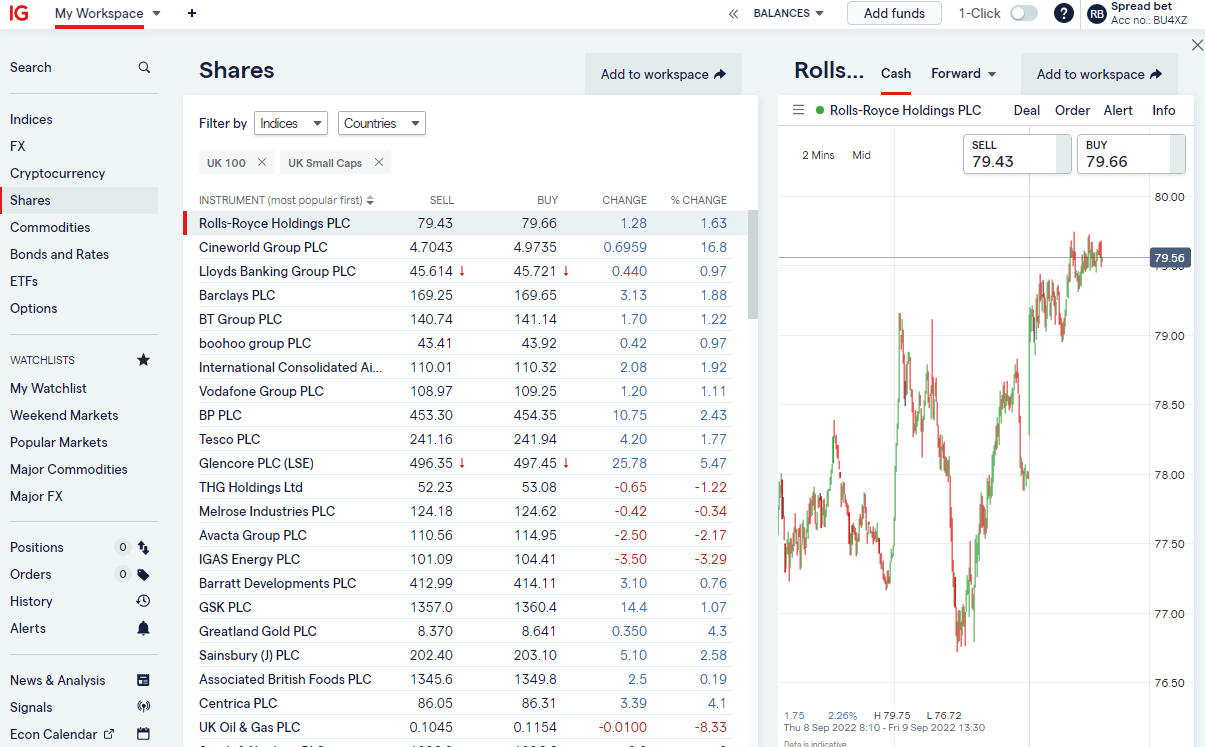
IG is one of the best UK share trading platforms based on our data matrix and analysis as they offer the most UK companies (large and small), through the most account types (CFD, spread bet and investment) as well as provide a huge amount of analysis, news, trading signals and have an industry-leading online and mobile trading platform. They also provide DMA CFD trading for higher volume and advanced traders.
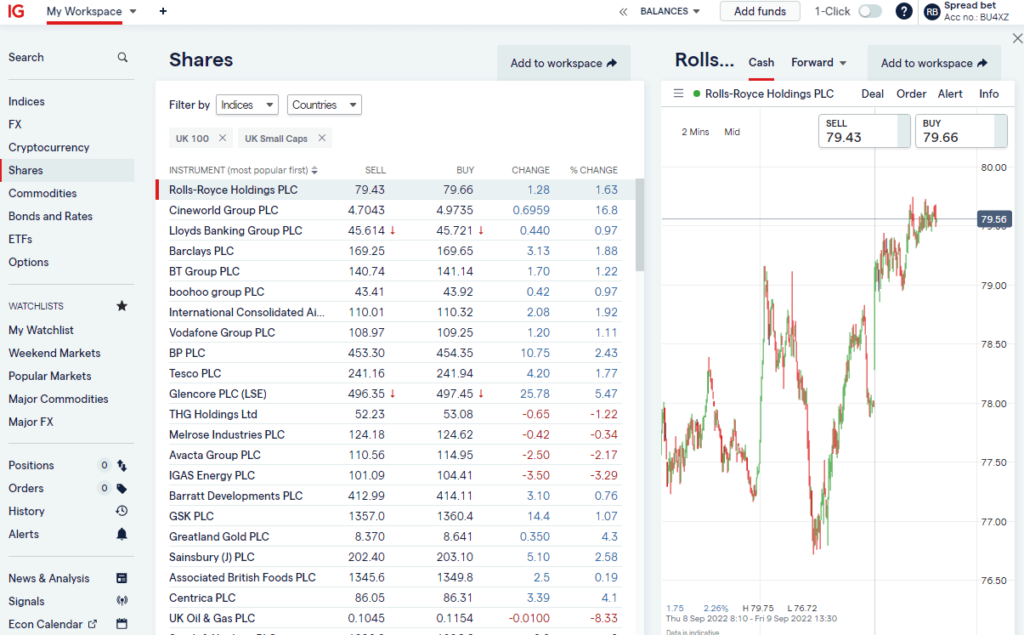
IG Won Best Trading App in the 2025 Good Money Guide AwardsProvider: IG Verdict: IG is one of the largest and best brokers in the world and offers the full suite of investing and trading accounts for all types of investors. Highly recommended. Founded in 1974 as Investors Gold Index, then IG Index, and now just “IG”, it’s one of the world’s largest margin trading brokers. IG offers contracts for difference (CFDs), FX and spread betting (in the UK) alongside share trading and prime brokerage to over 400,000 clients, and covers 15,000 tradeable markets. IG also offers physical share dealing and smart portfolios for longer-term investors. Is IG a Good Trading Platform?
First up, I must disclose that IG is my default broker. When I review brokers, I ask: “Why would you trade here rather than at IG?” It was my first trading account – I’ve had it for about 20 years and I remember the first online trading platform when it was basically a messaging system through to the dealing desk. When I was interning on the NYMEX and IPE trading floors in London and New York as a ticket checking clerk, I’d tap away on IG on my Ericsson R380. Along with Trading Places (my dog is even called Winthorpe #notobsessed) I hold IG accountable for the path my career has taken. Who is IG?Stuart Wheeler, IG’s founder, basically invented financial spread betting in the attic of a Chelsea townhouse in 1974. It was first called Investors Gold Index, then IG Index and then just IG. As the product range grows, the name shortens. His biography (Winning Against the Odds, My Life in Gambling and Politics) makes clear IG was founded for the love of the business (that business being gambling and investing). One of the things that makes IG stand out is that it’s good at what it does, and seems to want to be the best. I certainly gathered from my interview with the former IG CEO, June Felix, that the company wants to be on the client’s side, believing it’s better to try to help the client win, and give them good service, so they’re still a client 20 years later, rather than the churn and burn approach. Index & Forex TradingIG was one of the first brokers to let private individuals trade the financial markets, and IG clients can now trade a market-leading 80+ indices. You can also trade forex on the platform. But unlike most other forex brokers, which see the largest percentage of their volumes in the forex markets, IG’s most popular asset class is indices, followed by currency trading. Quality ServiceIG has always taken the view that clients trade with it because of the service it offers, rather than because of any incentives. No B-BookOne draw for big clients is that whilst IG does internalise orders, it has symmetrical exposure limits, so it doesn’t take a view on the markets. This means that IG is not betting against you with a B-Book. And, if you’re a big trader, because of IG’s liquidity there may actually be bigger volume on IG’s bid and offer than there is in the underlying market. You get positive slippage, so if you place a limit order and the market suddenly moves in your favour you get filled at a better price than your limit. Spread Betting & CFD TradingWith IG you can trade CFDs or spread bet 24 hours on major indices, forex and commodities markets. There are extended hours on global equities, where some fairly significant volume goes through, particularly on US equities when company announcements are made after the main market shuts. IG is one of the few brokers to allow trading during the weekend, so you can still take a view or limit your exposure if something big comes out politically. IG is one of the best CFD trading platforms as it offers a huge range of markets to trade and DMA access for more sophisticated traders. Also, because IG offers CFDs globally (with the exception of the US) it has a huge amount of volume and liquidity meaning that sometimes you can place bigger orders via IG’s order book than you could do on the underlying exchanges like the LSE or NYSE. Because of the sheer volume of CFD trades, IG is able to internally match up orders for quicker and larger fills. One key disadvantage of trading CFDs through IG is that you have to pay tax on profits. However, CFDs are not the only product that IG offers. You can also trade financial spread bets, where you do not have to pay capital gains tax on profits as this is classed as gambling. IPO Grey MarketOne feature that’s now unique to IG (lots of other brokers used to do it) is the “grey market”, where it will offer you a price in unquoted stocks that are due to come to market. You essentially take a bet on what the market cap will be of a company when it lists. Or you can just apply for shares in the IPO through PrimaryBid, which will deliver them to your IG account. Global DifferencesIG is good at knowing what customers in each region want. The UK, for example, is the only country that is offered financial spread betting, and the rest of the world trades on margin with CFDs. That’s with the exception of the Americans, who trade on margin by taking out a loan to buy stock (from their broker) or trade options, which are much more popular on equities. Japan has knockouts and Europe has barrier options and Turbos Warrants. What Does the Trading Platform & App Look Like?IG’s trading platform is DIY online, but still with phone support if you need it.
IG is keen to push its added value; the platform tries to integrate as much as possible. IGTV is based on the platform analytics of what people are trading, and IG creates programmes around what markets and assets traders are looking for information on. The news and analysis comes from Reuters, with snapshot videos and a series of IG market commentary videos. We rate IG’s trading app as extremely safe because of IG’s regulation and reputation. However, it’s important to note that while trading on the app itself is financially secure, the products on offer are high risk and IG does offer investments that are not safe for capital preservation. IG offers financial spread betting and CFDs which are high risk, potentially high reward products. High Net Worth AccountsIf you are a high-volume trader, you can also trade DMA with ProRealTime, and you can get level 2 pricing and trade directly on the exchange order book. This can be done on the IG trading app or by downloading the L2 dealer software. There is a cost, of course, but if you do a few trades that is rebated back. Brokers have to pay the exchanges for providing level 2 data to their clients, so the charge is there to dissuade everyone signing up without trading. If you are really clever and have developed your own trading algorithm, you can plug that into IG’s platform too. Or MT4/MT5 which it also offers, if you’re into that sort of thing. Sticky ClientsA problem all brokers are desperate to address is people losing money. It’s always been the case that only around 20% of people made money. A few brokers have implemented post-trade analytics, to help their clients try and win more. IG’s Trade Analytics tool does just that. Its sole purpose is to try and help traders win more by getting a better understanding of where they profit and lose in the markets. It’s been developed in-house by IG, based on analytics and to provide clarity. James Perry, a former IG Client Experience Manager, told me “We desperately want our clients to win, as the more they win, the longer they are going to be a client, and the more they are going to trade.” And the more commission IG will make. I know this to be true from my own trading, when you’re on a winning run you trade more, and when you can’t call the market right you step away until another day. Investing, ETFs & Share DealingIG also offers longer-term investing products, where you can buy and hold stocks, ETFs and funds in a stocks and shares ISA, or IG Smart Portfolio. It has a trading academy so you can learn through video and interactive courses. IG can see from its analytics that clients that use these become better traders. IG bought DAILY FX (for $40m) and offers live webinars to provide analysis and trading strategy. You can invest and trade ETFs with IG. You have the option of either investing in the long term by buying ETFs in the general investment account, SIPP or ISA. Or you can speculate on them going up or down by going long or short via CFDs or financial spread bets. IG is not the cheapest place for investing in ETFs, (that is probably Interactive Brokers) but it does have very good customer service and is a really easy-to-use ETF platform. Ratings Explained
Overall, if you are going to trade, I would be surprised if you didn’t have an account with IG. Pros
Cons
Overall4.7 |
|
 |
USDJPY Spreads 0.9 |
Forex Markets 338 |
GMG Rating |
Customer Reviews |
Visit Platform 68% of retail investor accounts lose money
CMC Markets Reviews |
Account Types:
|
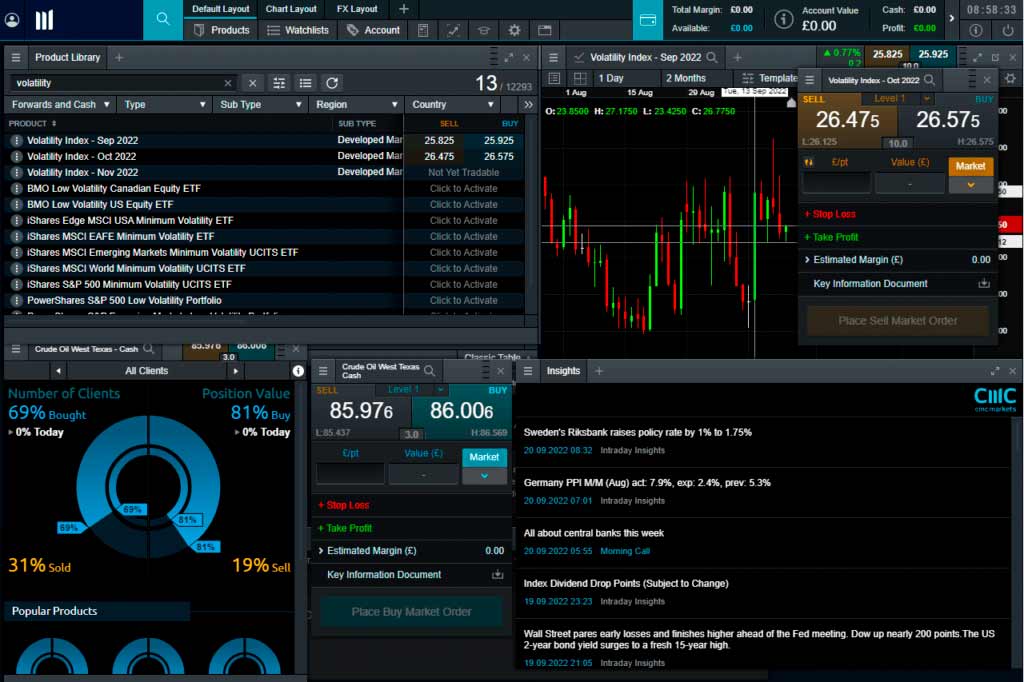
CMC Markets Review: Great Tech for Active TradersProvider: CMC Markets Verdict: CMC Markets is one of the best and fastest trading platforms available for active traders to speculate on the most popular markets. The company is one of the original spread betting and CFD brokers based in the UK. It’s been providing forex trading services since 1989 and is now listed on the London Stock Exchange. The broker has over 300,000 active clients trading online and is operated from 13 global offices, with headquarters in the City of London. Is CMC Markets a Good Broker? Yes, CMC Markets has always offered, and still offers, one of the best trading platforms for high-frequency and active traders. It’s a good choice for those who want to trade on tight spreads, with a platform built on exceptional tech. I’ve used CMC Markets for 20 years now and it’s typically been my go-to broker for trading forex and equity sectors. I recently gave it another full test with real money and live trades. I’ve also interviewed its founder and its head of product. In this review, I share my views on what CMC Markets is good at, where it needs to improve and which types of trader it suits. Almost 20 years ago, when I first had my account, I remember sitting in CMC’s reception, eager to pick up a CD-ROM of the Market Maker trading platform so I could trade personal account when I was a stockbroker at Phillip Securities. I used to flit between using IG and CMC Markets back then. IG had a few more markets, but the platform was a bit basic. CMC Markets had tighter pricing and because the platform had a dark background, and more flashing lights you felt like a real pro. Despite the fact that CMC’s heritage is in the FX markets, I could never really get the hang of those so I’d trade indices, and FTSE 100 shares (also, CMC only really did the main market stuff back then). I could have waited for CMC to post me a disc, but I had a real itch to try it out. It was an excellent trading platform then, and it still is today. What Does the Platform Look Like?
History Of CMCThe current CEO, Peter Cruddas, set up CMC as Currency Management Corporation in 1989 after leaving Western Union, where he learned how the foreign exchange markets worked, in particular the market-making side of the business. Originally offering forex trading, then financial spread betting and moving into CFD broking in 2000, CMC began to expand internationally in 2002. CMC Markets was listed on the London Stock Exchange in 2016. CMC Markets, which is now a member of the FTSE 250 index, has over 310,000 active clients globally, and in the 2023-24 financial year generated a net operating income of £332.8 million. When I visited the CMC offices a few years ago, the brokerage world was switching from voice to online. CMC was one of the first forex brokers to invest heavily in technology and has always led the way in online trading platform innovation. CMC Markets: Spread Betting & CFDsCMC Markets only offers CFD trading, rolling spot forex and spread betting in the UK. These are generally short-term speculative products. You can invest in the long term and buy physical shares through CMC Invest in the UK (although in Australia CMC Markets does offer stockbroking). If you don’t know what these are you shouldn’t be trading them. But if you do and you want to trade them, CMC Markets is in my view one of the best places to do so. In 2024, the platform came up with a nice tagline…
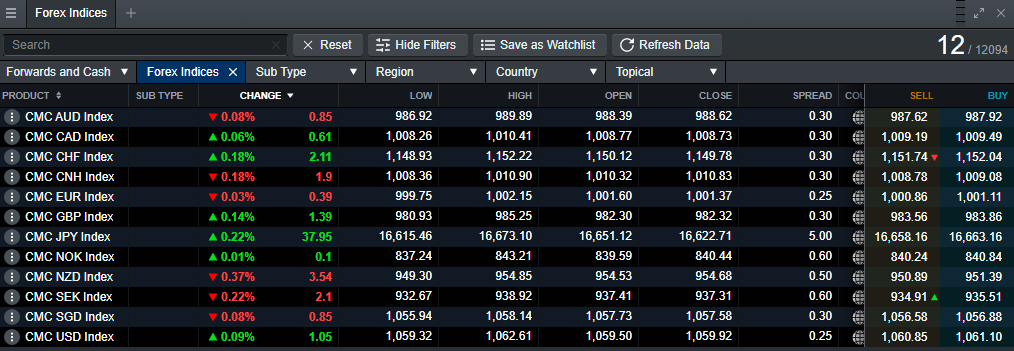
This is the essence of trading, really. Yes, trading is risky, but it’s a calculated risk. And one way to reduce risk is to go with a well-established and well-capitalised provider. CMC Markets is a public company so you can see how well it’s doing as a business. Trading is hard enough without having to worry if your broker is going to go bust. In the UK, retail client money is held in segregated client bank accounts, in a regulated bank. CMCX Share PriceThe current CMC Markets (LON:CMCX) share price is 339.5p which is a change of -7 or -2.02% from the last closing price of 346.5 with 593,746 shares traded giving CMC Markets a market capitalisation of £949,973,283. The most recent daily high has been 362 and daily low 335.5. The CMC Markets share price 52 week high has been 362 and the 52 week low 183.4. Based on the most recent CMC Markets share price opening of 339.5, the current CMC Markets EPS (earnings per share) are 0.23 and the PE (price earnings ratio) is 14.71. Pricing data automatically updates every 15 minutes, last updated: 19:08 27-Mar-2026. Although you’re out of luck if you want to trade CMC shares on CMC, I tried when I was demonstrating how to do a pairs trade against its main rival IG. I had to trade CMC on IG and IG on CMC. Market RangeCMC Markets definitely has one of the best market ranges of all brokers. Although it doesn’t offer all shares – around 12,000 assets vs IG’s 17,000 or Interactive Brokers’ epic coverage – it has some really great markets that are exclusive to CMC. I’ve always used it for trading the most popular shares, and I would say it’s aimed at active traders more than its rivals. You only really miss out on smaller cap stocks that aren’t appropriate for margin trading anyway, as they are growth investments. CMC Markets Sector Bets & DiversificationOne of the things that I’ve always liked about CMC is its approach to diversification. Everyone knows that you shouldn’t put all your eggs in one basket when it comes to investing, and the same is true of trading. You’ve got a better chance of beating the market consistently if you spread your risk across different asset classes and don’t go crazy Rio trading. I find forex trading incredibly difficult. I’ve never been able to make any money at it because I can’t judge forex price action – I find it too fast-paced. What I like to speculate on is the overvaluation or undervaluation of one currency against another. CMC has a market called weighted currency indices, which basket together one currency against many others. So you can trade how you think USD is going to perform against the EUR, GBP, AUD, CAD, CHF, CNH, JPY and SGD in one go. So instead of an outright punt, you are taking on a dollar position rather than a USD-GBP trade. What Does the Forex Section Look Like?
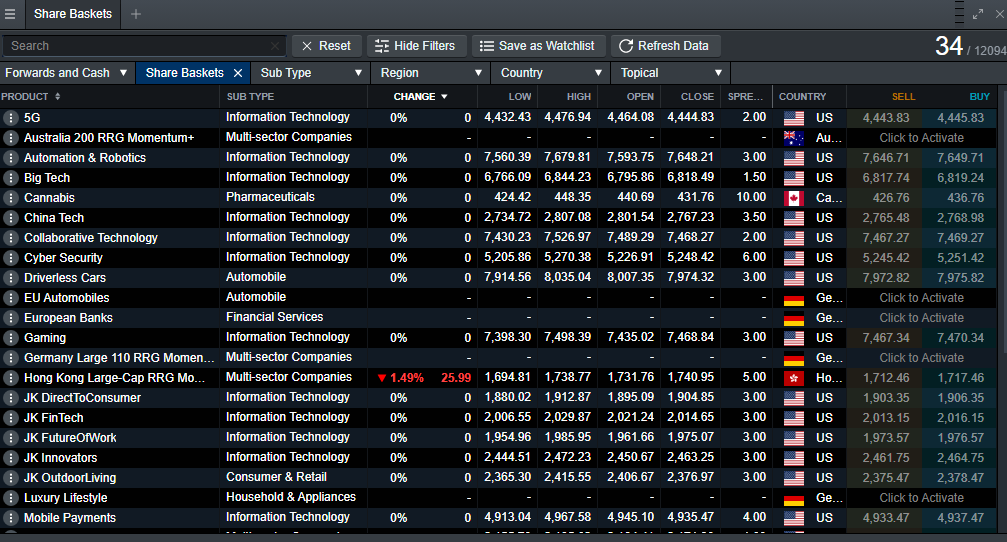
Share BasketsCMC Markets has always enabled sector bets, but it has fine-tuned these over the years because of the proliferation of ETFs into share baskets, like US Gold, Oil & Gas, Luxury Lifestyle and Collaborative Technology. This is great, because I really like trading stocks. I find this quite easy compared to forex as stocks are based on fundamentals I understand. One trading strategy that is relatively simple is trend following, especially now with the Reddit generation getting so worked up. If you see a sector getting some good press you can jump on the bandwagon without having to sniff out the individual stocks. Likewise, if sentiment is turning negative, it may be time to go short.
Deal4FreeDid you know that CMC Markets was once called Deal4Free? You obviously can’t say that anything is free now, because the regulators frown on that sort of thing. Instead, you have to say something like “zero commission”, because you’re being charged something somewhere – you just don’t see it on your statement. Trading with CMC Markets is obviously not free, but it is cheap. It has always been one of the best value trading platforms, primarily because it unashamedly acts as a market maker. If you are spread betting, charges are built into the spread and are competitive. It’s always been part of the appeal that if you are trading the most popular and liquid assets, CMC is one of the cheapest places to do it. Commission charges on single stock CFDs are set at 2 cents per share in the US (minimum $10) and 0.10% for UK and European equities (minimum of £9/€9). So you get the choice. If you are a normal trader you can have your costs built into the spread, or if you are one of the bigger boys you can trade CFDs with better pricing and commission charged afterwards. Alpha & Price PlusThere are two ways to get recognition at CMC. Firstly, you can buy your way in with a minimum deposit of £25,000 and join its premium membership, Alpha. It’s a nice name because, as I’m sure you know, an alpha in trading is trying to outperform the market. You get interest on cash balances and discounted spreads. There’s also a free subscription – it was to the FT but is now to Bloomberg. If you can’t afford to buy your way in, you can still get reduced spreads by putting the volume through. The more you trade the lower your spreads will be… CMC: Profitable Client SentimentCMC offers users access to client sentiment and positioning tools that show the aggregate positioning of its customers in various instruments. The data includes long-short percentages by clients and value as well as a breakdown of the current day’s order flow. Once again, this is broken down by both client percentage and value. What’s more, you can filter the positioning sentiment by client type, segmenting the data into top clients and other clients. The top clients view shows the positioning, in a particular instrument, of those clients who have made money on their trading account in the last 3 months, and who have an open position in the instrument under observation. The ability to filter the sentiment and positioning by client type gives CMC clients a potential advantage over peers who don’t get this additional insight. Positioning and sentiment data can be used to trade, though how you use it will be determined by your outlook on the markets. Experienced traders take the view that as the majority of CFD and spread betting clients lose money it follows that positioning data is a reverse indicator, especially when the clients seem to be opposing an established trend. In these days of social trading and large crowds, however, that may not always be the case. On balance it’s probably best to think of sentiment and positioning gauges as decision or trade support tools, rather than decision-makers in their own right. CMC Markets: Education & AnalysisCMC has plenty of education and analysis available for its clients. It’s divided into separate sections: current news and analysis, a section on learning to trade that covers FX, CFDs and spread betting, and equities trading. As well as technical analysis, CMC offers trading from home and trading strategies. CMC Markets also offers what it calls market intelligence through its specialist website OPTO, which includes a magazine full of insightful articles, plus podcasts, and interviews with high-profile guests from the markets. The trading guides are aimed at beginners and less experienced traders whereas OPTO is for more experienced traders who are looking for fresh ideas and inspiration. News and analysis from CMC’s in-house analysis team sits comfortably between them, and as we noted earlier, there is also an online moderated charting community within the trading platform. All of this is available at no additional charge and much of it is available to the public as well as CMC clients. Many of the major providers have a general education program and support their traders with news and in-house analysis. But OPTO stands out from the crowd and, to my mind, this elevates the CMC offering above the competition. CMC Markets offers an investment option with CMC Invest. Institutional Prime Services (CMC Connect)Recently rebranded to CMC Connect, the institutional side of the business is where CMC expects to grow over the next 5 to 10 years. The company has high profile joint ventures such as the stockbroking services it provides to the clients of ANZ Bank. Alongside these partnerships, it offers institutional liquidity, outsourced trading technology and connectivity, as well as pre and post-trade processing and trade reporting. These services are aimed at institutional customers such as hedge funds, family offices and prop traders. HNWI and the most active professional clients might be able to use some of CMC Connect’s services but the division is really aimed at corporate customers and funds. CMC competes with all of the large-scale margin trading brokerages in the CFD, FX and spread betting arenas. It’s also making inroads into the institutional and B2B spaces through liquidity provision, white labels, and JVs. That push on the institutional side and the firm’s focus on in-house trading technology, and the use of currency and share baskets, are the key differentiators from its competitors. CMC Markets Review Ratings Explained
Pros
Cons
Overall4.6 |
|
 |
USDJPY Spreads 1.4 |
Forex Markets 57 |
GMG Rating |
Customer Reviews |
Visit Platform 72% of retail investor accounts lose money
XTB Reviews |
Account Types:
|
XTB Review: A Great All Round Trading & Investing Platform Provider: XTB Verdict: XTB is a CFD and forex broker headquartered in Poland and listed on the Warsaw Stock Exchange (WSE:XTB) valued at over $1bn. XTB was founded in 2003 and offers forex, indices, commodities, ETF and stock CFD trading. XTB has historically used celebrity endorsements to promote it’s brand including Jose Mourinho, Conor McGregor, Joanna Jędrzejczyk and Jiří Procházka. Is XTB a good broker? XTB, are a decent all-round trading platform and a good choice for most small-to-medium sized CFD traders. They are publically listed in Poland and offer, competitive spreads on a fairly wide range of markets. The key things to focus on when considering trading with XTB are:
Pros
Cons
Overall4 |
|
 |
USDJPY Spreads 0.7 |
Forex Markets 84 |
GMG Rating |
Customer Reviews |
Visit Platform 62% of retail investor accounts lose money
Saxo Reviews |
Account Types:
|
Saxo Markets is the best broker for UK share trading with direct market access. Their SaxoTraderGo platform offers access to both UK shares to physical investing, CFD trading and also UK share options.
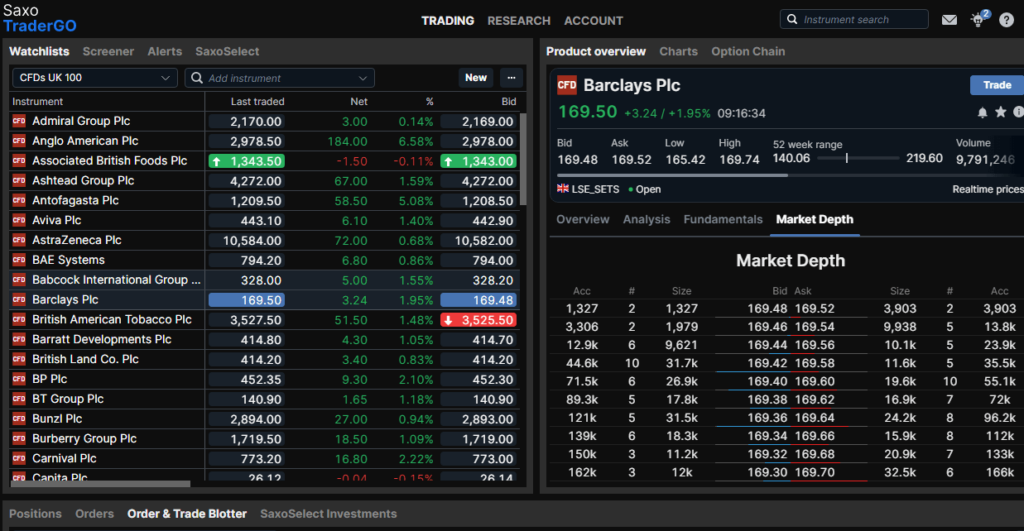
Saxo have some of the best trading and investing platforms for advanced and beginner investors Provider: Saxo Verdict: Saxo is an excellent investing and trading platform for those that who want institutional grade pricing, robust execution and wide market coverage as well as simple to use apps for beginners. Saxo was voted best investing account in the 2026 Good Money Guide Awards
Is Saxo Markets a good broker? Yes, Saxo has a great choice of accounts for beginners with SaxoInvestor and for professionals, the more sophisticated SaxoTrader go provides direct market access. The pro platform, analysis, and direct market access may be too complicated for beginners. But, for experienced traders, its coverage, commissions and research are unrivalled. Saxo is one of the largest investing and trading platforms worldwide and provides direct market access to equities, bonds, forex, futures and options as well as being a major liquidity and infrastructure provider to wealth managers, banks and smaller brokers. Awards: Saxo won best investing app and best DMA/Professional account in 2024. Before that, in our 2023 awards, Saxo won ‘Best CFD Broker’, and ‘Best DMA & Professional Trading Account’. In 2022 Saxo also scooped ‘Best Bond Broker’. Pricing: Commissions have just been reduced further making Saxo one of the cheapest brokers Market Access: Saxo offers a huge range of markets for both derivatives trading and physical investing Platform & Apps: Saxo has an industry-leading robust workhorse of a platform Customer Service: Experienced dealers for active larger customers Research & Analysis: Some of the best opinions on the markets around. Plus, with Saxo posting its best financial results in history (with over $118bn customer funds on account) and now that it has been 70% bought out by J. Safra Sarasin Group, they will be in an even better position to continue to provide excellent market access. This, combined with founder Kim Fournais still owning 28% will keep the firm’s customer-first ethos intact. Overall, Saxo Markets is an excellent trading platform for retail traders and investors who want institutional-grade pricing, robust execution and wide market coverage. Pros
Cons
Overall4.9 |
|
 |
USDJPY Spreads 0.0008% |
Forex Markets 100 |
GMG Rating |
Customer Reviews |
Visit Platform 59.7% of retail investor accounts lose money
Interacitve Brokers Reviews |
Account Types:
|
Interactive Brokers is the best UK share trading platform based on our testing. IBKR has some of the most advanced order functionality for working large UK share trades, including VWAP, iceberg, pairs trading and drip feeding.
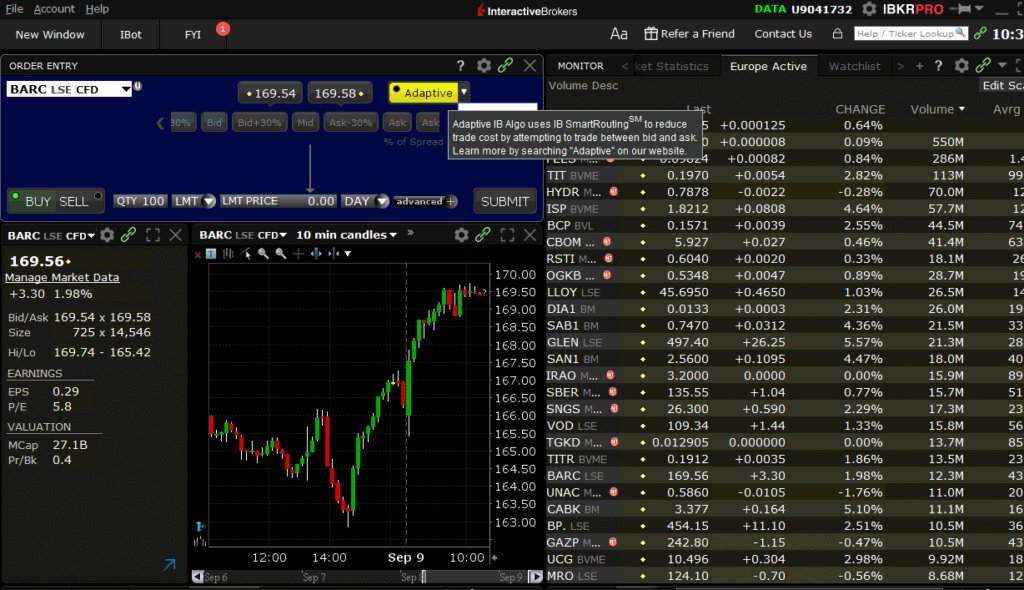
Interactive Brokers has a platform for everyone with very low costsProvider: Interactive Brokers Verdict: Interactive Brokers is an exceptional trading platform that offers institutional-grade trading capabilities to private clients around the world. IBKR has some of the lowest trading and investing fees and the widest market range in the industry. Interactive Brokers is a major US online automated electronic broker company. The financial broker is listed on the Nasdaq Exchange with ticker IBKR. The firm operates in 150 electronic exchanges in 34 countries, and offers trading in 28 currencies. Interactive Brokers has more than 3.19 million institutional and retail customers. Is Interactive Brokers any good?
The proof they say is in the pidding and IBKR, has increased it’s market share in the UK dramatically over the past few years. In 2024 alone, they increased the number of accounts by 142%. An amount I suspect will continue to rise, of all the brokers we cover, they provide the most updates, most platforms and are always looking to offer new markets, that investors actually want. 2025 Awards: Best Professional/DMA Broker 2025 Pricing: Top marks as IBKR don’t charge a custody (account) fee and commission are the cheapest around Market Access: Top marks again for the widest selection of markets available App & Platform: Hard to beat – excellent range of institutional grade execution tools and simple apps for beginners Customer Service: IBKR let themselves down a bit here. If you are a big customer you get an account manager, otherwise online support is slow Research & Analysis: Some of the best education, screeners and market data for free on their website and integrated into IBKR platforms. I’ve used Interactive Brokers for about 20 years now. I’ve interviewed their founder (Thomas Peterffy), their UK MD (Gerry Perez), they’ve been a competitor (when I was a broker myself), a customer and a partner over the years. I’ve traded live with real money when thoroughly testing their platforms. This included an in-depth conversations with their Head Of Product (Steven Sanders) to get inside insights on the best parts of the platform and services that some clients may not know about. In this review, I lay out my verdict on Interactive Brokers as an industry expert so you can decide if they are the right investing and trading platform for you. There is one thing that Interactive Brokers gives you above all other brokers, and that is control. You can invest and trade in pretty much anything you want, in pretty much any account type, pretty much how you want. If you are not familiar with Interactive Brokers (IBKR) they are American, but global, as most American things are, with the notable exception of their news, which always seems to be local. But I digress, IBKR was one of the first brokers to offer electronic trading to the masses. They were founded in 1978 and if you want to know more about the man who founded them and is still running the show, read my interview with Thomas Peterffy, the founder and chairman. Highlights: The key things to focus on if you are considering opening an account with Interactive Brokers is that: They are cheap: No other investment or trading platform can match their discount commissions, FX rates and zero account charges Huge market range: IBKR offer by far the best access to global stock exchanges around the world They innovate and create :You can invest in so many different ways through IBKR, from their beginner IBKR LITE apps, to their institutional-grade desktop workstation trading platform. They have some of the most advanced and easy-to-use features available to private investors. Interactive Brokers Account Types: IBKR offer by far the most types of accounts globally including regular investing account, active trader accounts, direct market access, futures, options and fractional stock trading You can also earn money on your cash, you can buy bonds (high and low yielding), buy warrants, partake in placings, vote on company corporate actions. You can convert currency at 0.2%, which is cheaper than most specialist currency brokers or money transfer apps. Foreign Exchange: Which actually segues me nicely to prove my control point. With most brokers you have to choose an account base currency (if you are in the UK that is probably going to be GBP) and when you trade, no matter what currency an asset is traded in your P&L will be converted to that base currency. But with Interactive Brokers you can run your account in multiple currencies. So, if you put in GBP and trade the S&P for example, your P&L will be in USD. If you buy USD stock you get the option to attach a currency conversion to the transaction so you can convert exactly the right amount to cover the purchase, or you can choose to run a deficit in USD. It’s not such an issue for small traders, as currency exposure, whilst important to be aware of, isn’t the most pressing matter. But if you are running a net flat long/short global macro portfolio, then keeping on top of your currency exposure could be the difference between making money or not. Desktop Trader: Through ScaleTrader, (one of the founder’s favourite features) IBKR also gives you some very advanced order functionality, the sort you usually only get with professional trading systems like Fidessa (for stocks) or TT (for futures). If you’re building a big position and don’t want the market to know you’ve got a big order to work, IBKR’s order ticket will let you gradually feed that into the market (but only charge you for the single order). You can automatically drop bids and offers into the market based on time and price to take advantage of volatile markets. You can also set it to scalp for quick profits in choppy markets.
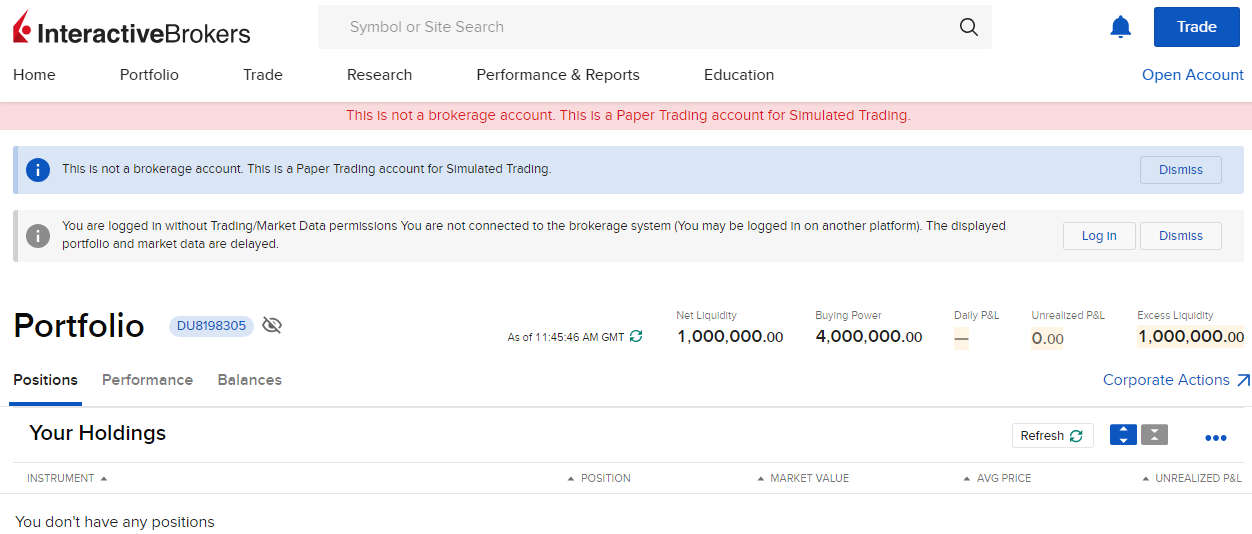
Pairs Trading: You can trade one stock against another automatically by spread, percentage or price. Why is that important? Because it can help you build a market-neutral portfolio and when we asked the boss of IBKR the habits he saw in his most profitable customers, (referring back to our interview with him for the third time) he said the ones that traded one stock against another, often did well. Interactive Brokers Universal Account: You can of course do these things with other brokers, but what you can’t do is do them all in one place. For this review, I spent a while talking to Steven Sanders, IBKR’s head of Marketing & Product Development, and he said in the twenty years, he’s worked for Interactive Brokers the thing he’s most proud of (other than it being founder lead and therefore very little red tape when you want to get things done) is the implementation of the Universal Account, where everything is done from one account. What’s amazing to me is that nobody else really offers it. Ten years ago when I was a derivatives broker at Man Financial, we offered everything that IBKR did, but all on separate platforms. We have a couple of big accounts, £20m upwards, that we were always trying to lure back from IBKR with our personalised voice brokerage where you could phone us up we’d take care of your complicated orders for you. But times change, there is still demand for bespoke voice brokerage, but not as far as Interactive Brokers are concerned. They do offer it from specialists desks if needed, but most trading and investing is done online. Demo Account: Interactive Brokers does have a demo account, but they call it a free trial instead. This is odd, because you don’t actually have to pay to have an account with IBKR. In fact, Interactive Brokers is one of the only trading platforms that does not have a custody fee for investing in a GIA, SIPP and ISA. If you want to know more about that, you can listen to my podcast with Gerry Perez, the UK MD, who explains, how they offer such amazing market access for such little cost. You get a cool $1m to paper trade with on the Interactive Brokers demo account or ‘Paper Trading version’ as they call it. You get access to the easy-to-use investors portal and the more complex IBKR TWS provides delayed market data, simulated trading and access to all of our unique tools and offerings, including the IBKR Risk Navigator, the Volatility and Probability Labs, Portfolio Builder, Research and News. But, to be honest, I didn’t find the demo account very good. Lots of information was missing and I couldn’t place a trade. I’m not sure why, and actually, that’s going to be a bit of an issue for Interactive Brokers because demo accounts are a great way to get client’s interest. In a world where so many brokerages a vying for the same business, even small hiccups like that can cause a massive drop off rate in opening an account.
Usually, IBKR’s technology is first-rate, but the demo account isn’t up to scratch. I didn’t use the paper trading account, just the live trading platform with real market orders. Customer Service At Interactive Brokers: It’s not all great, it takes a while to get through on the phone to customer service, and it has a slightly outsourced feel about it (if you know what I mean). The desktop trading platform, despite its exceptional functionality, is also a bit ‘Windows 95’. But if you don’t need all the bells and whistles, the web based platform, or app has a more modern feel to them. Options Strategy Builder: Options trading is gaining in popularity in the UK, mainly because of the press attention they derived from meme stocks (where US traders punt via options). But they are still a very complicated product. So what Interactive Brokers has down is create a Strategy Builder product, that essentially reverse the process of putting on options strategy trades. You tell Strategy Builder what you think the market is going to do. For example, either, go up, stay still, not move for a while, or volatility will increase and it will create an options strategy around that. Instead of you having to know what strategy to put in place or working out the individual options legs. IMPACT Ethical Investing: In tune with moving with the times, Interactive Brokers has also released the IMPACT app to help people investing in ESG and impact sectors, so they can put their money to good. You can see the IMPACT dashboard on desktop, but it also operates as a standalone app that connects directly to your IBKR account and scores your portfolio based on how ethical the stocks you hold in it are. Ratings come from FactSet and Refinitiv, and there is this excellent feature that allows you to swap into more ethical stocks. If one of your holdings is flagged as not that ethical, the app will suggest another one and at the click of a button, it will sell your shares and calculate how many new shares of a more ethical but similar company to buy and do it all for you. If you’re in the US, you can also make charitable donations directly on the app. Interactive Brokers For Beginners: There is no doubt that Interactive Brokers is a proper trading platform, for those who know what they are doing and cater mainly to the more sophisticated investor. But they are making an effort to open their services up to the newer breed of investor and trader. It’s standard now among many fintechs, but IBKR were actually the first to offer no commission trading. They also offer fractional shares through IBKR LITE and IBKR Pro accounts and have removed the monthly minimum account charge. The hope of course is that by onboarding investors when they just start, they can look after their investments for the next 40 years, just as they have been doing for their existing clients for the last 40. Interactive Brokers runs a Student Trading Lab where students from 600 schools and universities take part in a $1m paper trading account for the purposes of getting a better understanding of the markets. No broker these days can tell you what to buy or sell, but IBKR GlobalAnalyst helps you hunt out undervalued opportunities, across the world, not just in the US. IBKR offer a Trading Academy, podcasts, webinars and blogs for beginners and experienced traders so that new customers survive the markets to become long-term clients. Plus, they are cheap. 24-Hour ETFs At Interactive Brokers:Interactive Brokers has a list of 24 selected ETFs available to trade around the clock from Sunday evening, east coast time, through to the close on Friday, by adding these funds to its US overnight trading facility. Clients who are permissioned to deal in US stocks, are able to trade these ETFs 23.50 hours a day, five days per week, allowing them to react to news stories, macroeconomic and geo-political events as they happen, rather than waiting for US markets to open. The trading hours and ETFs are available to both retail and institutional clients alike and are traded via the firm’s IBEOS system. Trades can be submitted using multiple order types. The range of ETFs is pretty broad and includes firm favourites such as SPY, QQQ, DIA and IWM, which track the S&P 500, Nasdaq 100, Dow 30 and Russell 2000 indices respectively. You can also short those indices by trading the SH, PSQ, DOG, and RWM inverse ETFs. Pros
Cons
Overall4.8 |
 Yes,
Yes, 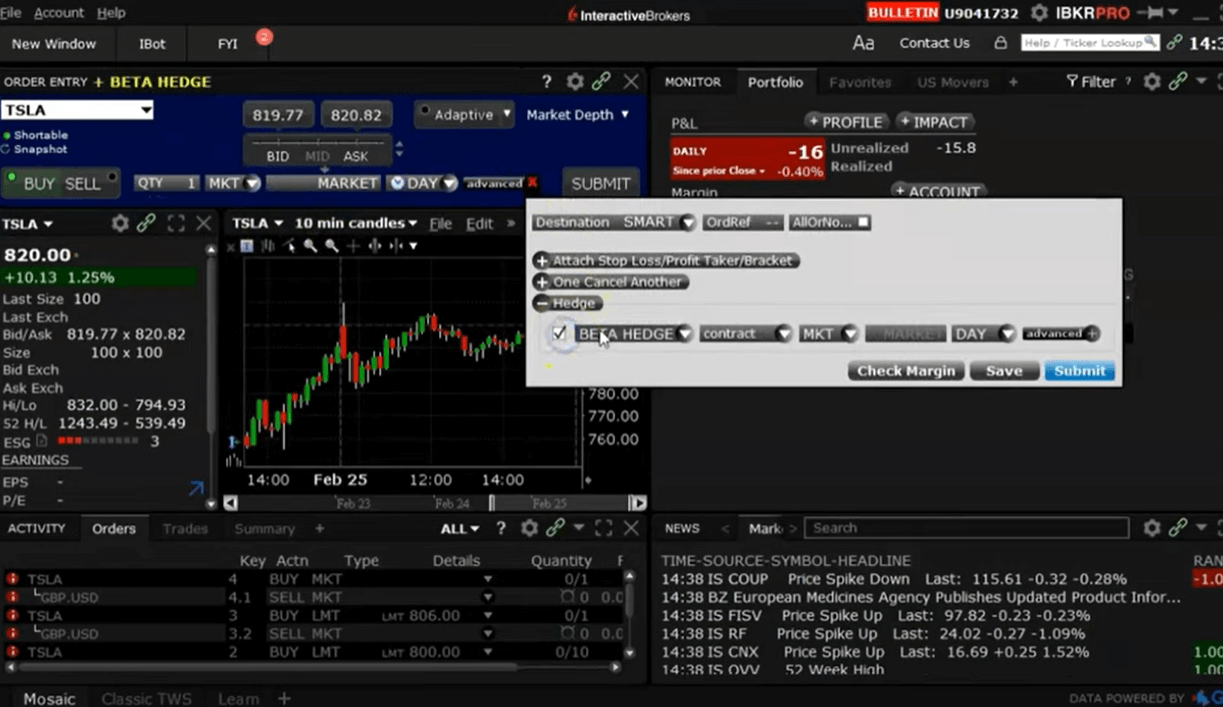
What is USDJPY?
Forex (FX) is the short name for ‘foreign exchange’. It is a market about trading money. Unlike stocks, FX is about measuring one money against another foreign currency. For example, USDJPY is the ticker symbol for the exchange rate between the Japanese Yen against the US Dollar. Specifically, it measures how many Yen convert into one US Dollar. Currently, it takes about 110 Yen to change one US Dollar.
What is the major attraction of trading USDJPY?
The Japanese Yen is one of the most traded FX currencies globally. According to the latest Bank of International Settlements (BIS) Triennial Global FX Turnover Survey (Sept 2019, available here), the Japanese Yen is the third most traded currency in the world after the USD and EUR (see below).
Its daily turnover exceeds $1 trillion, one of the three currencies to do so. In other words, most major Yen pairs are highly liquid and the bid-ask spreads are competitive.
You can trade the Japanese Yen in most financial hubs, such as Tokyo, Hong Kong, Singapore, London or New York. Hedging FX exposure with future contracts are routinely done.
| FX | Value Traded (US,Bln) |
|---|---|
| USD | $5,819 |
| EUR | $2,129 |
| JPY | $1,108 |
| GBP | $843 |
| AUD | $445 |
| CAD | $332 |
| CHF | $327 |
| CNY | $284 |
| Others | $1,892 |
Source: BIS (Data as of Apr 2019)
What are the major risks of trading USDJPY?
Despite good liquidity and a deep market, FX rates can sometimes go haywire.
Why? Because of fear and greed, because of algorithmic trading, because of a temporary structural mishap.
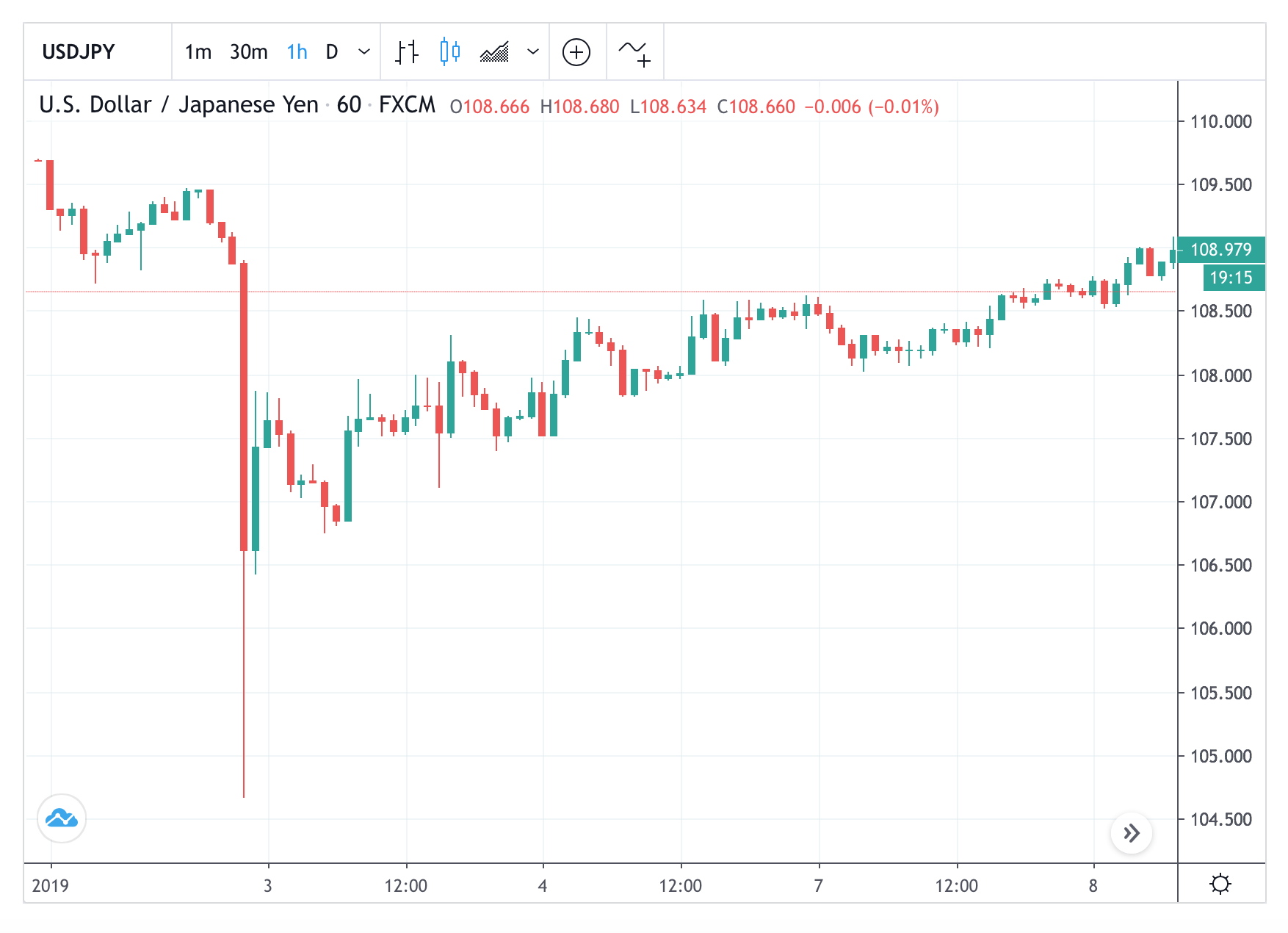
For example, earlier in the year the Japanese Yen suffered a ‘flash crash’ in the early hours of January 3. Prices of USDJPY surged uncontrollably for a few minutes before retracing much of its gains just hours later (see below). Those with stop losses orders are likely to see them triggered, even though that move was temporary.
When trading becomes highly volatile, transaction costs are likely to go up simply because brokers may exit the market temporarily.
The other risk is leverage. Many retail FX accounts lose capital over time because of the overly high leverage. Minute, random price movements decimate accounts equity quickly if traders are caught on the wrong side. Small losses piled up. This can lead to early termination of the account.
What moves the USDJPY price?
A currency is impacted by many factors, primarily monetary policies, fiscal announcements, and technical factors.
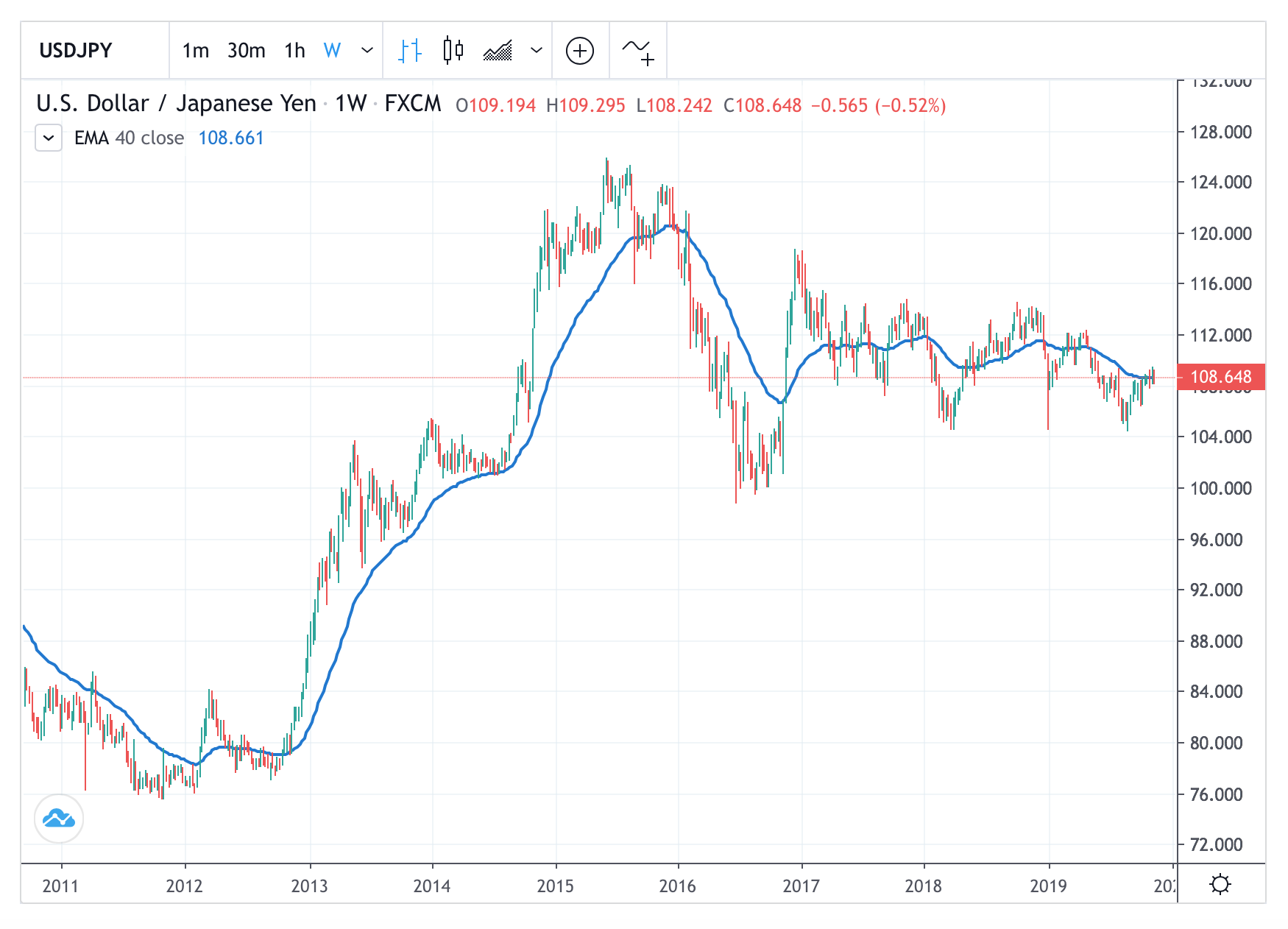
For example, during 2012-2016 the direction of the Japanese Yen was propelled by the Bank of Japan. Especially the Yen was driven down by the massive quantitative easing (QQE) policy enacted by the newly-appointed governor Kuroda. From 78 Yen to the Dollar, the rate plummeted to as low as 124 Yen to the Dollar.
Since that low in 2015, the rate has been trading in a 20-Yen range, occasionally falling to 104 on market setbacks.
Note that the Japanese Yen is a ‘safe haven’ currency. So it tends to strengthen when market uncertainties increase.
What are the costs of trading USDJPY?
We have ranked Pepperstone as the best broker for trading USDJPY based on their spreads of 0.25 pips.
For this ranking of the best forex trading platforms to trade USDJPY we have ranked by which forex broker has the cheapest trading costs.
Given that FX trading are mainly financial trading – without any underlying currencies changing hands, there are a few trading costs you need to be aware of:
- Commission (if any)
- Bid-ask spread (the difference between buying and selling at any time)
- Rollover costs – this is the cost of rolling over current positions
Alternative Forex Pairs For Trading
You can read about the the most liquid forex pairs in our guide to the best forex pairs for trading.
| Rank. | Symbol | FX Pair |
| 1 | EUR/USD | Euro vs US Dollar |
| 2 | GBP/USD | British pound vs US dollar |
| 3 | USD/JPY | US Dollar vs Japanese Yen |
| 4 | EUR/GBP | Euro vs British Pound |
| 5 | AUD/USD | Australian Dollar vs US Dollar |
| 6 | USD/CAD | US Dollar vs Canadian Dollar |
| 7 | USD/CHF | US Dollar vs Swiss Franc |
| 8 | NZD/USD | NZ Dollar vs US Dollar |
| 9 | EUR/JPY | Euro vs Japanese Yen |
| 10 | EUR/AUD | Euro vs Australian Dollar |