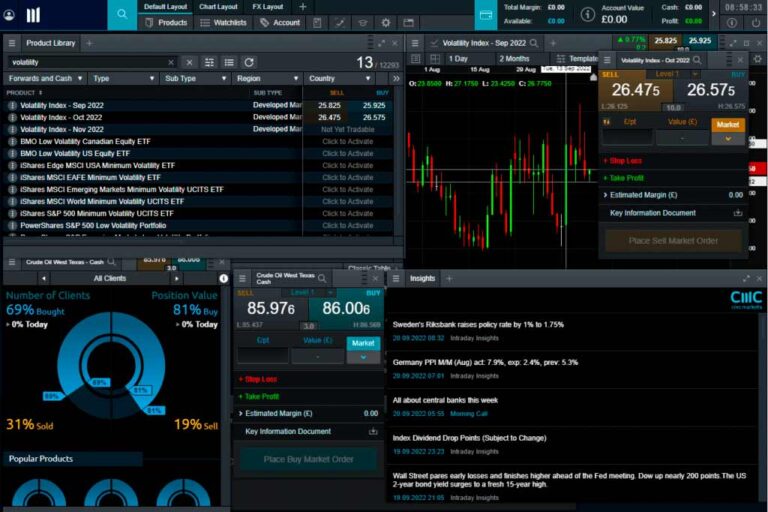
CMC Markets offers CFD trading in the UK as an OTC derivative product and is therefore a market maker. However, it does hedge client positions in the underlying market but does not provide direct market access (DMA trading) to exchange and currency liquidity. But, CMC Markets offers very low CFD and spread betting spreads, as a result of its size, it is able to internalise a good proportion of client orders (match buyers with sellers among its client base).

69% of retail investor accounts lose money
- Good Money Guide experts regard CMC Markets as a leading CFD trading platform, highlighting its competitive pricing and extensive market coverage. They appreciate the unique client sentiment indicators that allow traders to analyse positions by time frame and profitability, although they note the absence of direct market access (DMA) CFDs as a drawback. Overall, experts rate the platform 4.1/5, with strong scores for pricing, market access, and customer service.
- Across 237 user reviews on Good Money Guide, averaging 4.2/5, customers frequently commend the platform's ease of use, quick execution, and reliable customer service. Many users highlight the competitive spreads and comprehensive educational resources, while some suggest improvements for the mobile app's user-friendliness. Overall, the platform is praised for its functionality and support, making it a preferred choice for many traders.
CMC Markets CFD Trading Expert rating
Our expert rating is the average of the areas listed here, each scored out of 5 by our team.Our experts have rated CMC Markets CFD Trading across five key areas of our review framework.
- Pricing4.5
- Market Access4.0
- Online Platform4.0
- Customer Service4.0
- Research & Analysis4.0
Pros
- Excellent CFD trading platform
- Client CFD sentiment indicators
- Tight CFD spreads and pricing
Cons
- No DMA CFDs
See full expert review
Our verdict
CMC Markets is one of the original CFD brokers launched in 1989. They offer access to over 12,000 markets and are known for tight pricing and good trading platform tech.
69% of retail investor accounts lose money when trading CFDs with this provider
Is CMC Markets a market maker for CFD trading?
Yes, CMC Markets is a CFD market marker in more ways than one. CMC operates a b-book dealing desk model where you are trading against them. CMC also provide liquidity as a market marker for smaller brokers to use their trading volumes.
Overall, CMC Markets is an excellent CFD trading platform with good market coverage and very competitive pricing. It’s most suited to short-term CFD traders speculating on the major markets.
One of the main features I like when trading through their platforms that makes CMC Markets stand out is how they present their CFD client sentiment indicators. Most brokers provide sentiment indicators based on what their clients are trading, but CMC enables CFD traders to break down what long and short positions their clients have by time frame and profitability. So you can filter in more profitable traders or longer-term positions.
CMC charges a bid-offer spread on CFDs on indices, commodities, FX and interest rates etc but charges a commission on CFDs over individual stocks and ETFs. Commissions start at 0.10% of the notional value of the trade for UK and European stocks, and at 2 cents per share for CFDs over US equities. Spreads vary by product and contract but are competitively priced relative to peers such as IG and Saxo Markets.
There are some excellent other features as well like thematic indices, share baskets, a wide range of order types, and the ability to enter, work and move orders direct from the charts.
Customer reviews for CMC Markets
Customer ratings come from reviews left on this site. Every review is read and approved before it is published.Based on 237 reviews
- Excellent52%
- Very good22%
- Basic18%
- Poor6%
- Bad2%
Read customer reviews
excellent company
Everything, from data sharing to information sharing to ideas to trade. Really good provider. I love it.
Let not mobile app close it self
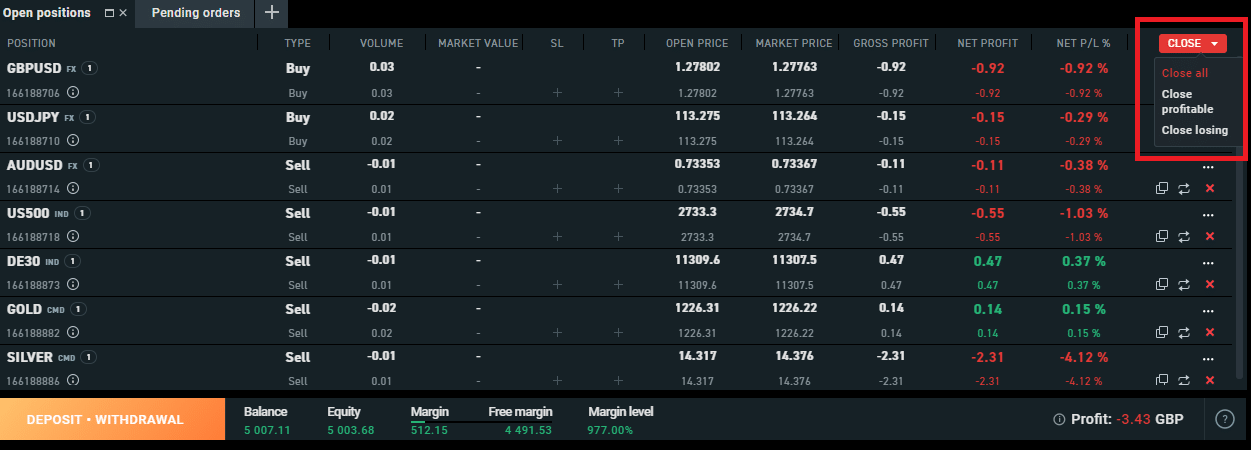
You can close all your positions at one -- one click
Excellente
Customer service
Extremely efficient
Excellent trading platform
Efficient
Tight spreads
Customary
Available anytime you need assistance, their educational videos are explanatory
trustworthy
market price action accuracy and response, good spreads, very easy to use, quick withdraw and depositing
easy
Makes trading easy
Good
Everything, good customer facing service .
transparent
very easy to use interface, most competitive spreads also on futures
Efficient
Gives in formation
Efficient
Web Platform works very well
easy and clear data
Presents the information in a clear way and loads of charts and analysis tools
Don't Play games like IG Markets and other providers
CMC Markets does a number of things exceptionally well. The app is consistently reliable and always available when you need it, which is crucial in fast-moving markets.
One standout feature is how quickly prices become available. For example, when Sunday trading opens, CMC Markets provides pricing almost immediately, whereas other platforms can take several minutes before showing any market activity. That early access can make a real difference.
Another major advantage is the flexibility in position sizing. CMC allows you to take very small positions, unlike some providers that enforce larger minimum contract sizes. This gives you much better control over your risk, which is especially important when trading CFDs and other leveraged products. It makes the platform more accessible and, in my view, safer for managing exposure.
Overall, the combination of reliability, speed, and flexibility makes CMC Markets stand out from many other providers.
Very good
Really good
Very efficient and been using them for years
Customer service and execution very precise and no issues over the years , satisfied customer
Reliable
Ease of execution of trades. Simple to amend trades.
Excellent Service
Great trading platform and a wide range of products
Professional
I always find that CMC customer service always find a solution to any problems i have - this enhances my day to day CFD trading experience.
Excellent broker - used for 10yrs
I've been using CMC Markets for the last 10 years
Compare CMC Markets To Other CFD Brokers
| Name | Logo | CFD Markets | Overnight Fees | GMG Rating | Customer Reviews | CTA | Feature | Expand |
|---|---|---|---|---|---|---|---|---|
 |
CFD Markets 13,500 |
Overnight Fees 2.5% +/- SONIA |
GMG Rating |
Customer Reviews |
Visit Platform 69% of retail investor accounts lose money |
Account Types:
|
|
|
 |
CFD Markets 7,000 |
Overnight Fees 2.5% +/- SONIA |
GMG Rating |
Customer Reviews |
Visit Platform 74% of retail CFD accounts lose money. |
Account Types:
|
|
|
 |
CFD Markets 4,500+ |
Overnight Fees n/a |
GMG Rating |
Customer Reviews |
Visit Platform 65% of retail investor accounts lose money |
Account Types:
|
Capital.com Expert ratingOur expert rating is the average of the areas listed here, each scored out of 5 by our team.
Pros
Cons
Our verdictCapital.com was voted best CFD broker in 2026 and won the People's Choice vote for "Best Trading Account" in the 2025 Good Money Guide Awards and "Best Trading App" in our 2023 awards as they have one of the most intuitive apps for trading the most popular markets globally. Capital.com was founded in 2016 and is a CFD trading platform broker with offices in the UK and around the world. Since then, they have grown to offer over 5,500 tradable assets to 100,000 monthly active clients. Is Capital.com any good for trading?Capital.com has a user friendly and intuitive trading platform and app, that gives access to the most popular financial markets with competitive spreads with the ability to reduce risk by decreasing your leverage. Trading via the app has always been capital.com's forte, and in 202, it won our award for "best trading app" not in part due to the fact that the company CTO has extensive experience in building engaging apps like Candy Crush. What makes Capital.com different? Thumbs up, literally Do you know what one of the most impressive thing about Capital.com is? They put the buy and sell buttons at the bottom of the app. I don't mean that in a facetious way, it's genuinely a brilliant feature. This may not sound like much but it's a good example of how Capital.com has integrated decades of analytics, experience, feedback and customer data into creating a very easy-to-use intuitive trading app from scratch. When Capital.com first became authorised by the FCA back in 2018, I visited their offices in London to have a chat about what they offer. The two main things we discussed were button placement and AI. Trading App But anyway, if you've updated your iPhone to the latest iOS you'll notice that Apple has started moving things to the bottom of the screen, the search bar for instance. This is because, phones are getting bigger, and your thumb can't reach the top of the screen if you are holding it with one hand. This is something that Capital.com figured out would make trading easier 5 years ago. I've just been through a bunch of other trading apps on my phone and still, amazingly enough, none of the other brokers have done this yet.
Capital.com was also the first to integrate artificial intelligence to help you improve your trading, they say, based on the Martingale theory. When I spoke to Chris Demetriou, the head of sales in the UK, he said that the system should give you prompts based on your previous trades. So for example, if you are about to do a trade that is similar to ones you have constantly lost on before, you should get a "are you sure you want to do this" notification. Leverage Control Everybody knows, that one of the main reasons people lose money when trading is overleverage. This could be either from not having enough free cash on account to give your position breathing space, or simply putting on trades that are too risky. One really good feature is that you can change your leverage based on asset class. The default leverage is the max that retail traders in the UK are permitted, but you can change this to 1:1 so you need to fully pay up for positions. A sensible thing to do if you are just getting started, which can help reduce excessive losses. As your experience grows you can increase your leverage accordingly. Hedging You can also set the platform to put on hedging positions, so you can be long and short the same thing at the same time. Why you ask? Well, it can help you run longer-term positions and short-term hedges. This in fact is the very point of CFDs. They were originally hedging tools, and still a good way to protect your long-term investment portfolio against short-term market corrections without having to close off your positions. Customer Support Customer support is pretty good too, you can get in touch via the chat widget on the platform, whatsapp or telegram. When I tested it I got a response within a minute and the issue I had was dealt with quickly (uploading ID to verify my account if you must know). TradingView You can't trade from the charts, but when you have open positions they are overlayed along with your stops and limits, which you can move by dragging and dropping. But, if charting is your thing, you can join the other 78,000 Capital.com customers using and trading from TradingView. Proprietory Tech One thing I quite like though is that instead of relying on third-party software, the Capital.com trading platform is built in-house, and if you want something you can ask for it. For example, previously on the app you could see where an asset is as a percentage relative to the daily range. But, a customer asked, if you could see it in points too. So, that was quickly integrated so that you can now toggle between percentages and points. A small thing, but indicative of a broker that can do things and does do things, rather than just logging a helpdesk ticket. Refinitiv There are no trading signals on the platform or app, but you do get access to Refinitiv reports on US stocks, which give you a good overview of historic and potential future financial health. A good feature for those looking at slightly longer-term positions. Overnight funding Talking of long positions, or longer long positions, Capital.com also display quite clearly what your overnight financing rates are going to be on a daily basis. I'm sure this is a regulatory obligation anyway, but it's done in a way that you can actually see what the price is, rather than an opaque formula. It gives a bit more transparency about how much a position is going to cost you. Investmate If you are new to trading, they have a stand-alone app called Investmate, which puts you through a series of bitesize courses that explain the financial markets. Capital.com also own currency.com if you fancy a punt on crypto, and shares.com so we can expect to see more comprehensive physical investing options soon. |
|
 |
CFD Markets 2,000+ |
Overnight Fees n/a |
GMG Rating |
Customer Reviews |
Visit Platform 76% of retail investor accounts lose money |
Account Types:
|
|
|
 |
CFD Markets 1,200 |
Overnight Fees 2.5% +/- SONIA |
GMG Rating |
Customer Reviews |
Visit Platform 73% of retail investor accounts lose money |
Account Types:
|
Pepperstone CFD Trading Expert ratingOur expert rating is the average of the areas listed here, each scored out of 5 by our team.4.0Very good Our experts have rated Pepperstone CFD Trading across five key areas of our review framework.
Pros
Cons
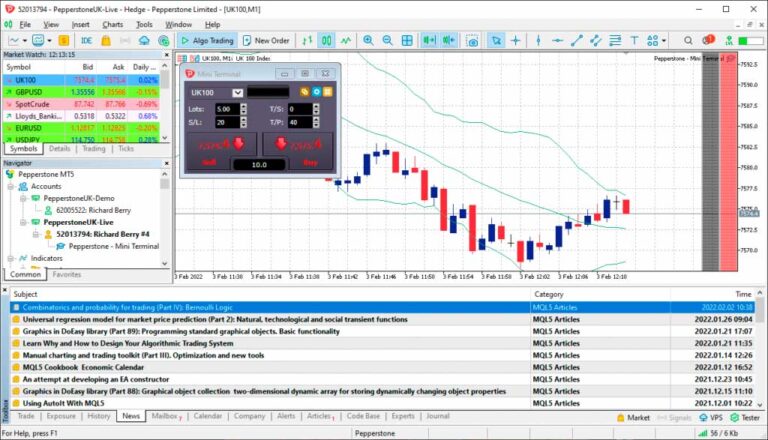
Our verdictPepperstone is a good choice for active CFD traders looking for competitive pricing and a wide choice of trading platforms. You can trade through TradingView, MT4, MT5, cTrader or Pepperstone's own platform and app. Markets include forex, shares, indices, commodities and ETFs, alongside Pepperstone's newer range of perpetual CFDs, which can be traded 24/7 and have no fixed expiry date. Is Pepperstone a good CFD broker?Overall, Pepperstone offers one of the better CFD trading packages for active traders, particularly those who want tight spreads, access to MT4/MT5, TradingView and cTrader, and the ability to run automated trading strategies. When testing Pepperstone, I found its main proposition to be a combination of competitive pricing and platform choice. Its Standard account includes the trading fee within the spread on forex, commodities and indices, while the Razor account provides raw spreads alongside commission-based pricing. MT4 and MT5 are particularly good for traders running automated strategies and Pepperstone provides additional indicators and trading tools. cTrader offers a more traditional trading experience with strong charting and order management, while TradingView is a good option for traders who want to combine its charts and community features with Pepperstone execution. Pepperstone has also expanded its own web trading platform and mobile app, so you are no longer reliant on third-party trading software. What CFDs can you trade with Pepperstone? Pepperstone's CFD range has expanded considerably and now includes more than 90 currency pairs, 1,100 global share CFDs, 20+ major stock indices, 40+ commodities and 90+ ETF CFDs. You can trade major markets including the UK 100, S&P 500, Nasdaq, gold and crude oil, alongside UK, US and international shares. Pepperstone also offers 24-hour trading on selected US share CFDs. One of the most interesting recent additions is Pepperstone's range of perpetual CFDs. Pepperstone Perpetual CFDs Perpetual CFDs are similar to conventional CFDs in that they allow you to speculate on rising or falling prices without owning the underlying asset. However, rather than having an expiry date or referencing a futures contract that periodically needs to roll, Pepperstone's perpetual CFDs have no fixed expiry. They can also be traded 24/7, making them particularly interesting for traders who want to react to news and market movements outside normal exchange opening hours. Pepperstone currently offers perpetual CFDs on markets including the NASDAQ 100, S&P 500, WTI and Brent crude oil and gold, as well as individual stocks and private-market themes including SpaceX. The range also includes major technology stocks such as Nvidia, Tesla, Google and MicroStrategy. Rather than the conventional overnight financing calculation used by standard CFDs, Pepperstone sets the funding rate for its perpetual CFDs weekly in advance and applies it daily. This gives you greater visibility over what it will cost to keep a position open. Perpetual CFDs are available through the same Pepperstone account and can be traded through TradingView, MT5, cTrader and Pepperstone's own platform, so there is no need to open a separate account or use a crypto wallet. The main drawback is that these are proprietary OTC products created and managed by Pepperstone rather than exchange-traded futures. The perpetual CFD range is also much smaller than Pepperstone's overall CFD market list. Pepperstone CFD pricing Pepperstone offers two main CFD account types. The Standard account charges no separate commission on forex, commodity and index CFDs, with Pepperstone's fee incorporated into the spread. Share CFDs are commission-based, with UK share CFD commissions starting from 0.1% per side. The Razor account is aimed more at active traders and offers raw spreads from 0.0 pips on forex CFDs, with commission charged separately. Standard CFDs held overnight can incur swap or rollover charges. Perpetual CFDs work differently, with a funding rate set weekly in advance and applied once per day.
|
|
 |
CFD Markets 10,000 |
Overnight Fees 3% +/- SONIA |
GMG Rating |
Customer Reviews |
Visit Platform 61% of retail investor accounts lose money |
Account Types:
|
Spreadex CFD Trading Expert ratingOur expert rating is the average of the areas listed here, each scored out of 5 by our team.4.2Very good Our experts have rated Spreadex CFD Trading across five key areas of our review framework.
Pros
Cons
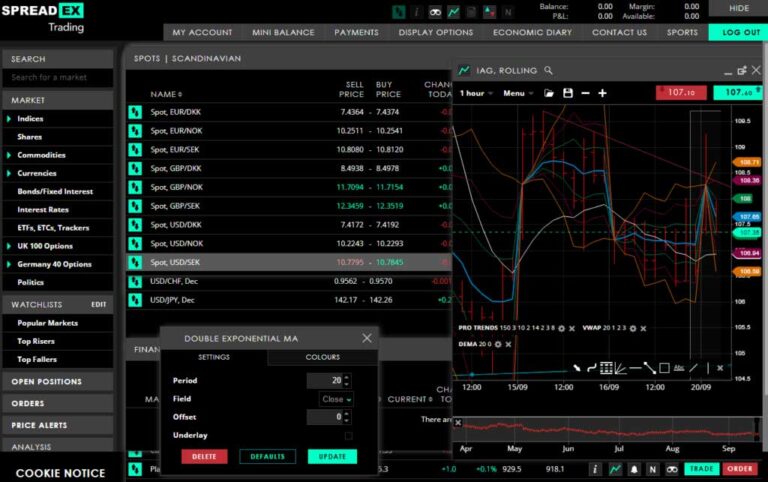
Our verdictSpreadex is a CFD broker that has a huge focus on customer services offers trading on a relatively large amount of markets, 10,000 including lots of smaller UK shares. I’ve used them for about 10 years and know some of the staff well. Is it better to CFDs with Spreadex or spread bet?I would say if you are in the UK it is better to spread bet with Spreadex rather than to trade CFDs. Pricing and market access is exactly the same and the only reason Spreadex started offering CFDs in 2017 was so that they could offer financial trading to non-UK customers. Overall Spreadex is a good CFD broker for traders that want to trade on major and minor shares and put more of a focus on customer service than technology. Spreadex has been providing trading since 1999, but only recently introduced CFD trading in 2017. The trading platform, whilst quite basic, does represent what Spreadex is good at, which is the major markets and customer service. Being a smaller CFD broker they have a bank of experienced dealers who can work orders for you and provide support for the CFD app and platform. Recently Spreadex has become much more competently priced, offering UKX CFD trading with 1 pips spreads, 0.6 pips on EURUSD and 0.2% on UK shares. There is no minimum deposit and no inactivity fee.
|
|
 |
CFD Markets 17,000 |
Overnight Fees 2.5% +/- SONIA |
GMG Rating |
Customer Reviews |
Visit Platform 70% of retail investor accounts lose money |
Account Types:
|
|
|
 |
CFD Markets 21,000 |
Overnight Fees 2.9% +/- SONIA |
GMG Rating |
Customer Reviews |
Visit Platform 69% of retail investor accounts lose money |
Account Types:
|
CMC Markets CFD Trading Expert ratingOur expert rating is the average of the areas listed here, each scored out of 5 by our team.4.1Very good Our experts have rated CMC Markets CFD Trading across five key areas of our review framework.
Pros
Cons
Our verdictCMC Markets is one of the original CFD brokers launched in 1989. They offer access to over 12,000 markets and are known for tight pricing and good trading platform tech. Is CMC Markets a market maker for CFD trading?Yes, CMC Markets is a CFD market marker in more ways than one. CMC operates a b-book dealing desk model where you are trading against them. CMC also provide liquidity as a market marker for smaller brokers to use their trading volumes. Overall, CMC Markets is an excellent CFD trading platform with good market coverage and very competitive pricing. It’s most suited to short-term CFD traders speculating on the major markets. One of the main features I like when trading through their platforms that makes CMC Markets stand out is how they present their CFD client sentiment indicators. Most brokers provide sentiment indicators based on what their clients are trading, but CMC enables CFD traders to break down what long and short positions their clients have by time frame and profitability. So you can filter in more profitable traders or longer-term positions. CMC charges a bid-offer spread on CFDs on indices, commodities, FX and interest rates etc but charges a commission on CFDs over individual stocks and ETFs. Commissions start at 0.10% of the notional value of the trade for UK and European stocks, and at 2 cents per share for CFDs over US equities. Spreads vary by product and contract but are competitively priced relative to peers such as IG and Saxo Markets. There are some excellent other features as well like thematic indices, share baskets, a wide range of order types, and the ability to enter, work and move orders direct from the charts.
|
|
 |
CFD Markets 2,100 |
Overnight Fees +8.5% / -5.8% |
GMG Rating |
Customer Reviews |
Visit Platform 74% of retail investor accounts lose money |
Account Types:
|
XTB CFD Trading Expert ratingOur expert rating is the average of the areas listed here, each scored out of 5 by our team.
Pros
Cons
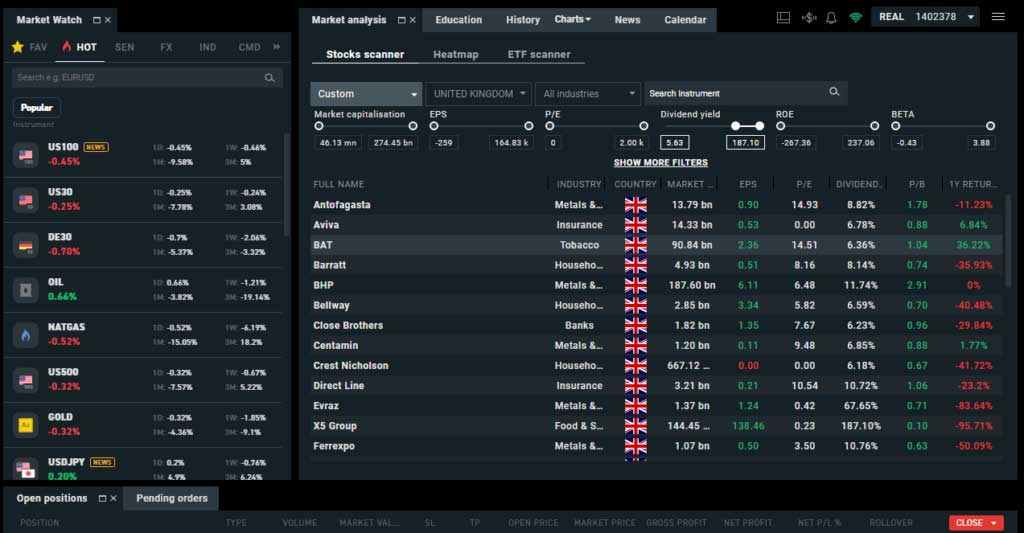
Our verdictXTB’s CFD trading platform offers access to a well voer 2,000 CFD markets including 57 forex pairs, 22 commodities and 25 indices as well as UK, US and international stocks. Is XTB a good CFD broker?Overall, XTB, is a well-established CFD trading platform with some nice added value that is suitable for most traders. When I tested XTBs CFD brokerage I found what sets them apart is some of the platform features. There are also some nice close-off features, so you can close all your CFD positions in one go, or if you want to cut your losses, just close the losers, or if you want to lock in profits you can just close your winning trades. There is a lot of educational content on how to trade from various independent “experts” such as Tom Hougaard, Lee Stanford. As well as different courses on how to understand specific aspects of trading like technical analysis and trading psychology. You also have a comprehensive suite of CFD trader tools like constantly updating market analysis including stock screeners, heatmaps and ETF scanners to help you pick out new trades. There is also an integrated news feed and economic calendar so you can check for upcoming events or news flow that may affect your open positions.
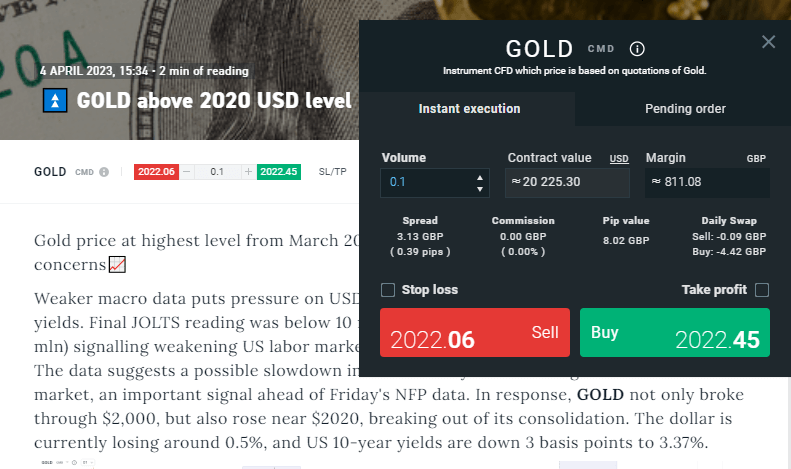
Is XTB CFD trading real DMA or OTC? When you trade CFDs with XTB you are not buying or selling real shares, instead, you are entering into a contract for the difference between the opening and closing prices of your position with the broker. However, if you would rather not trade on fake prices you can buy real shares with XTB's investing plans. XTB’s CFD trading platform offers access to a well over 2,000 CFD markets including 57 forex pairs, 22 commodities and 25 indices as well as UK, US and international stocks. XTB News, Analysis & Trading Ideas All brokers have news, technical analysis, economic announcements and fundamental data. Most even have RanSquark (where your computer shouts at you every time there is a market figure), but XTB also has an integrated dealing ticket so you can trade quickly from the analysis. You can see below in their recent Gold analysis. You can either place a market order to go long or short at your saved standard lot size or bring up a dealing ticket to work a limit.
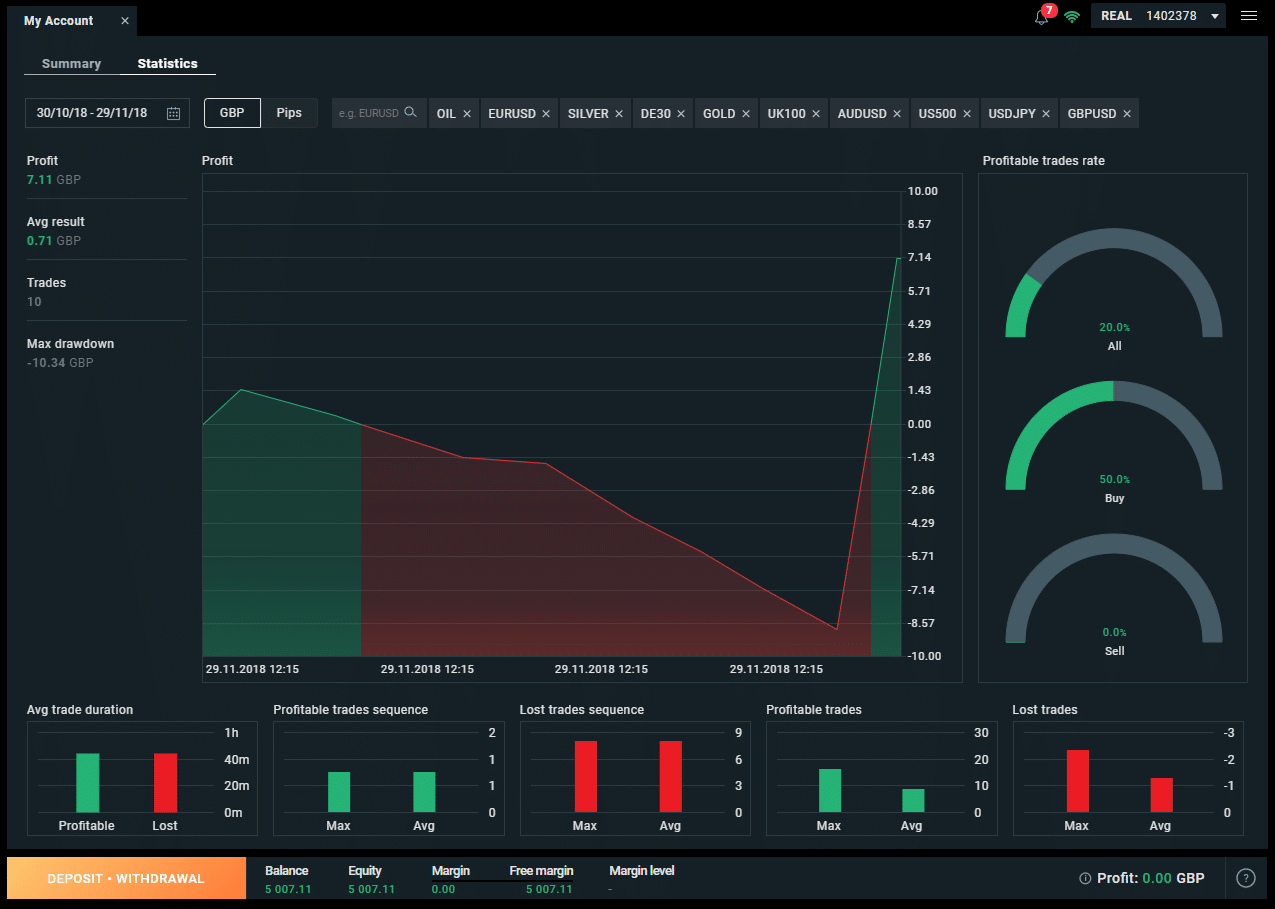
Post-Trade Analysis See a breakdown of what markets and trades you make or lose money. XTB was one of the first brokers to introduce post-trade analysis, and this sits nicely alongside their ethos of trading to educate their clients rather than churn and burn them. You can see a recap of your previous trades in your account settings. This gives a very visual representation of which trades you make and lose money on. This is a really interesting feature because, as we all know, it’s hard to make money trading. But oddly enough it’s not that hard to pick winners. Picking on Josh again, we highlighted an article he wrote (The truth about whether trading is actually winnable) way back in 2014, showing that the profitable trades were around 60%. It’s just that the losses were larger than the profits. This suggests that it is a post-trading strategy that is the issue. Not picking trades. So, by using this section to evaluate which trades you most frequently win on you should be able to improve your overall trading strategy.
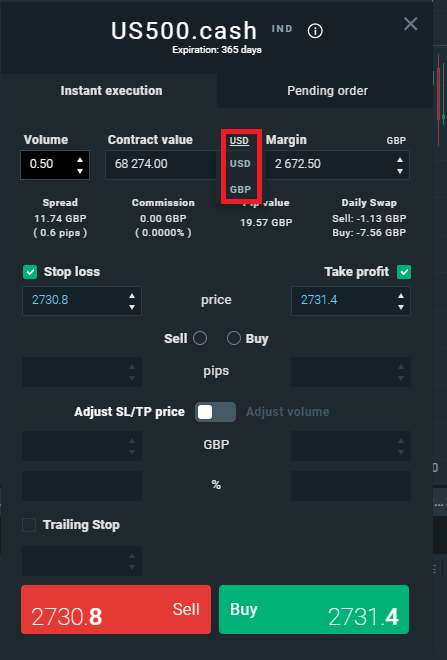
Account Base Currencies You can change your base currency in XTB by setting up different sub accounts. This may not seem like a big deal on the surface, but it’s actually a really nice feature. One thing traders never really take into account when trading international markets is currency exposure. Even when trading Forex, traders tend to just look at what is happening on the chart and not the overall economic climate. Trading profits are hugely affected by currency exposure and in some cases can wipe out profits. Also, as tight as deliverable foreign exchange rates are becoming they are still always never below 0.5%. So if you are in the UK with GBP on account and trading US products your P&L will be in USD. This will then have to be converted into GBP before you can withdraw (unless you want to be at the mercy of your banks tourists rates (which you don’t)). But, if you go to your 'My Accounts' page you can open up sub accounts in GBP, USD, or EUR. So, if you have a strategy that mainly relies on non-local currencies you can reduce your FX fees and currency exposure. You can also change the currency in the dealing ticket, between local and base currency, which can give you more control over your position exposure. This is particularly helpful, when FX markets are volatile.
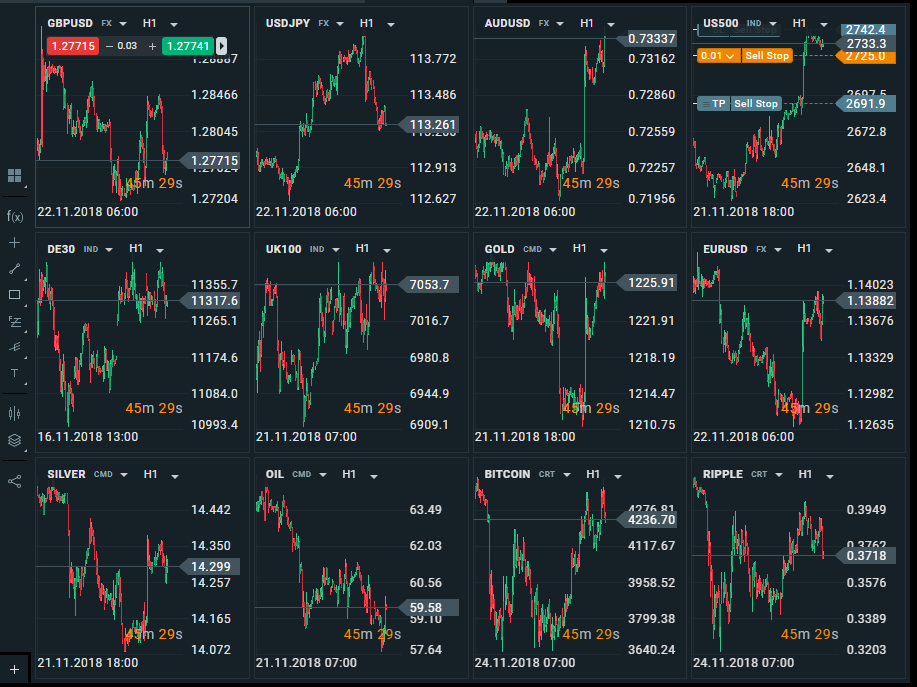
Chart Grids You can get an instant macro market overview in XTB with grid charts. When I first started off as a stockbroker many decades ago we used this pricing system called QTS. It’s long gone now, but it had this great feature where you could get a grid view of a market with a single click. It was a great default view so you can instantly see what was going up or down without having to have multiple screens up. I know you can set this up manually on most other brokers, but other than CMC, I don’t think it’s that easy anywhere else. XTB, have a really nice feature where you can see all your open charts as a grid. A very handy visual overview of what is going on. Plus, if you’ve got a pending order you can see the levels on the chart. When I took the below screenshot I had a working stop entry in US500 (top right).
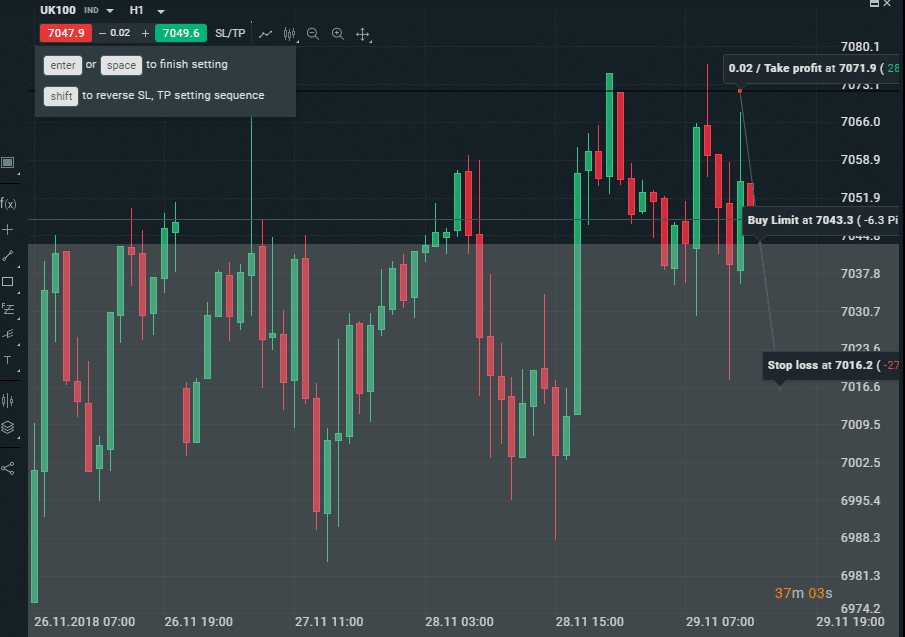
Trade From The Charts You can add market orders, stops entries, limits and stop losses by clicking directly on the charts. A lot of other brokers let you trade from the charts, which is an almost essential feature. Because let’s face it, you either place stops at support and resistance levels or base them on how much you want to win or lose. So it’s quite nice to set your P&L limits then move your orders based on what the chart looks like. However, what is unique to XTB (as far as I know) is the ability to place stop entries, stop losses and limits straight onto the chart. The first click is where you want to buy, second your stop loss and third your limit. You basically draw your trade on the chart and it is created in the dealing ticket.
Closing Off Positions You can close all, profitable or losing trades in one go This is a nice feature to end off our XTB review. When you are done for the day, or popping off to the shops, you can select what trades you want to close. It’s really annoying when you have to click on twenty different trades to close them out when you want to be flat. So on the XTB 'Open Positions' tab you can choose to close either all your trades or just the duds that are losing. Or, you can bank your profits by closing all the winners and leave your losers to either get stopped or reverse. But I shall leave it to you to decide if that is a sensible trading strategy.
|
|
 |
CFD Markets 7,000 |
Overnight Fees 1.5% +/- SONIA |
GMG Rating |
Customer Reviews |
Visit Platform 59.7% of retail investor accounts lose money |
Account Types:
|
Interactive Brokers (IBKR) CFD Trading Expert ratingOur expert rating is the average of the areas listed here, each scored out of 5 by our team.4.7Excellent Our experts have rated Interactive Brokers (IBKR) CFD Trading across five key areas of our review framework.
Pros
Cons
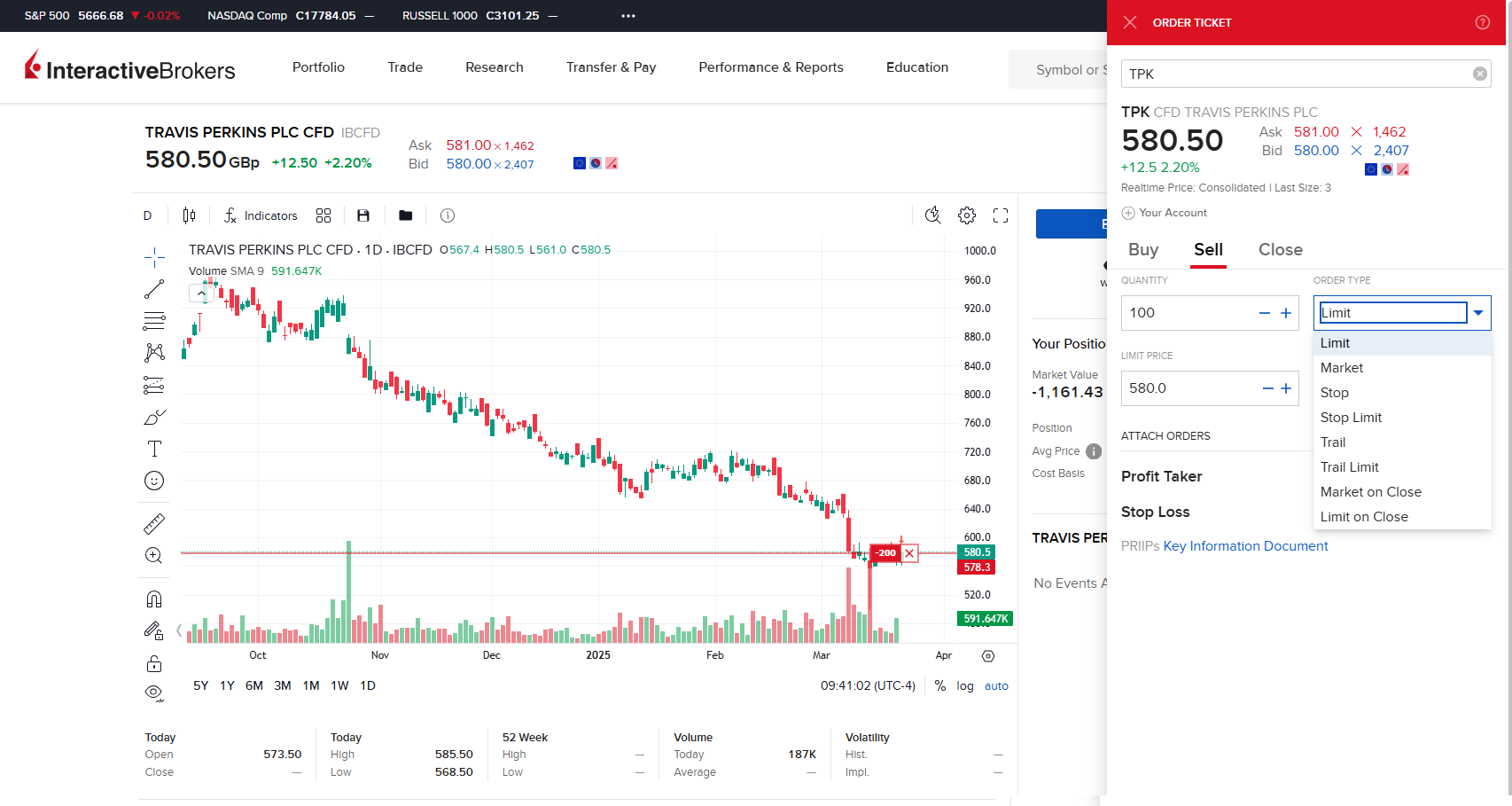
Our verdictIBKR offers CFD trading on around 8,500 markets including 100 forex pairs, 20 commodities, 13 indices, and thousands of international stocks. I’ve traded through IBKR a fair bit and there is no doubt that Interactive Brokers CFD offering is one of the best around. Can you trade CFDs with Interactive Brokers (IBKR)?Yes, you can trade CFDs or contracts for difference with Interactive Brokers, but you have to go through some quite arduous suitability tests to ensure that you understand the risks involved. But once you are in, I found Interactive Brokers to be one of the best CFD brokers, most appropriate for experienced and sophisticated CFD traders. However, it also has lighter versions of its Workstation downloadable trading platform on the portal for newer traders who may want to stick with one platform as they become more experienced. Trading Platforms: There are two different platforms, which I tested by short-selling Travis Perkins as a CFD. We discussed TPK in our podcast, and the general consensus in the comments on TikTok was that everyone hates them and that it's too expensive. You can see below examples of both trading platforms and how different they look. The downloadable platform Workstation lets you trade CFDs with the most types of order execution with IBKR, for instance, VWAP, pairs trading, time and price-sensitive order entry. These tools are most suited to professional and very high-volume traders, or hedge funds that are working very large orders and don’t want to scare the market. Most retail CFD traders will have no need for them, but it is representative of IBKRs overall service in that it provides an exceptional institutional-grade CFD platform to retail clients. There is also an excellent pairs trading feature where you can simultaneously trade one CFD stock against another as a percentage. IBKR is the only CFD broker that lets you do this. With other trading platforms you have to do two separate orders.
As you can see from when I shorted TPK on the Portal web-based version it is much simpler. But you still get some good order execution types, but it's very much for retail CFD traders compared to IBKR Workstation which is for professionals.
Market Access: Whilst Interactive Brokers does not offer the most CFD markets, they do offer one of the best ways to trade them. With IBKR CFDs you can trade with direct market access (DMA) on the exchange so you can place your orders directly on the order book at better prices than the bid/offer. In reality, CFD brokers with the most markets are those that offer access to small or illiquid stocks which are probably not suitable for CFD trading anyway. But, IBKR offers access to the majority of stocks and markets most traders could need. CFD Fees: The commission is charged post-trade so you get clean prices with no mark-up and IBKRs commission rates (added post trade) are the best around. Commission on UK stocks is 0.02% and 0.003% on US stocks. Out-of-hours Trading: IBKR lets you trade CFDs on US stocks, indices, commodities and currencies overnight and on some parts of the weekend. Overnight trading starts from 8pm US ET time on Sundays and for those with US stock trading permission you get access to free overnight data. CFDs on restricted ETFs: You can also trade ETFs as a CFD that you otherwise would not be able to invest in if based in the UK. One of the major drawbacks of ETFs listed in the US is they do not provide a Key Information Document (which tells you what is in them and how risky they are), so the UK regulators won't let UK investors buy them as they are not transparent. However, with IBKR you can trade these as a CFD (which is an OTC product). |


Richard is the founder of the Good Money Guide (formerly Good Broker Guide), one of the original investment comparison sites established in 2015. With a career spanning two decades as a broker, he brings extensive expertise and knowledge to the financial landscape.
Having worked as a broker at Investors Intelligence and a multi-asset derivatives broker at MF Global (Man Financial), Richard has acquired substantial experience in the industry. His career began as a private client stockbroker at Walker Crips and Phillip Securities (now King and Shaxson), following internships on the NYMEX oil trading floor in New York and London IPE in 2001 and 2000.
Richard’s contributions and expertise have been recognized by respected publications such as The Sunday Times, BusinessInsider, Yahoo Finance, BusinessNews.org.uk, Master Investor, Wealth Briefing, iNews, and The FT, among many others.
Under Richard’s leadership, the Good Money Guide has evolved into a valuable destination for comprehensive information and expert guidance, specialising in trading, investment, and currency exchange. His commitment to delivering high-quality insights has solidified the Good Money Guide’s standing as a well-respected resource for both customers and industry colleagues.