

St James’s Place Wealth Management Customer reviews
Customer ratings come from reviews left on this site. Every review is read and approved before it is published.Based on 1 review
- Excellent0%
- Very good0%
- Basic0%
- Poor0%
- Bad100%
Read customer reviews
Sharks who steal your money
My parents invested in SJP for decades. My inheritance was left in their hands. Since their deaths two years ago I have been trying to encash my inheritance, but SJP will not release it all. There has been endless filibustering from them although the fact that the money is mine is not in dispute. Yet still they will not release my money unless ‘I can prove that I will be dying soon or otherwise am in desperate need of the money. I cannot understand how they can legitimately withhold my money by sitting in judgement of my condition either financial or physical. We both agree the money is mine, but they simply will not release it to me. It has been hell trying to extract a proper reason from them. Meanwhile the money dwindles as they pull from it for their ‘expertise’. You could not make this up!
Leave a review
St James’s Place Alternative Wealth Managers
| Name | Logo | Minimum | Initial Fees | Ongoing Fees | Customer Reviews | CTA | Tag | Feature | Expand |
|---|---|---|---|---|---|---|---|---|---|
 |
Minimum £250,000 |
Initial Fees 1%-2% |
Ongoing Fees 0.6%-1.5% |
Customer Reviews |
Featured Wealth Manager |
Features:
|
|
||
 |
Minimum £1 |
Initial Fees £0 |
Ongoing Fees 0.1%-0.45% |
Customer Reviews |
Features:
|
Moneyfarm Expert ratingOur expert rating is the average of the areas listed here, each scored out of 5 by our team.
Pros
Cons
Our verdictMoneyfarm is a digital wealth manager that aims to make personal investing simple and accessible. It was launched initially in Italy in 2012 by Italian bankers Paolo Galvani and Giovanni Dapra and entered the UK in 2016 and has big-name financial backers such as Allianz Global Investors, Cabot Square Capital, United Ventures and Poste Italiane. Is Moneyfarm any good for wealth management?Yes, Moneyfarm is more of a digital wealth manager rather than a robo-advisor as the portfolios are put together by investment managers, rather than automatically. The automation, as it were, is fine-tuning your portfolio to match your risk/reward choices. Unlike with other robo-advisors, with Moneyfarm you can also top up your portfolio with individual shares and ETFs. Fees: Moneyfarm charges 0.75% to 0.6% up to £100k then 0.45% to 0.35% over £100k. Moneyfarm investing account fees are scaled between 0.75% for accounts between £500 and £50,000, then above £100k are 0.45% to 0.35%. Average investment fund fees are 0.2% and the average market spread when buying and selling is 0.10%. Market Access: You can invest in 7 pre-made portfolios, but also (unlike a lot of other digital wealth managers and robo-adviors) also buy individual shares, ETFs, bonds and mutual funds online. It’s a bit of a shame you can’t buy US stocks, But Moneyfarm is best really for setting up regular investments in a GIA, ISA or SIPP, then letting them grow over time without too much tinkering and speculating on Tech stocks. App & Platform: It’s really easy to use, plus it puts you through your paces to make sure you understand what you are investing in. Apparently, my Moneyfarm investor profile is “pioneering”, which means I want to take on more risk for potentially better returns. Customer Service: This is mostly online as you’d expect but solves all issues – I’ve had some good calls with Moneyfarm about how its products work over the years, and its people really know their stuff. If you want to find out more about the ethos, you can read my interview with the CEO Giovanni Daprà on how they are so much more than a robo-advisor. Research & Analysis: Not much to speak of other than a few guides, but that’s ok, as I don’t really want Moneyfarm spamming me with stock trading ideas.
|
|||
 |
Minimum £100 |
Initial Fees £299 |
Ongoing Fees 0.75% – 1.15% |
Customer Reviews |
Features:
|
Octopus Money Expert ratingOur expert rating is the average of the areas listed here, each scored out of 5 by our team.
Pros
Cons
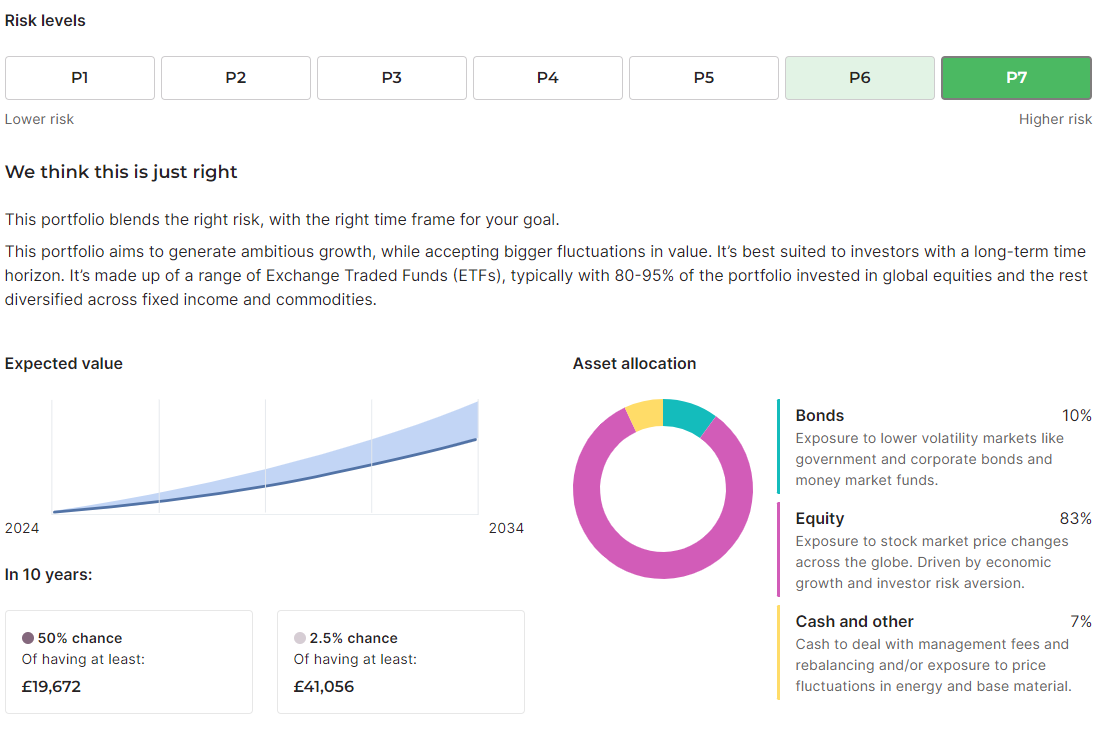
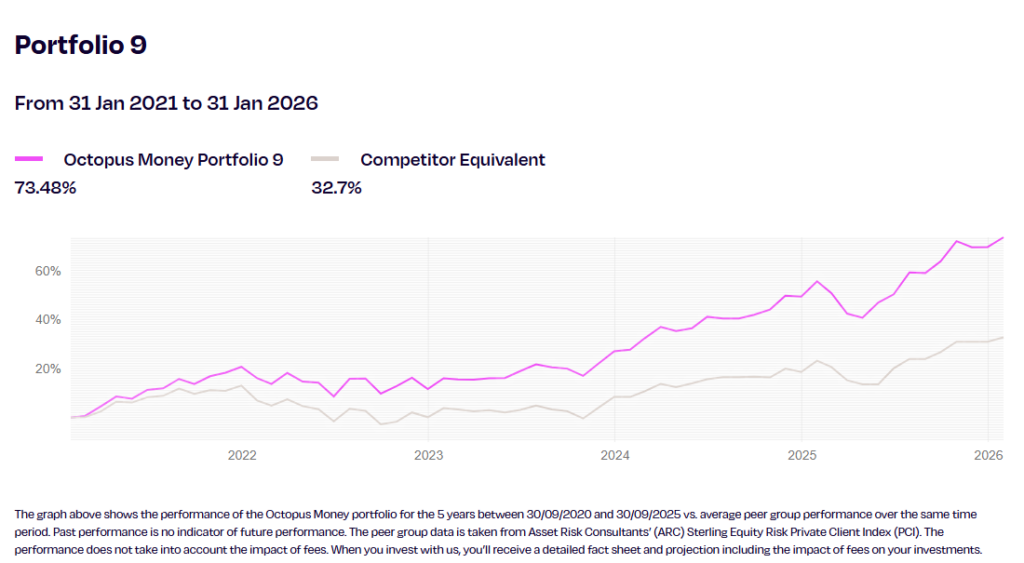
Our verdictOctopus Money starts with a free video chat to explain its service, costs, and build your financial profile. A personalised financial plan costs from £299, with one-to-one sessions focused on your goals and a clear, visual forecast of your finances, alongside practical next steps. For ongoing support, you can opt into regulated advice from around 1.15% all-in. This includes tailored investment and pension recommendations, portfolio management, and continued access to a financial adviser, helping you stay on track and adapt your plan as your circumstances change. Octopus Money Offers Financial Coaching For Fixed FeePricing: The one off fixed coaching fee of £299 is a great way to get started. But if you want ongoing regulated investment advice 1.15% is inline with what traditional wealth managers charge for financial planning. If not, ongoing fees are 0.75% per year. Market Access: You can invest in a pension, stocks and shares ISA or general investment account through 10 different Octopus Portfolios (graded by risk).
App & Platform: Both simple to use. Customer Service: One of the key advantages of octopus money is access to experienced coaches and regulated advisors as and when you need them. Research & Analysis: As with customer service, you get tailised guidence and advice based on your individual circumstances. |

Is now a good time to buy St James’s Place shares?
The shares of financial adviser St James ‘s Place sold off by -13.39% yesterday. The reason the emergence in the US of a new platform that will allow financial advisors to create bespoke tax-efficient planning for their clients. In other words Ai is helping to automate and speed up, and personalise the advisors job, and

SJP’s tiered charges for initial advice revealed by Citywire
St James’s Place (SJP) is set to introduce three new tiers of charges for financial advice, as it moves away from its current fee model. A presentation by the advice group showed the new plans being put forward for SJP’s tiered charges to bill clients based on the size of their pot, Citywire reported on

St James’s Place value assessment report finds it could do (a lot) better
St James’s Place, one of Britain’s largest wealth management groups, has released its annual value assessment report. The results of which have raised eyebrows, and questions, about the value that the firm provides to investors. St James’s Place has admitted to failing to offer value for money in 36 out of 45 of its funds.

How to switch from St James’s Place Wealth Management
This week’s news that the UK’s largest wealth manager St. James’s Place, was removing exit fees from its range of pensions and investment bonds raises the possibility of clients being able to switch wealth managers without penalty if they are unhappy with the service and performance they are currently receiving. Switching from St James’s Place
Who owns St James’s Place Wealth Management?
St James’s Place is a public company listed on the London Stock Exchange, which trades under the ticker of SJP. The company has a market cap of £3.73 billion, a PE ratio of just over 10.0 times earnings, and a prospective dividend yield of 7.79%. But who owns shares in one of the largest wealth

St James’s Place removes its exit fees from several key products
St James’s Place will remove the exit charges from several of its key products going forward, following pressure from the regulators and the new consumer duty initiative. St James’s Place removes exit fees Wealth manager St James’s Place or SJP as it is often referred to, has announced an overhaul of its fee structure, including