
Zopa has doubled the cashback rate on household bills for customers using its Biscuit current account, as banks continue competing for savers and current account customers amid ongoing cost-of-living pressures.
The challenger bank announced that new customers opening a Biscuit current account during the promotional period will receive 4% cashback on eligible household bills paid by direct debit, up from the previous 2% rate. The enhanced cashback applies to up to £2,000 of direct debits per year and will remain in place for 12 months after opening the account.
The offer is designed to help consumers offset rising essential costs such as energy bills, broadband and council tax, with further increases to energy prices expected later this year. Customers must open the account through the Zopa app and set up direct debits to qualify for the cashback.
Alongside the cashback increase, Zopa says the Biscuit account also offers 7.1% AER on up to £300 monthly deposits into its linked regular saver and 2% AER interest on current account balances.
The move comes as challenger banks and traditional providers continue battling for market share by offering higher savings rates, cashback incentives and app-based banking features. Cashback current accounts have become increasingly popular as consumers look for ways to earn rewards on everyday spending rather than relying solely on interest rates.
Clare Gambardella, Chief Customer Officer at Zopa Bank, said the bank wanted to help customers “get more money back as they pay” rising bills, adding that the increased cashback could help households continue progressing towards their financial goals despite financial pressures.
Zopa launched the Biscuit current account in June 2025 and says it has attracted hundreds of thousands of customers within its first year. The bank describes the account as the UK’s “best free current account for everyday value”, claiming customers can earn up to £242 per year through a combination of cashback and interest.
The promotional 4% cashback offer is currently scheduled to run until the end of May, with the bank saying it will review the campaign again in June.
What’s the catch?
The main catch with Zopa’s Biscuit current account is that the headline 4% cashback only applies to eligible Direct Debit household bills rather than everyday card spending, and the boosted rate is temporary for new customers opening the account during the promotion.
There are also limits on how much cashback you can earn, the account is app-only with no branches or cash deposits, and customers currently need to move Direct Debits manually because it does not support the full Current Account Switch Service.
However, it still stands out because there is no monthly fee, it pays interest on current account balances, includes fee-free overseas spending, and offers one of the market’s highest regular saver rates.
How does it compare to other savings accounts?
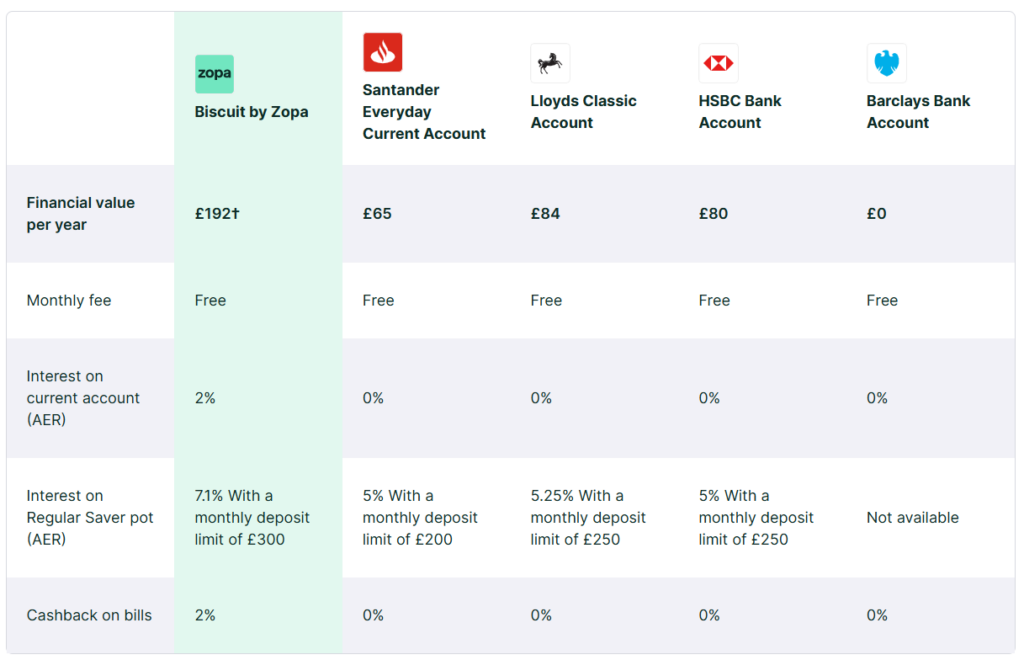
Based on Zopa’s comparison, the Biscuit account appears significantly more rewarding than standard high street current accounts because it combines several features that are usually separated across multiple products. The table shows Biscuit offering an estimated £192+ annual value, compared with £65 for Santander, £84 for Lloyds, £80 for HSBC and effectively nothing for Barclays.
The biggest difference is that Zopa pays 2% interest on current account balances, offers a market-leading 7.1% regular saver on up to £300 monthly deposits, and includes cashback on household bills, benefits the other accounts largely do not provide.
However, the comparison is slightly selective because it focuses on free mainstream current accounts rather than the very best standalone savings accounts or premium reward accounts elsewhere in the market. So while Biscuit looks excellent as an all-in-one everyday banking and savings product, people with larger cash balances could still earn more by separating their current account and savings into specialist accounts.

Richard is the founder of the Good Money Guide (formerly Good Broker Guide), one of the original investment comparison sites established in 2015. With a career spanning two decades as a broker, he brings extensive expertise and knowledge to the financial landscape.
Having worked as a broker at Investors Intelligence and a multi-asset derivatives broker at MF Global (Man Financial), Richard has acquired substantial experience in the industry. His career began as a private client stockbroker at Walker Crips and Phillip Securities (now King and Shaxson), following internships on the NYMEX oil trading floor in New York and London IPE in 2001 and 2000.
Richard’s contributions and expertise have been recognized by respected publications such as The Sunday Times, BusinessInsider, Yahoo Finance, BusinessNews.org.uk, Master Investor, Wealth Briefing, iNews, and The FT, among many others.
Under Richard’s leadership, the Good Money Guide has evolved into a valuable destination for comprehensive information and expert guidance, specialising in trading, investment, and currency exchange. His commitment to delivering high-quality insights has solidified the Good Money Guide’s standing as a well-respected resource for both customers and industry colleagues.