Planning for retirement can feel overwhelming, but a pension calculator is one of the quickest ways to find out whether you’re on track. Whether you’re saving into a workplace pension, a personal pension or a Self-Invested Personal Pension (SIPP), our free calculator helps estimate how much your pension could be worth when you retire and whether you’ll have enough income to support your lifestyle.
How To Use Our Pension & SIPP Calculator
This guide explains what information you’ll need, how the calculator works and how to understand your results.
What does the Pension & SIPP Calculator do?
Our Pension & SIPP Calculator estimates:
- How much your pension pot could be worth at retirement.
- Your projected annual retirement income.
- Whether you’re on track to meet your retirement goals.
- How increasing contributions or retiring later could improve your retirement income.
Rather than guessing whether you’re saving enough, the calculator gives you a personalised projection based on your own circumstances.
What information do you need?
Before you start, it’s helpful to have the following details:
- Your current age.
- The age you’d like to retire.
- The current value of your pension or SIPP.
- How much you contribute each month.
- How much your employer contributes (if applicable).
- Your annual salary (if requested).
- Any other retirement income you expect to receive.
Don’t worry if you don’t know every figure exactly. Pension calculations are estimates, so reasonable approximations are usually sufficient.
Step 1: Enter your current age
Your age is one of the biggest factors affecting your retirement savings.
The earlier you start investing, the longer your money has to benefit from compound investment growth. Even small monthly contributions made over several decades can grow into a substantial pension pot.
Step 2: Choose your retirement age
Next, enter the age you hope to retire.
This determines how many years your pension has left to grow before you start drawing an income.
Try experimenting with different retirement ages. Delaying retirement by just a few years can often make a significant difference because:
- Your investments have longer to grow.
- You’ll usually contribute for longer.
- Your pension needs to provide income for fewer years.
Step 3: Enter your current pension value
This is the total value of all your defined contribution pensions or SIPPs.
You can usually find this on your latest pension statement or by logging into your pension provider’s online account.
If you have several pensions, you can either:
- Add their values together.
- Run separate calculations for each pension.
If you’ve lost track of an old pension, it’s worth finding it before calculating your retirement income, as many people have forgotten pension pots from previous employers.
Step 4: Add your monthly pension contributions
Enter how much you currently save each month.
If you’re employed, include:
- Your own pension contributions.
- Your employer’s contributions where possible.
If you’re using the calculator for a SIPP, simply enter your own monthly contributions.
One of the most useful features of the calculator is testing different contribution levels. Increasing monthly contributions—even by £50 or £100—can have a surprisingly large impact over several decades thanks to compound growth.
Step 5: Review your projected pension income
Once you’ve entered your information, the calculator estimates:
- Your projected pension pot.
- Your estimated annual retirement income.
- Whether you’re likely to have enough to fund your retirement.
Remember these are forecasts rather than guarantees. Investment returns, inflation and future pension rules can all affect the final outcome.
How much income will you need?
Everyone’s retirement is different.
However, the latest Retirement Living Standards suggest that a single person currently needs approximately:
- £13,900 per year for a minimum retirement lifestyle.
- £32,700 per year for a moderate retirement.
- £45,400 per year for a comfortable retirement.
Couples generally need higher combined incomes, although shared living costs reduce the amount needed per person. These figures provide a useful benchmark when comparing your projected retirement income.
What if you’re not on track?
If the calculator suggests you may fall short of your retirement income target, don’t panic.
There are several ways to improve your retirement prospects:
- Increase your monthly pension contributions.
- Make additional one-off pension payments.
- Maximise employer matching contributions if available.
- Consolidate old pension pots where appropriate.
- Delay retirement by a few years.
- Review your investment strategy.
Even relatively small increases made early can make a meaningful difference over time.
Why use a SIPP calculator?
A Self-Invested Personal Pension (SIPP) gives you greater control over how your retirement savings are invested.
If you invest through a SIPP, using a pension calculator helps answer important questions such as:
- Am I saving enough?
- What could my pension be worth at retirement?
- How much monthly income could it provide?
- What happens if I increase my contributions?
- Can I afford to retire earlier?
Running different scenarios can help you make informed decisions long before retirement.
Remember: A pension calculator is only an estimate
No pension calculator can predict the future with complete accuracy.
Investment returns, inflation, tax rules and your personal circumstances may all change over time. That’s why it’s worth reviewing your pension every year and updating your calculations as your salary, savings and retirement plans evolve.
The earlier you start planning, the more options you’ll have—and the easier it is to make small changes today that could significantly improve your retirement income tomorrow.
Ready to start your pension? Choose a UK FCA-regulated pension provider
| Name | Logo | GMG Rating | Customer Reviews | Pension Fees | Minimum Deposit | CTA | Tag | Feature | Expand |
|---|---|---|---|---|---|---|---|---|---|
 |
GMG Rating |
Customer Reviews |
Pension Fees £210 |
Minimum Deposit £1 |
Featured |
Features:
|
|
||
 |
GMG Rating |
Customer Reviews |
Pension Fees £155.88 |
Minimum Deposit £1 |
Features:
|
interactive investor Pensions Expert ratingOur expert rating is the average of the areas listed here, each scored out of 5 by our team.5.0Excellent Our experts have rated interactive investor Pensions across five key areas of our review framework.
Pros
Cons
Our verdictInteractive Investor offers the most investment options in the UK SIPP markets. With II you can invest more than 40,000 domestic and international shares, ETFs, bonds and over 3,000 funds (AJ Bell has 2,000 and HL offers 2,500 funds). Is Interactive Investors' SIPP (pension) any good?Yes, interactive investor won "Best SIPP Provider" in the 2025 Good Money Guide Awards. ii has a really good pre-selected fund section, which makes crucial SIPP asset allocation decisions much easier. It's very low cost too, with excellent education and research, and a huge range of investments to choose from. The key advantage of interactive investor’s SIPP is that it has a flat-fee structure. This means that annual account charges do not increase as your pension pot grows in size. This structure can help those with larger SIPP portfolios save on fees, however it can be a little expensive for small pensions if you are just starting to invest for your retirement. For smaller pension pots, those that just want to invest in ETFs, InvestEngine offer a free SIPP, but it is limited to just UK-listed ETFs, so you can't buy individual shares. One of the good things about ii's SIPP is that you can buy bonds, gilts, and shares in small and large UK and international companies. Even though ii charges £3.99 for buying funds. If you compare this to Hargreaves Lansdown, which does not charge for buying and selling funds, but HL SIPP fees are higher. If you have £100,000 in your SIPP with ii you'd pay £71.88 a year, versus HL where your fees would be £450. So, if you have a big pension, is it worth moving it to ii? Well, yes at the moment, as interactive investor claim their SIPP pricing can give you an additional £68,467 towards your pension after 30 years compared to HL. Plus, if you transfer your SIPP to ii before 31st August, you can claim up to £2,000 in cash back.
Of course, you’ll need to add cash or start a transfer of a minimum value of £10,000 to qualify for your cashback reward. Terms apply. |
|||
 |
GMG Rating |
Customer Reviews |
Pension Fees 0.6% - 0.3% |
Minimum Deposit £5,000 |
Features:
|
Wealthify Pension Expert ratingOur expert rating is the average of the areas listed here, each scored out of 5 by our team.
Pros
Cons
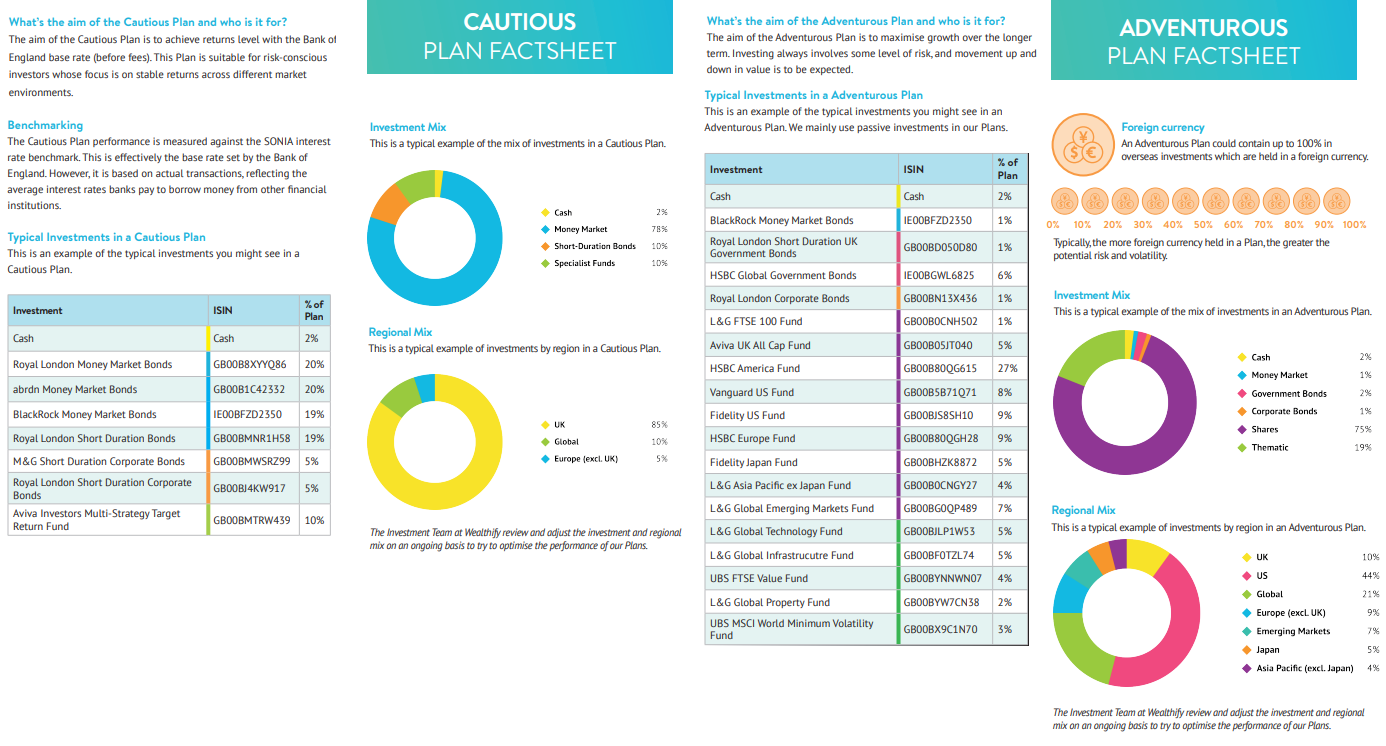
Our verdictOverall we rate Wealthify as a good managed pension as they won Best Private Pension Provider 2025 in the Good Money Guide Awards, but it is not a SIPP pension as you cannot invest in individual shares, instead you pick one of their portfolios based on how much risk you want to take, so it's more of a private managed personal pension. Wealthify is authorised and regulated by the Financial Conduct Authority and owned by Aviva. Is Wealthify's pension any good?Wealthify won "Best Pension" in the 2025 Good Money Guide Awards as it lets you invest either in an original portfolio of investments from the UK and overseas or choose an ethical investment plan made from a blend of environmentally and socially responsible investments. Pension Fees: Wealthify has recently cut management fees for SIPP accounts holding more than £100,000 by introducing a tiered charging structure. Any amount above £100,000 in Wealthify Personal Pension accounts will be charged at a lower annual fee of 0.3%, putting the service in a very competitive position against other providers. This represents a reduction on the offering’s standard annual fee of 0.6% on balances up to £100,000. Both fees are charged monthly. In real terms, that means if you have £200,000 in your Welathify pension, your fees will now be £300 a year lower The updated pricing structure is aimed at enhancing the appeal of Wealthify’s SIPP, particularly among more affluent clients. Wealthify chief executive Richard Ambrose said: “Too many people are unaware of what they are paying in fees. It’s our duty as pension providers to make this clear. Fees are charged as a percentage of the pension pot, so the more you put in, the more fees will eat into your retirement savings. “Whatever stage people are at with their pensions, I hope Wealthify’s new tiering inspires them to review their fees and vote with their feet so that they aren’t paying more than they need to.” By introducing tiered fees, Aviva-owned Wealthify's SIPP offering comes in line with its direct digital wealth manager competitors Nutmeg and Moneyfarm, as well as other personal pension providers. Moneyfarm for example have slightly higher tiered management fees depending on the amount of assets held in their SIPPs. Wealthify’s decision to cut its pension management fees on sums above £100,000 to 0.3% puts it in a more competitive position. Its “Fixed Allocation” service carries a fee of 0.45% up to £100,000 and then 0.25% on further investments. It is important to note that these charges concern only the management of the SIPP and do not account for other costs such as the fees of funds (average fund fees for Original portfolios are 0.14%, and for Ethical: 0.46%) in which portfolios are invested or transaction fees. Market Access: You can only invest in either an Original Plan or an Ethical Plan with Wealthify, so you can't buy individual shares. So Wealthify's pension is better for those who just want to invest passively without being too involved. Once you have chosen your plan, you can then decide how much risk to take on by setting your pension from cautious to adventurous. You can see the difference in how Wealthify pensions are balanced for risk below, the more risk/reward you choose, the more stocks are allocated to your portfolio.
Wealthify screenshots taken Feb 2026 Performance: Excluding fees, Wealthify plans have returned just over 24% since 2019, with an average return of just over 4% per year. Which, if we're honest, is not great seeing as the S&P, the major US stock market that contains 500 of the biggest US public companies, has returned around 85%. It's not exactly a fair comparison because Wealthify plans are diversified (as portfolios are supposed to be) across bonds and different countries. It will certainly be interesting to see the 2026 performance update after the most recent stock market crash, where you'd expect a diversified portfolio to be more resilient than an index tracker. Customer Service: Great support from Wealthify from an experienced team that can help with any issues either via email, chat or over the phone. App & platform: Both are easy to use and easy to navigate. Research & Analysis: When you are logged in, you get some brief market updates online, but that's about it, other than the odd email, about how things like the budget may affect your investments. Remember that past performance is not an indication of future results. Capital at risk. Your tax treatment will depend on your individual circumstances and it may be subject to change in the future. |
|||
 |
GMG Rating |
Customer Reviews |
Pension Fees 0.75% |
Minimum Deposit £1 |
Features:
|
|
|||
 |
GMG Rating |
Customer Reviews |
Pension Fees 0% - 0.25% |
Minimum Deposit £500 |
Features:
|
|
|||
 |
GMG Rating |
Customer Reviews |
Pension Fees 0.45% |
Minimum Deposit £100 |
Features:
|
|
|||
 |
GMG Rating |
Customer Reviews |
Pension Fees 0% |
Minimum Deposit £1 |
Features:
|
|