

A new Federal Reserve chair, a resurgent US dollar and cracks appearing in parts of the technology sector are beginning to reshape the investment landscape. In this week’s global macro analysis, we examine three developments investors need to watch closely, and why they could have major implications for stocks, commodities and global markets.
New Fed Chair Walsh holds first FOMC meeting
Three important market developments over the past week.
The first is the Federal Reserve monetary meeting under new chair Kevin Walsh, who took over from Jerome Powell last month. According to the FOMC public statement (17 Jun), the committee voted, 12-0, to hold the policy rate unchanged at 3.75 percent. The reason for this stance is clear: US inflation risk remains high.
According the FOMC statement:
Economic activity is expanding at a solid pace despite elevated uncertainty that owes, in part, to the conflict in the Middle East. Productivity growth and capital investment are strong. Job gains have kept pace with the workforce, and the unemployment rate has changed little.
As a result, “inflation remains elevated relative to the Committee’s 2 percent goal.”
I’m not sure if this is what the Trump administration had in mind when they ousted Powell. The new Fed chair is trying to establish his credentials as a fighter on price stability. That means raising interest rates when required.
Long-time bond investor, Jeffrey Gundlach, CEO of DoubleLine Capital CEO, quickly noted: “He is absolutely telling you that he plans on delivering on price stability. So that means… we’re not going to have such easy money policy.”
That’s less-than-rosy interpretation is also causing some wobbles in the asset market.
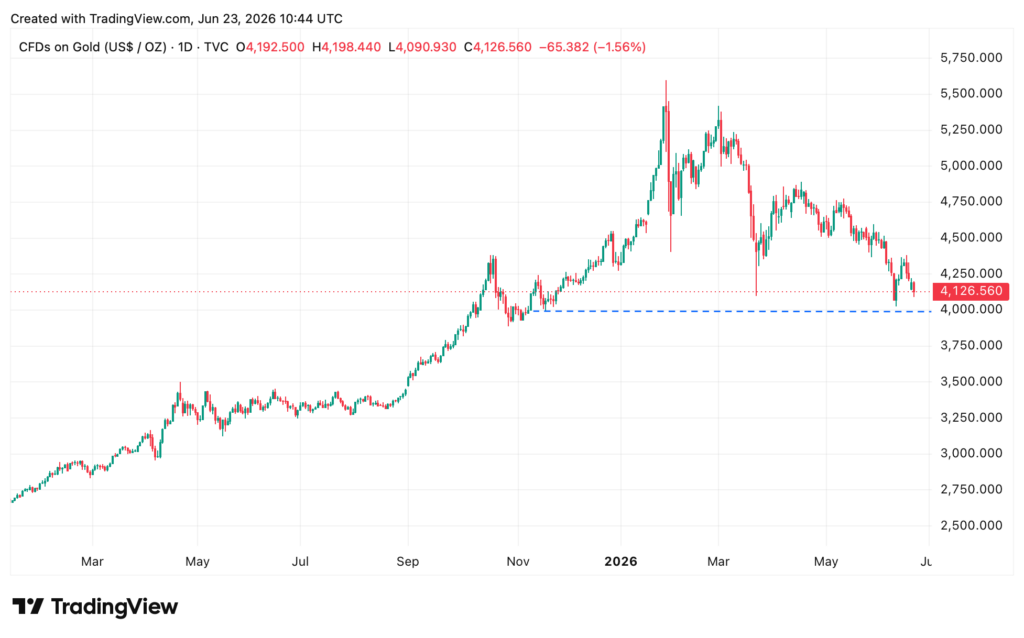
The first casualty, seemingly, are dividend-free assets like gold. The metal has remained under significant pressure and is about to test the critical support at $4,000 (see below). As for silver, its trend is bearish too and prices are falling into the major support at $60. Platinum, the sector laggard, is pushing its drawdown from last year’s peak ($2,900) almost 50%.
In other words, momentum chasers from last year’s gold bull run are sitting on sizeable losses.
A tighter Fed monetary policy is hitting Big Tech
The second important development, partly derives from the hawkish interpretation of the Fed policy, involves the shaky tech sector. When the monetary policy is loose, asset prices go up. When the Fed becomes ‘less accommodative’, prices drop. The latter is now threatening on the ongoing boom in the AI sector.
Last week, I highlighted the importance of “mean reversion” in financial markets. When prices rally significantly, they have the tendency to come back down.
A few tech stocks are doing precisely that.
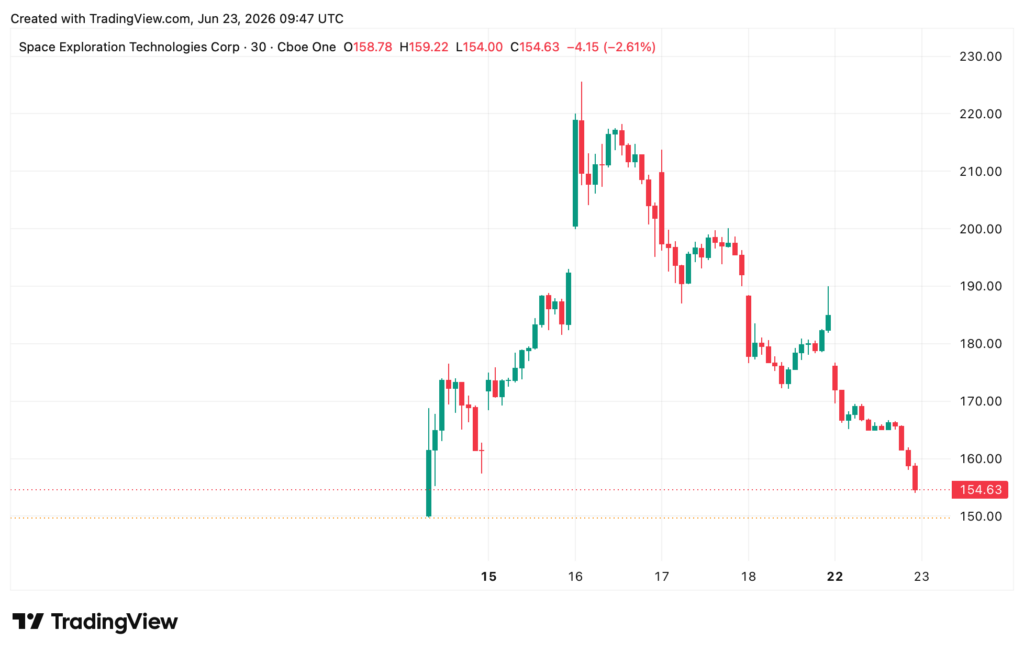
Even SpaceX (SPCX), the newly-listed exploration company, has lost much upside momentum (see below). The Elon Musk-led stock is on the cusp of breaking through its IPO price at $135, which could be a significant event since every holder who bought during its listing – and held – will be sitting on paper losses.
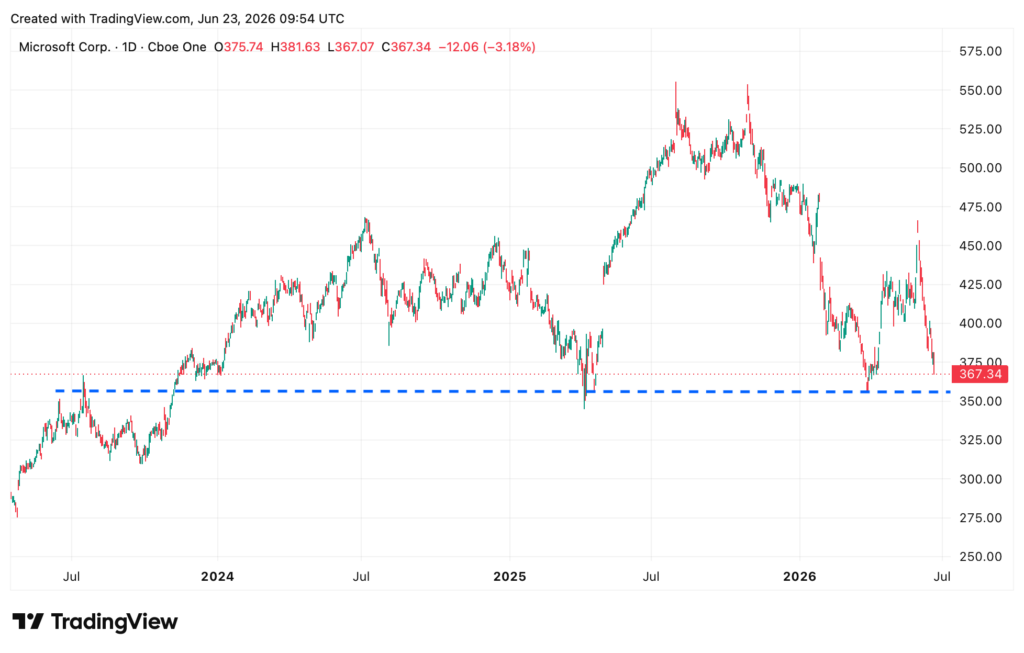
Big techs like Microsoft (MSFT) are not doing well. MSFT’s recent rally to $450 was a short-lived affair and prices quickly resumed its ferocious drop. A break of the major support near $350 will test the resolve of long-term shareholders (see below).
Meta (META) is another large tech suffering from stiff selling pressure. Prices failed again to regain the $600 level and so the path of least resistance here appears south.
For Amazon (AMZN), its 4.75% decline yesterday affirmed the short-term bearish trend into the congestion zone at $200.
A few other US mega caps are continuing their downtrends as well.
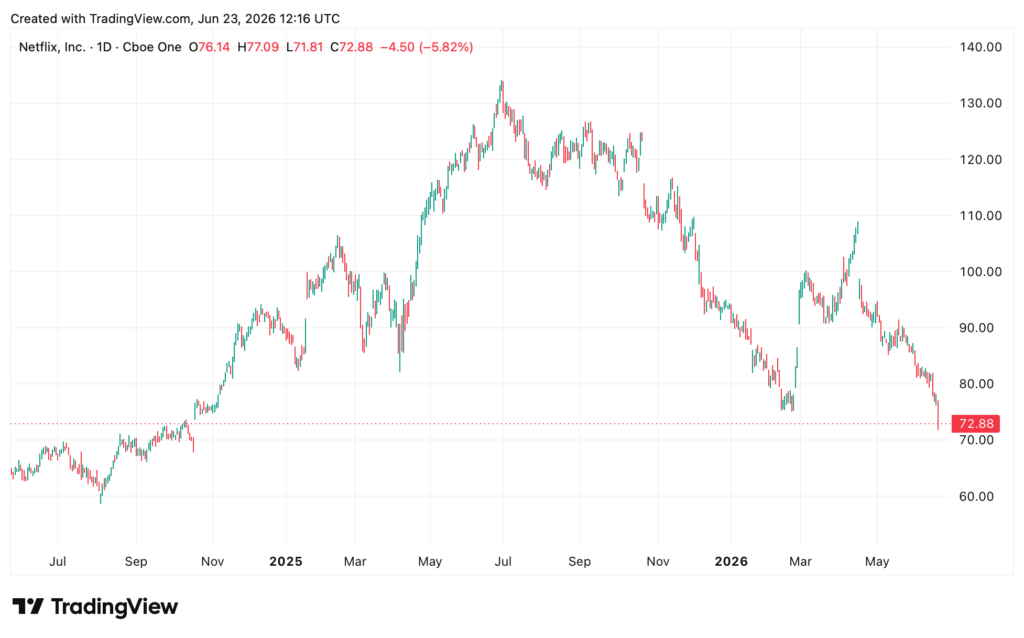
Netflix (NFLX) is a case in point. The stock sank to 18-month lows this week, as prices resumed its bearish posture from $130 (see below). Similarly, Salesforce (CRM) and Palantir (PLTR) slumped to 52-week lows.
Mind you, these aren’t small-cap stocks but large corporations with huge business interactions globally. Their price declines will incur sizeable losses on many portfolios.
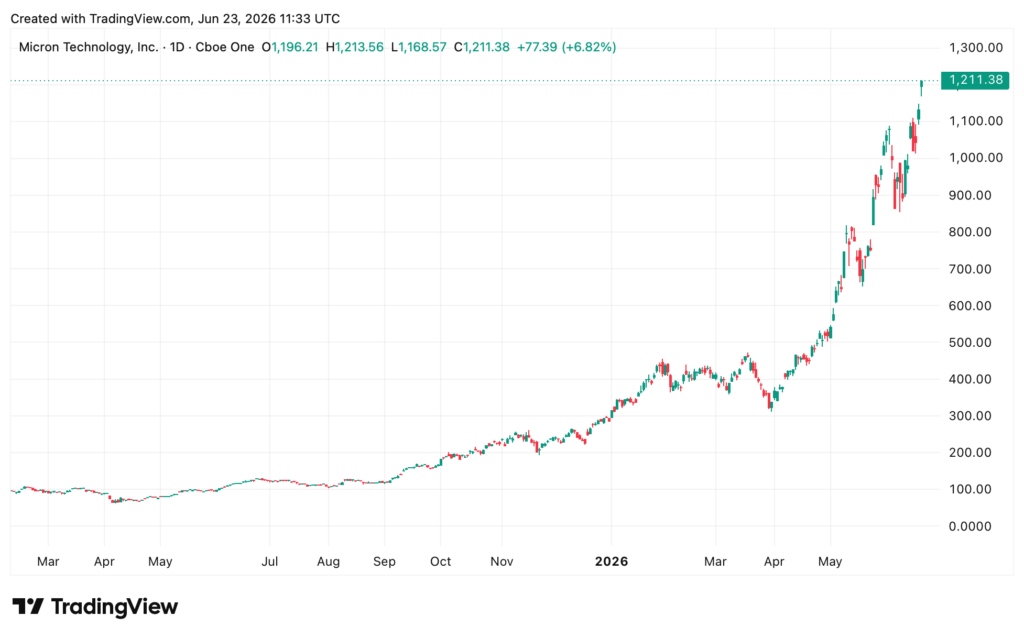
But the bulls will contend this overly bearish thesis. Big Techs, they say, have not been delivering strong returns for many quarters. The boom has moved on to those memory stocks like Micron Tech (MU) and Sandisk (SNDK), which remain very much in play. That’s partly true.
MU, for example, hit new all-time highs yesterday with a gap (see below). The uptrend here – and in SNDK – is strong and affirmative.
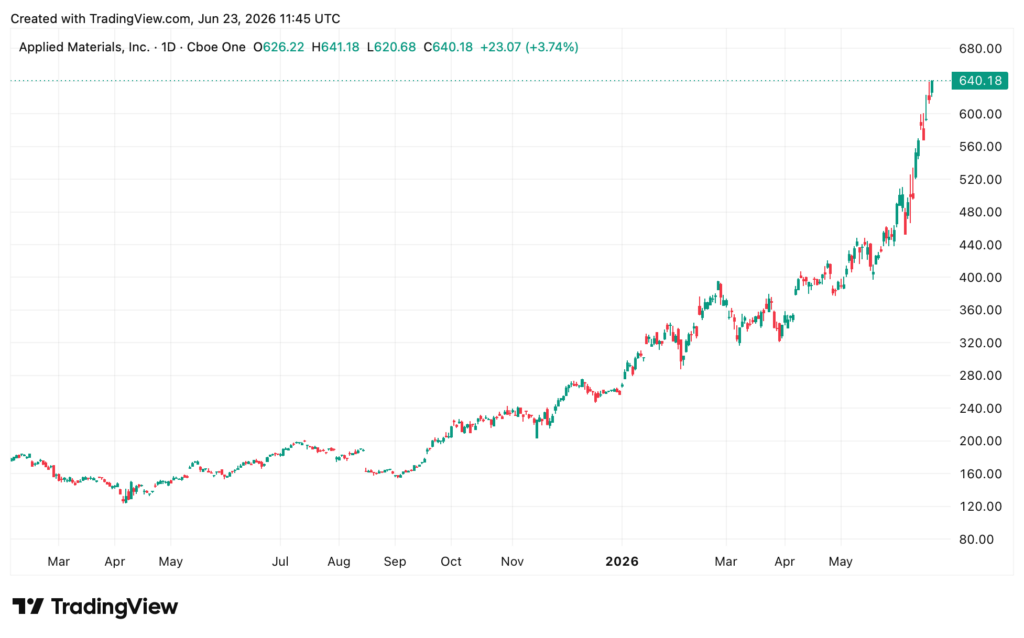
Applied Materials (AMAT) and Lam Research (LCRX) are, too, following Micron’s lead and hitting fresh highs this week.
Still, no stock can defy financial gravity forever. At some point, traders will be tempted to convert these profitable positions back into cash. This urge to reduce risk will be especially acute when other positions in the portfolio – such as Big Techs – gradually suffer from drawdown.
And you don’t really want to be the last ‘bag holder’.
US dollar breaks base formation
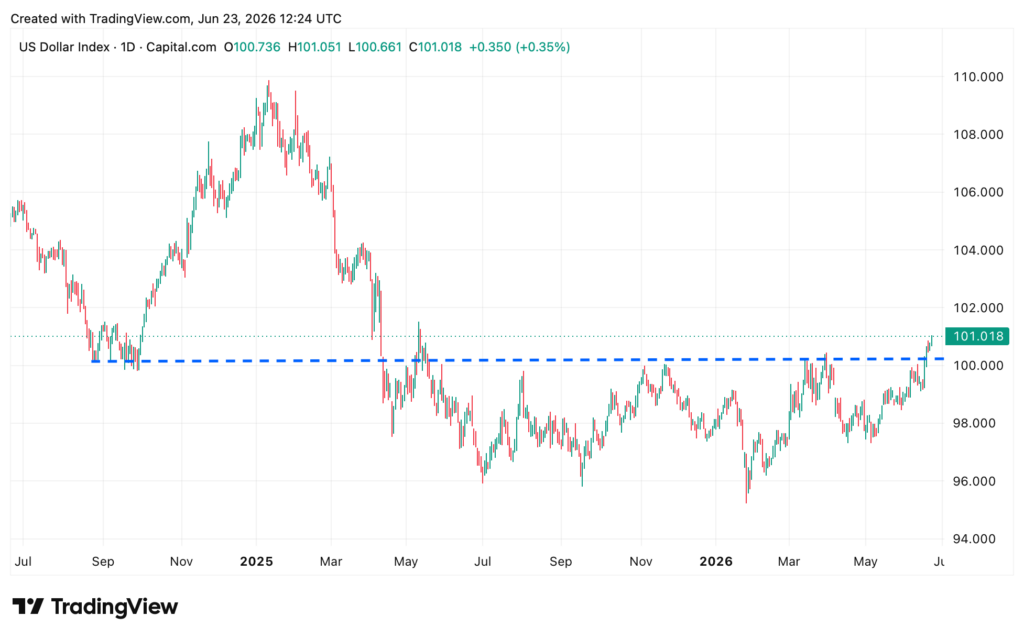
The last important development is the base breakout in the Dollar Index.
Remember that the US dollar is a widely-traded currency. To move its direction requires plenty of buying against many currencies.
Thus the breakout here is potentially significant. The currency has been meandering sideways for many quarters; a break of the lateral resistance at 100.0 signifies a new – perhaps stronger – phase in the USD.
Why the rush into USDs?
One potential case is that the Fed may increase rates. Another reason is that investors are less positive about other economies and are accumulating USDs from foreign assets.
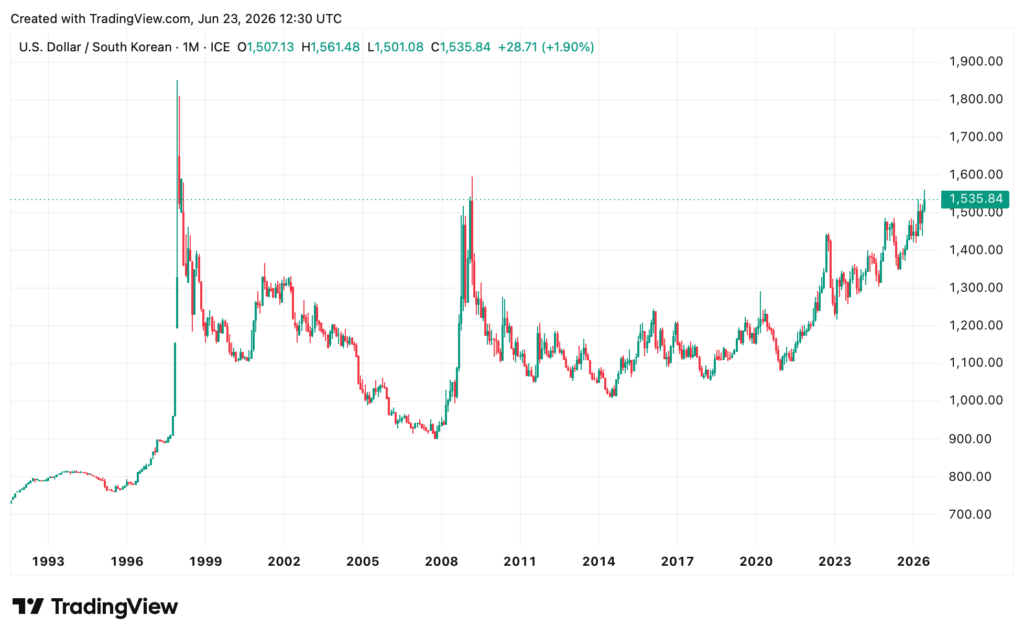
For example, many Asian currencies are hitting new long-term lows against the USD.
The Korean Won, despite having enjoyed a strong domestic stock market boom and rising exports, is trading near its crisis lows against the US dollar (see below).
And the weak Won is not an isolated case. The Japanese Yen, Indonesian Rupiah, Indian Rupee, and Philippine Peso are all flirting at cyclical lows against the USD.
In all, the USD appears to be an inflection point. It is gaining strength and may introduce a new economic factor in the world economy.
Whether or not this is due to a more downbeat forecast on the rest of the world is hard to say, but remember that when market wobbles, investors tend hide in the USDs. We last saw that herd behaviour back in 2020.

Jackson is a core part of the editorial team at GoodMoneyGuide.com.
With over 15 years of industry experience as a financial analyst, he brings a wealth of knowledge and expertise to our content and readers.
Previously, Jackson was the director of Stockcube Research as Head of Investors Intelligence. This pivotal role involved providing market timing advice and research to some of the world’s largest institutions and hedge funds.
Jackson brings a huge amount of expertise in areas as diverse as global macroeconomic investment strategy, statistical backtesting, asset allocation, and cross-asset research.
Jackson has a PhD in Finance from Durham University and has authored over 200 guides for GoodMoneyGuide.com.