

In this week’s global macro analysis, we look at the divergence between growth and value stocks as the market continues to trade at all-time highs. We also highlight a key value play as investors ask whether now is the time to take a more defensive stance in their portfolios.
Over the last three weeks, risk assets staged a strong recovery from their March lows. Many US stocks surged to their February highs. Some even broke new ground vigorously.
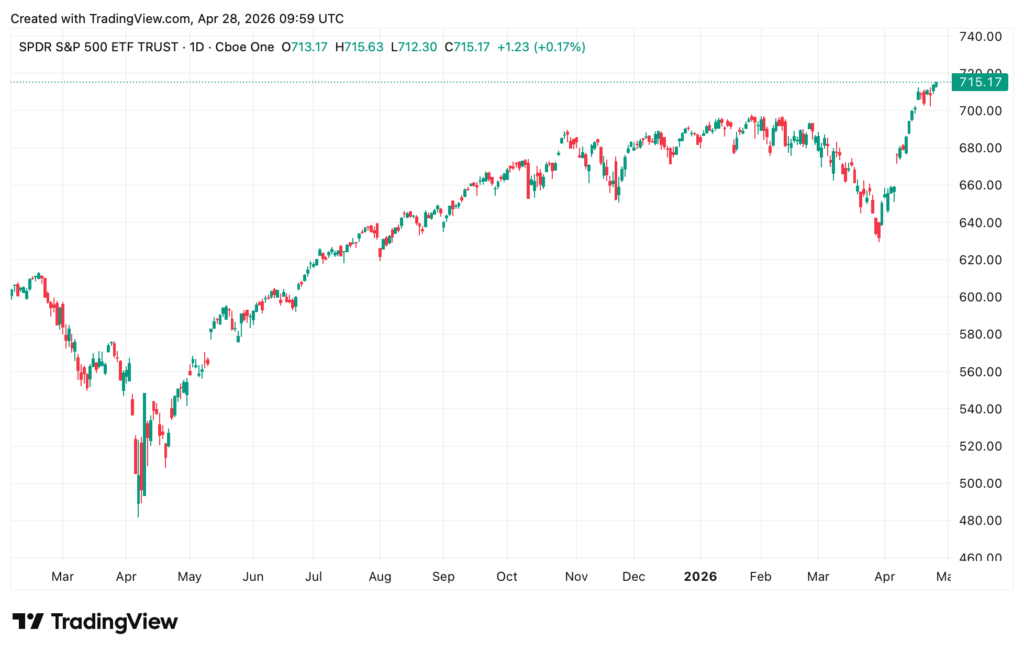
The US blue-chip S&P 500 Index established several new highs in the past month (see below). Nasdaq, by far the clear leader, propelled north of 24,000, a rally fuelled by clusters of outperforming tech stocks.
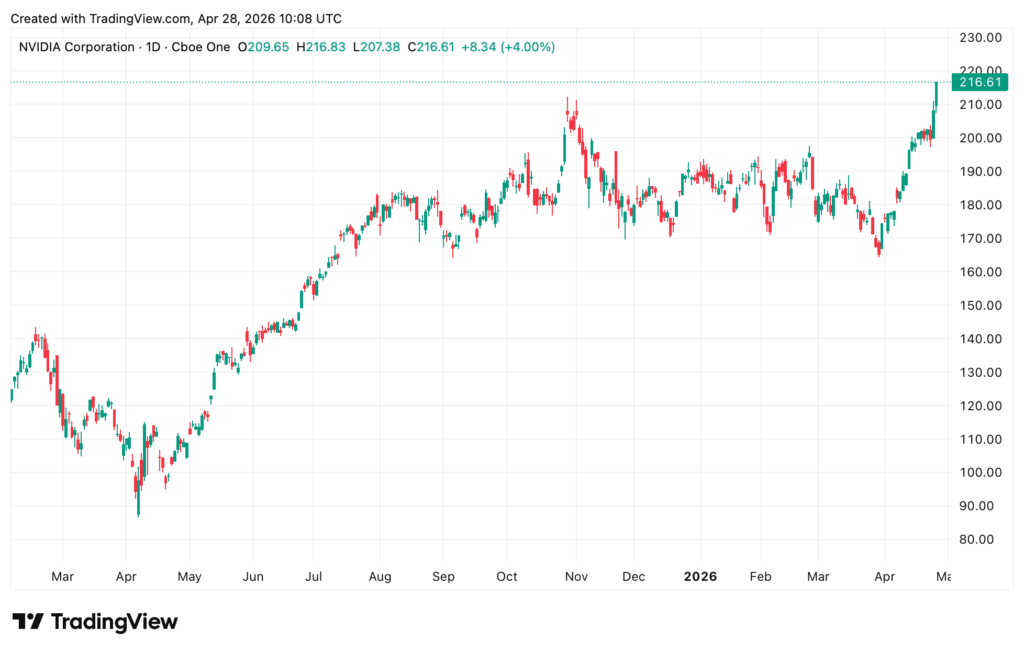
Just this week, Nvidia (NVDA) regained its top spot as the world’s largest company by market cap. Prices broke past the $200 psychological resistance to push the AI-powered chip firm to a $5 trillion valuation once more. A massive price breakout like this often carries the stock higher. Momentum persists in financial markets.
If you analyse the charts of AMD (AMD), Broadcom (AVGO) Sandisk (SNDK), Intel (INTC) – virtually all of them surged to new highs lately. Even some old techs like Cisco (CSCO) and Texas Instruments (TXN, founded 1951) are participating in the rally by sitting at new multi-year highs.
There is no dispute that we are amidst a roaring equity bull run, especially in this part of the tech-AI ecosystem.
Nothing seems to be capping, blocking or slowing down equities’ stunning advance. Not the $100 oil; not the rising inflation outlook; and certainly not the Trump administration.
However, many investors are finding it hard to explain the explosive rally in US stocks. The ‘animal spirits’ on display here far exceed the growing list of downside risks. Hard to square current equity returns with the jittery macro background.
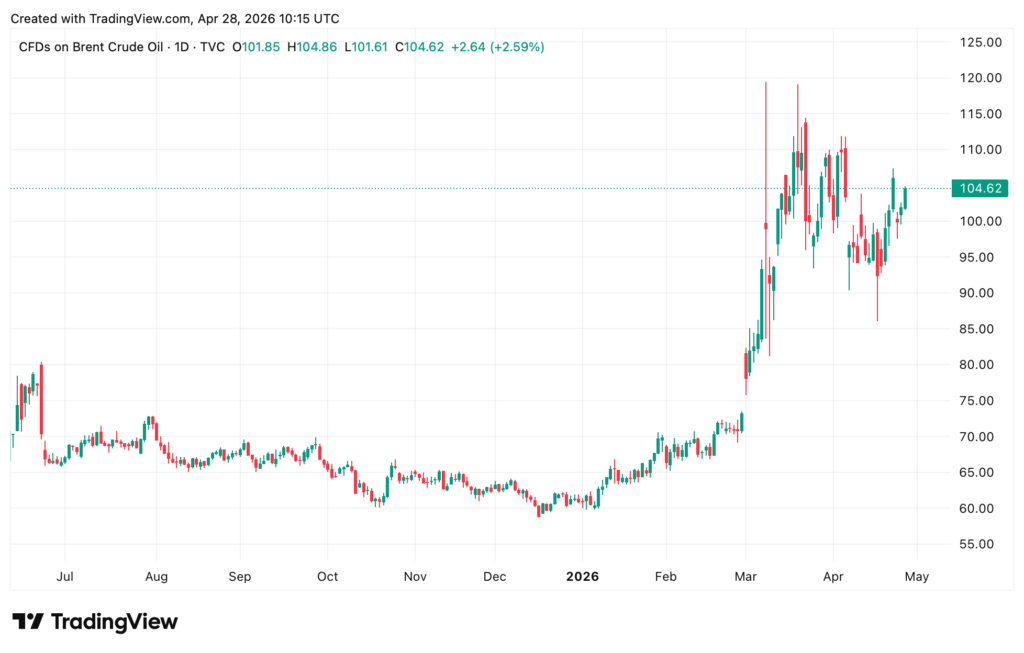
The chart of the Brent oil prices reflects this growing disparity between the exuberant stock market and events on the ground. The ‘ceasefire’ announced a while back has not really helped to cool down oil prices. The Strait of Hormuz remains largely off limits to tankers (see hormuzstraitmonitor.com).
Vitol, one of the world’s largest commodity firms, recently estimated that the Iranian conflict slashed oil output by a billion barrels. That’s a huge supply of oil removed from the global markets.
Ergo, oil prices quickly rebounded to their March highs (see below). A further closure of the Strait may lead to much higher oil prices over the medium term.
Unsurprisingly, the US inflation rate is heading back up.
US March CPI readings, for example, rose to their highest level in nearly two years (see below). This jump is aided by higher fuel prices at the pump.
As a result, US Treasury yields remain near the top of their ranges. Investors are expecting the Fed, with its new chair soon, to be more cautious about slashing rates. The 30-year yield is already probing the massive resistance at 5%. A breakout here is not to be ruled out.
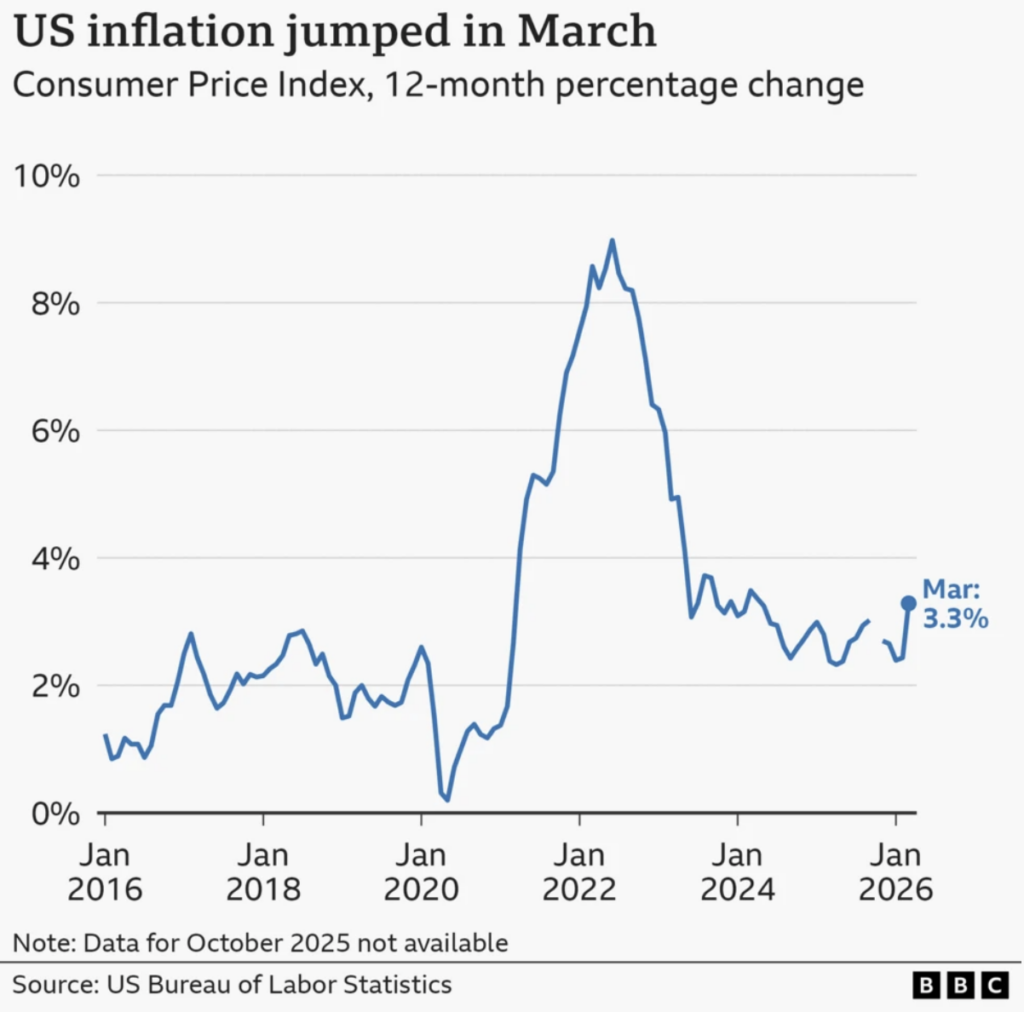
Source: BBC
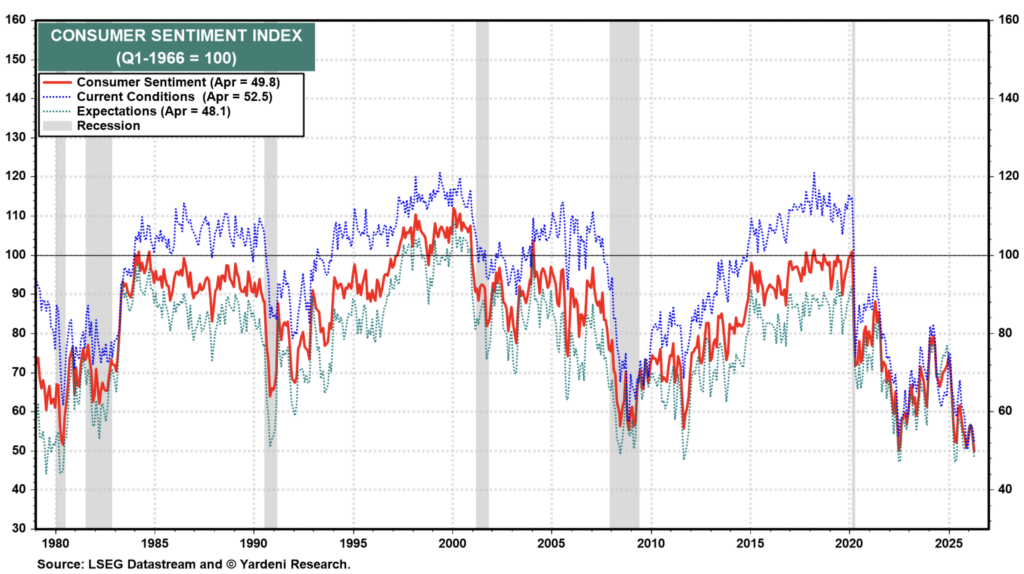
Higher-than-expected inflation, borrowing costs and an uncertain job market (due to AI) are a bad combination for the average household.
Consequently, US consumer sentiment index has sunk to its lowest level in 46 years! This divergence between depressed household outlook and the rocketing stock market is wide – and widening still.
Source: Yardeni.com
Time to take a more defensive stance?
Based on the above analysis, should we take a (modest) contrarian view on markets? Yes and no.
First, let’s look at the reasons to be more cautious on risk markets:
- Valuation – is starting to run higher again (investors paying more to own future corporate profits)
- Market Sentiment – is pricing a swift end to the Iranian conflict, not a prolonged war (which may or may not happen)
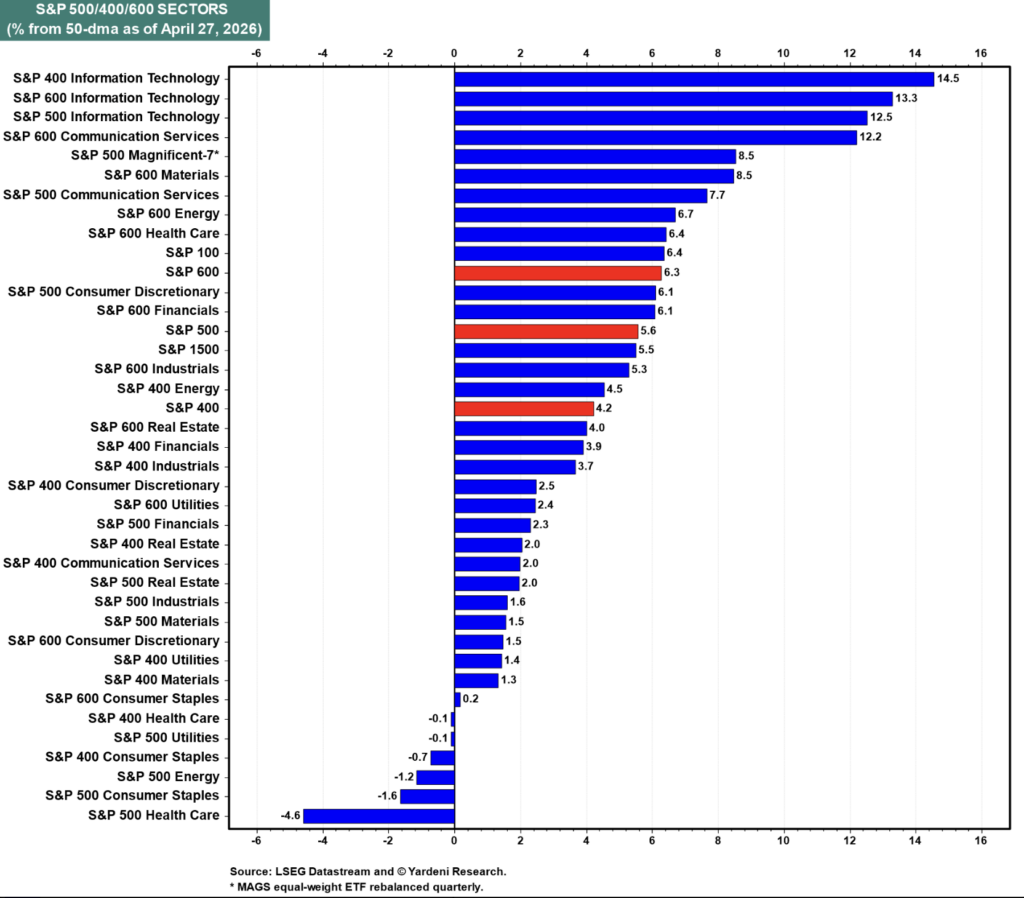
- Technicals – are stretching on many tech stocks. The table below ranks the sectors currently above their 50-day moving average. At the top of the list are IT/Communication stocks (see below)
- Adverse Events – like Private Credit may return to haunt investors
In other words, markets are gradually heading into ‘pricing for perfection’ territory.
But we all know that’s not the case with the messy situation on the ground. A political mishap here, or a military miscalculation there, may end the fragile truce.
Source: yardeni.com
The bulls, however, are optimistic that these bearish factors are not to be worried about.
First, they point to the swift rebound in stock prices as a testament to the underlying health of the market. Plus, the Trump administration may produce another TACO at any time – which will further juice up the markets.
Second, the rank speculation in equity markets is not confined to the US. Stock markets in Korea, Japan, and a host of other countries have continued to hit new all-time highs, too. This reflects a strong secular uptrend in the asset class.
Third, many stocks are still beating earnings guidance (eg Coca-Cola KO, UPS). Corporate health remains robust.
And at this point, nobody wants to be long fixed income, especially at the long end. This is due to soaring inflation. See, for example, Treasury ETF (TLT).
Therefore, there is a case to continue being overweight on stocks.
Time to overweight value stocks?
What should investors buy now given the recent huge run-up in prices?
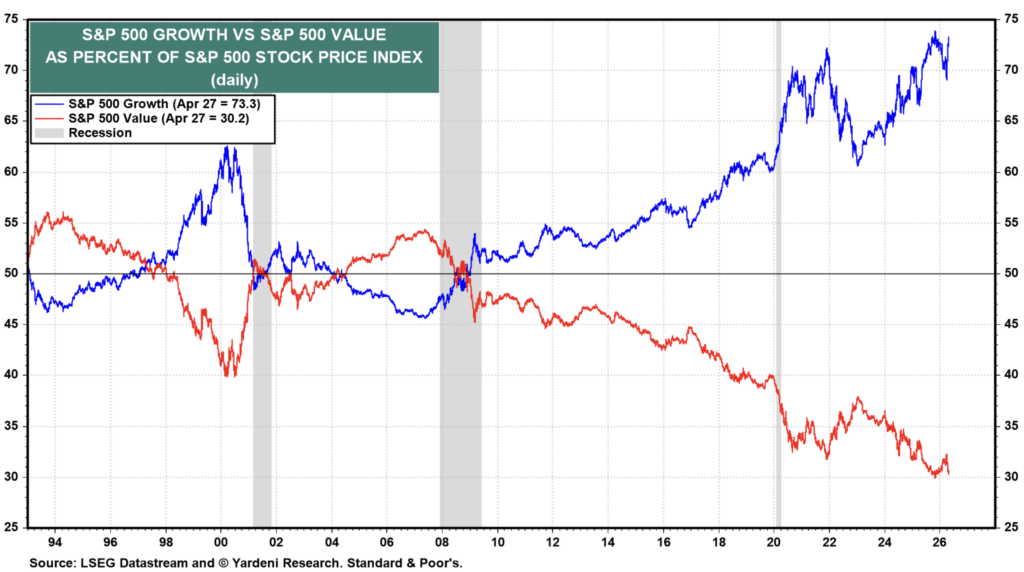
One chart that caught my attention was the wide disparity between value and growth stocks (see below).
Since 2008, growth stocks have outperformed value stocks significantly. FAANG, Mag-8, techs, and AI are all part of this secular market trend. All the trillion-dollar US companies are tech-related.
However, as borrowing costs hover near 5% and the AI revolution gathers pace, will this bring about a new paradigm with value stocks outperforming? Perhaps. But this may not happen overnight.
The trend now remains starkly in favour of growth sectors. But as some point, I anticipate some mean reversion moves over the long term. An interesting pick may be the iShares S&P 500 Value ETF (IVE, factsheet), which also contains a list of mega-tech stocks.

Jackson is a core part of the editorial team at GoodMoneyGuide.com.
With over 15 years of industry experience as a financial analyst, he brings a wealth of knowledge and expertise to our content and readers.
Previously, Jackson was the director of Stockcube Research as Head of Investors Intelligence. This pivotal role involved providing market timing advice and research to some of the world’s largest institutions and hedge funds.
Jackson brings a huge amount of expertise in areas as diverse as global macroeconomic investment strategy, statistical backtesting, asset allocation, and cross-asset research.
Jackson has a PhD in Finance from Durham University and has authored over 200 guides for GoodMoneyGuide.com.