

Choosing the best low-spread broker in the UAE involves much more than comparing headline spread figures. While tight spreads can reduce trading costs and improve profitability, traders should also consider financing charges, currency conversion fees, execution quality, platform features and regulation.
The most cost-effective broker is often the one that combines competitive spreads with transparent pricing, reliable execution and strong regulatory oversight. We only list CFD brokers on Good Money Guide that offer transparent spread-based pricing, or commission on positions and clear visibility of trading costs before a trade is opened on the dealing ticket.
Compare The Best CFD Brokers In The UAE For Low Trading Commission
| Name | Logo | CFD Markets | Min Deposit | GMG Rating | Customer Reviews | CTA | Feature | Expand |
|---|---|---|---|---|---|---|---|---|
 |
CFD Markets 5,000 |
Min Deposit $100 |
GMG Rating |
Customer Reviews |
Visit Platform 74% of retail CFD accounts lose money. |
Account Types:
|
FOREX.com UAE CFD Trading Expert ratingOur expert rating is the average of the areas listed here, each scored out of 5 by our team.5.0Excellent Our experts have rated FOREX.com UAE CFD Trading across five key areas of our review framework.
Pros
Cons
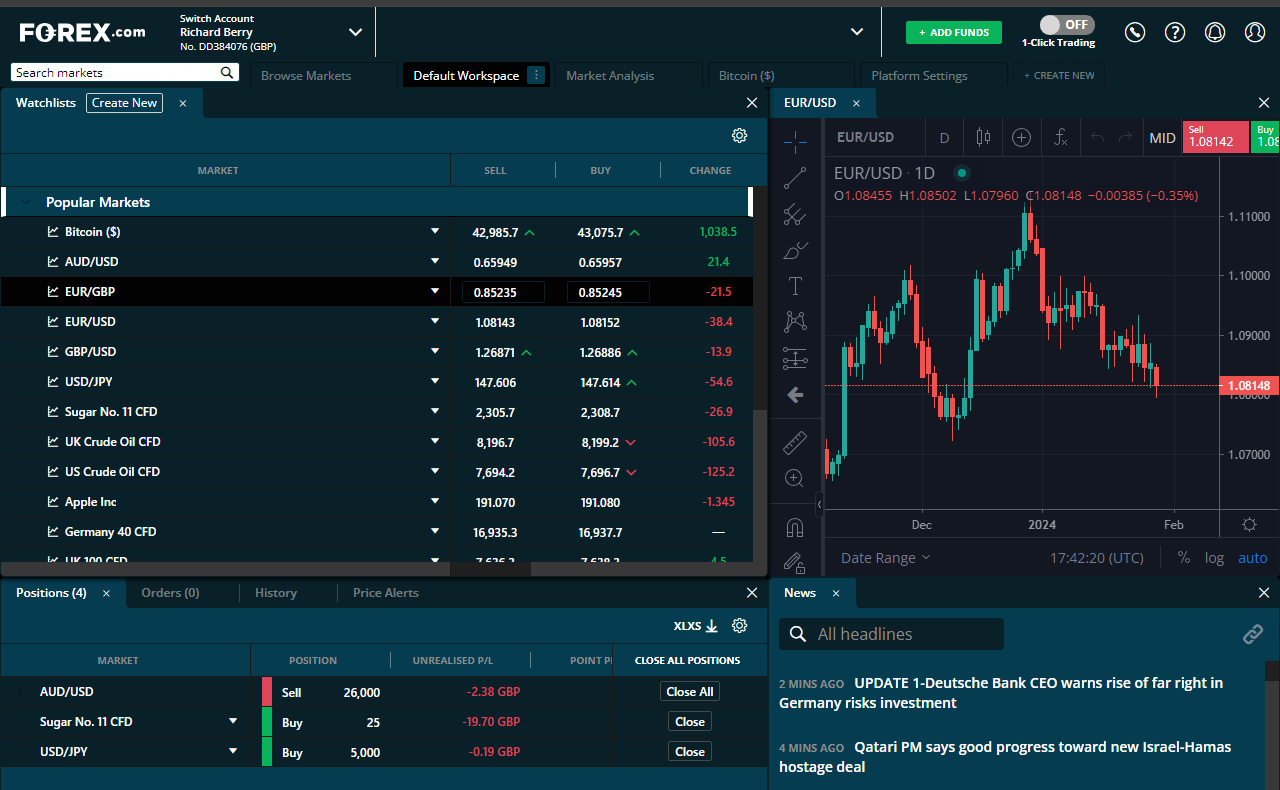
Our verdictForex.com is a global provider of CFDs and other trading instruments. CFD traders in Dubai can access a wide range of CFDs on various asset classes, including stocks, indices, commodities and forex. Forex.com provides competitive pricing, tight spreads, and a user-friendly trading platform for executing CFD trades. But what makes Forex.com stand out are the trading signals and performance analytics that can help CFD trading become more profitable. Is Forex.com a good CFD trading platfom in the UAE?Overall, an excellent CFD trading platform with lots of markets 25 commodities, with spreads as low as 0.8 for gold trading and 0.3 for crude oil. If you are a forex trader, then Forex.com’s trading signals, platform and trading performance data make it one of the best platforms for currency trading. Is Forex.com CFD trading OTC or DMA in the UAE? You can trade real CFDs in the UAE with forex.com as they are regulated by the DFSA and have a local office in Dubai. Forex.com is owned by NASDAQ listed StoneX and is one of the largest forex brokers in the world. Forex.com is properly regulated by the DFSA Reference Number: F000542 and have a local UAE office with their parent companies (StoneX): Office 48D Almas Tower Jumeirah Lakes Towers PO Box 125942 Dubai, UAE
|
|
 |
CFD Markets 1,200 |
Min Deposit $1 |
GMG Rating |
Customer Reviews |
Visit Platform 73% of retail investor accounts lose money |
Account Types:
|
Is CFD trading on Pepperstone legal in the UAE? Expert ratingOur expert rating is the average of the areas listed here, each scored out of 5 by our team.4.5Excellent Our experts have rated Is CFD trading on Pepperstone legal in the UAE? across five key areas of our review framework.
Pros
Cons
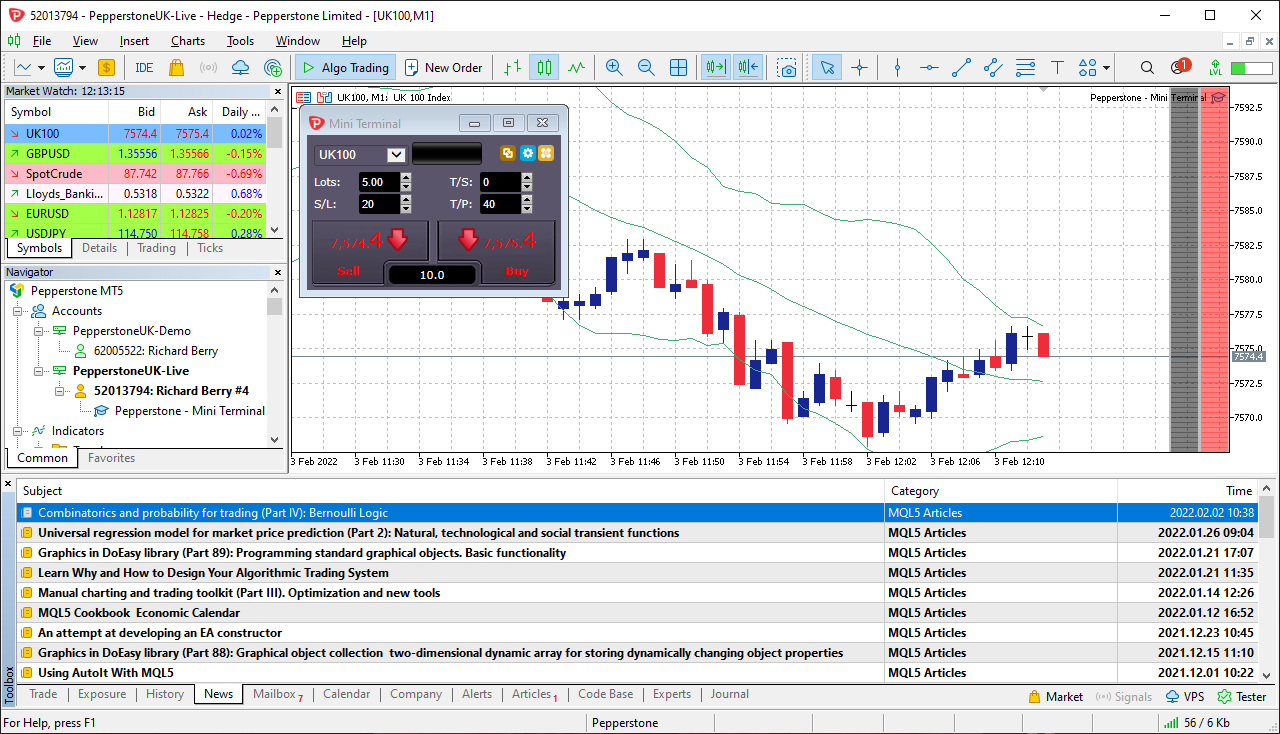
Our verdictIn 2020 Pepperstone obtained a Dubai Financial Services Authority (DFSA) license to expand its CFD brokers services in the Middle East and Dubai. Set up by industry vet Tarik Chebib in 2021, who has prior experience setting up similar CFD trading services operations in the region, it is one of the largest CFD brokers globally led by Alexander Kolpokchi. Can you trade CFDs with Pepperstone legally in the UAE?Yes, is it legal to trade CFDs with Pepperstone in the UAE as they are regulated by the DFSA and have a local office in Dubai. Pepperstone focus on MT4 and automated trading strategies and cater to high-net-worth individuals (HNWIs) in the Gulf states and the wider Middle East, who want to trade CFD on popular local markets like Oil and Gold as well as the most popular international indic DFSA Reference Number: F004356 UAE Address: Pepperstone Financial Services (DIFC) Limited – Office 1502, Al Fattan Currency House, Tower 2 – Dubai – United Arab Emirates
How long do withdrawals take from Pepperstone in the UAE? In the UAE, Pepperstone withdrawals are typically processed quickly. The median processing time is 0.90 hours (54 minutes) for eSCA accounts and 1.47 hours (around 88 minutes) for DFSA accounts. These figures cover Pepperstone’s internal processing only; the time for funds to reach your bank or card will depend on the payment provider. |
|
 |
CFD Markets 4,500 |
Min Deposit $20 |
GMG Rating |
Customer Reviews |
Visit Platform CFD trading carries risk. Capital.com is regulated by the Capital Markets Authority (CMA).
|
Account Types:
|
Capital.com Expert ratingOur expert rating is the average of the areas listed here, each scored out of 5 by our team.
Pros
Cons
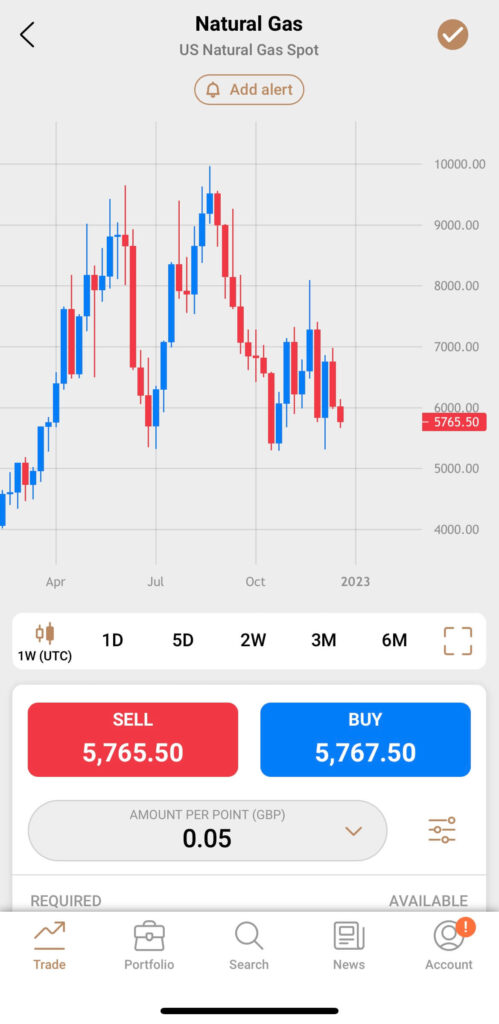
Our verdictCapital.com was voted best CFD broker in 2026 and won the People's Choice vote for "Best Trading Account" in the 2025 Good Money Guide Awards and "Best Trading App" in our 2023 awards as they have one of the most intuitive apps for trading the most popular markets globally. Capital.com was founded in 2016 and is a CFD trading platform broker with offices in the UK and around the world. Since then, they have grown to offer over 5,500 tradable assets to 100,000 monthly active clients. Is Capital.com any good for trading?Capital.com has a user friendly and intuitive trading platform and app, that gives access to the most popular financial markets with competitive spreads with the ability to reduce risk by decreasing your leverage. Trading via the app has always been capital.com's forte, and in 202, it won our award for "best trading app" not in part due to the fact that the company CTO has extensive experience in building engaging apps like Candy Crush. What makes Capital.com different? Thumbs up, literally Do you know what one of the most impressive thing about Capital.com is? They put the buy and sell buttons at the bottom of the app. I don't mean that in a facetious way, it's genuinely a brilliant feature. This may not sound like much but it's a good example of how Capital.com has integrated decades of analytics, experience, feedback and customer data into creating a very easy-to-use intuitive trading app from scratch. When Capital.com first became authorised by the FCA back in 2018, I visited their offices in London to have a chat about what they offer. The two main things we discussed were button placement and AI. Trading App But anyway, if you've updated your iPhone to the latest iOS you'll notice that Apple has started moving things to the bottom of the screen, the search bar for instance. This is because, phones are getting bigger, and your thumb can't reach the top of the screen if you are holding it with one hand. This is something that Capital.com figured out would make trading easier 5 years ago. I've just been through a bunch of other trading apps on my phone and still, amazingly enough, none of the other brokers have done this yet.
Capital.com was also the first to integrate artificial intelligence to help you improve your trading, they say, based on the Martingale theory. When I spoke to Chris Demetriou, the head of sales in the UK, he said that the system should give you prompts based on your previous trades. So for example, if you are about to do a trade that is similar to ones you have constantly lost on before, you should get a "are you sure you want to do this" notification. Leverage Control Everybody knows, that one of the main reasons people lose money when trading is overleverage. This could be either from not having enough free cash on account to give your position breathing space, or simply putting on trades that are too risky. One really good feature is that you can change your leverage based on asset class. The default leverage is the max that retail traders in the UK are permitted, but you can change this to 1:1 so you need to fully pay up for positions. A sensible thing to do if you are just getting started, which can help reduce excessive losses. As your experience grows you can increase your leverage accordingly. Hedging You can also set the platform to put on hedging positions, so you can be long and short the same thing at the same time. Why you ask? Well, it can help you run longer-term positions and short-term hedges. This in fact is the very point of CFDs. They were originally hedging tools, and still a good way to protect your long-term investment portfolio against short-term market corrections without having to close off your positions. Customer Support Customer support is pretty good too, you can get in touch via the chat widget on the platform, whatsapp or telegram. When I tested it I got a response within a minute and the issue I had was dealt with quickly (uploading ID to verify my account if you must know). TradingView You can't trade from the charts, but when you have open positions they are overlayed along with your stops and limits, which you can move by dragging and dropping. But, if charting is your thing, you can join the other 78,000 Capital.com customers using and trading from TradingView. Proprietory Tech One thing I quite like though is that instead of relying on third-party software, the Capital.com trading platform is built in-house, and if you want something you can ask for it. For example, previously on the app you could see where an asset is as a percentage relative to the daily range. But, a customer asked, if you could see it in points too. So, that was quickly integrated so that you can now toggle between percentages and points. A small thing, but indicative of a broker that can do things and does do things, rather than just logging a helpdesk ticket. Refinitiv There are no trading signals on the platform or app, but you do get access to Refinitiv reports on US stocks, which give you a good overview of historic and potential future financial health. A good feature for those looking at slightly longer-term positions. Overnight funding Talking of long positions, or longer long positions, Capital.com also display quite clearly what your overnight financing rates are going to be on a daily basis. I'm sure this is a regulatory obligation anyway, but it's done in a way that you can actually see what the price is, rather than an opaque formula. It gives a bit more transparency about how much a position is going to cost you. Investmate If you are new to trading, they have a stand-alone app called Investmate, which puts you through a series of bitesize courses that explain the financial markets. Capital.com also own currency.com if you fancy a punt on crypto, and shares.com so we can expect to see more comprehensive physical investing options soon. |
|
 |
CFD Markets 2,000+ |
Min Deposit $50 |
GMG Rating |
Customer Reviews |
Visit Platform 76% of retail investor accounts lose money |
Account Types:
|
Plus500 UAE CFD Trading Expert ratingOur expert rating is the average of the areas listed here, each scored out of 5 by our team.4.4Very good Our experts have rated Plus500 UAE CFD Trading across five key areas of our review framework.
Pros
Cons
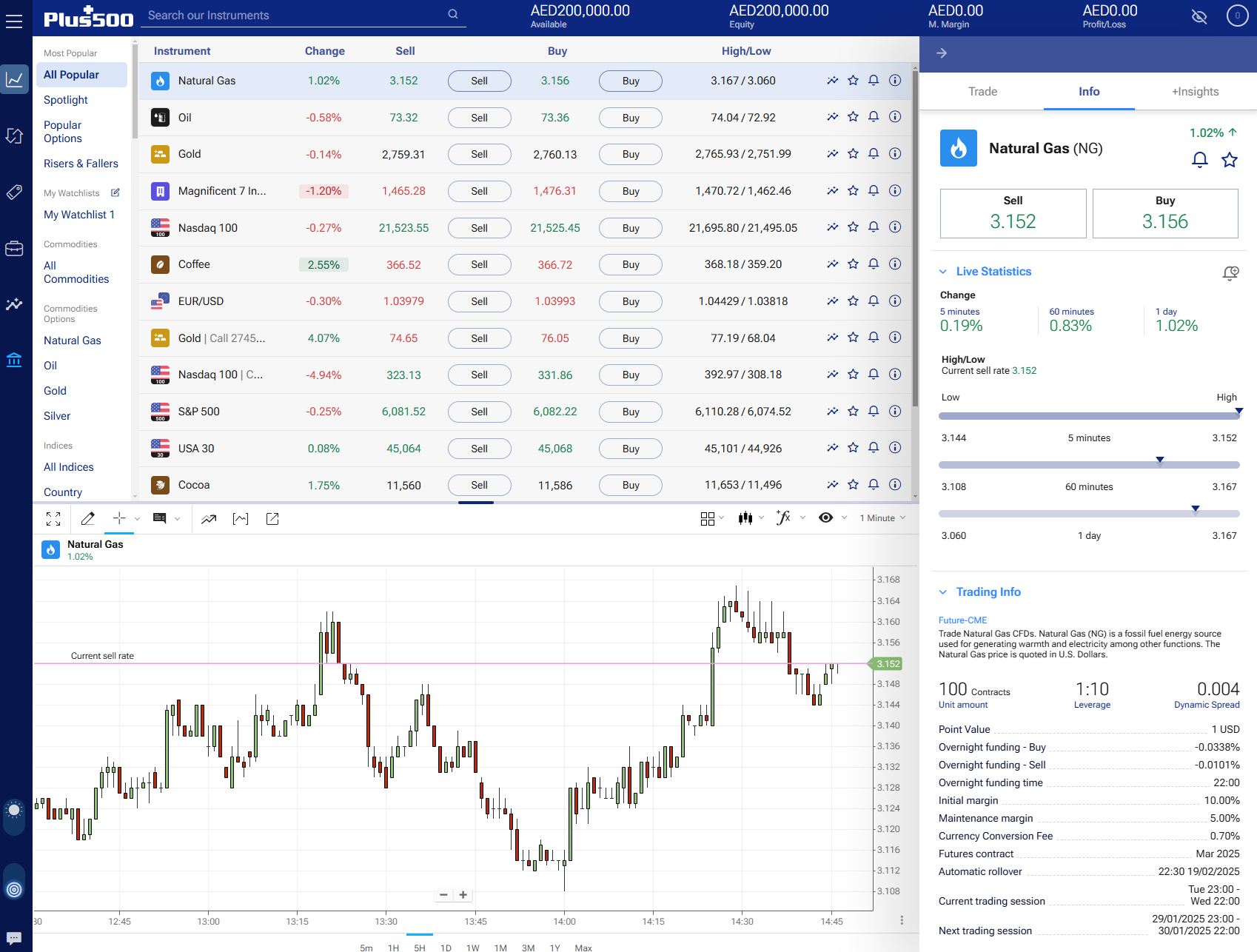
Our verdictPlus500 is one of the largest CFD trading platforms in the world and is available in the UAE as well as operating in more than 50 countries worldwide. Founded in 2008, it has more than 26 million customers today. Plus500 is headquartered in Israel, however, it’s listed in the UK on the London Stock Exchange (it’s a member of the FTSE 250 index). Here in Britain, its platform is operated by Plus500UK Ltd, which has offices in London. CFDs are complex instruments and come with a high risk of losing money rapidly due to leverage. 76% of retail investor accounts lose money when trading CFDs with this provider. You should consider whether you understand how CFDs work and whether you can afford to take the high risk of losing your money. Is CFD trading on Plus500 legal in the UAE?Yes, it's fine to trade CFDs with Plus500 in the UAE as Plus500AE Ltd is regulated by the CFTC (NFA ID number 0001398). Plus500's trading platform has evolved nicely over the years from a simple interface to an intuitive execution venue for CFDs on the major markets and stocks. Pricing: It's dynamic so moves with the market for minimum spreads Overall, Plus500 is a good CFD trading platform for UAE traders who want to buy and sell CFDs on major markets. The broker does provide sentiment indicators and are quite transparent with costs and fees.
|
|
 |
CFD Markets 12,000 |
Min Deposit $1 |
GMG Rating |
Customer Reviews |
Visit Platform 69% of retail investor accounts lose money |
Account Types:
|
CMC Markets UAE CFD Trading Expert ratingOur expert rating is the average of the areas listed here, each scored out of 5 by our team.4.7Excellent Our experts have rated CMC Markets UAE CFD Trading across five key areas of our review framework.
Pros
Cons
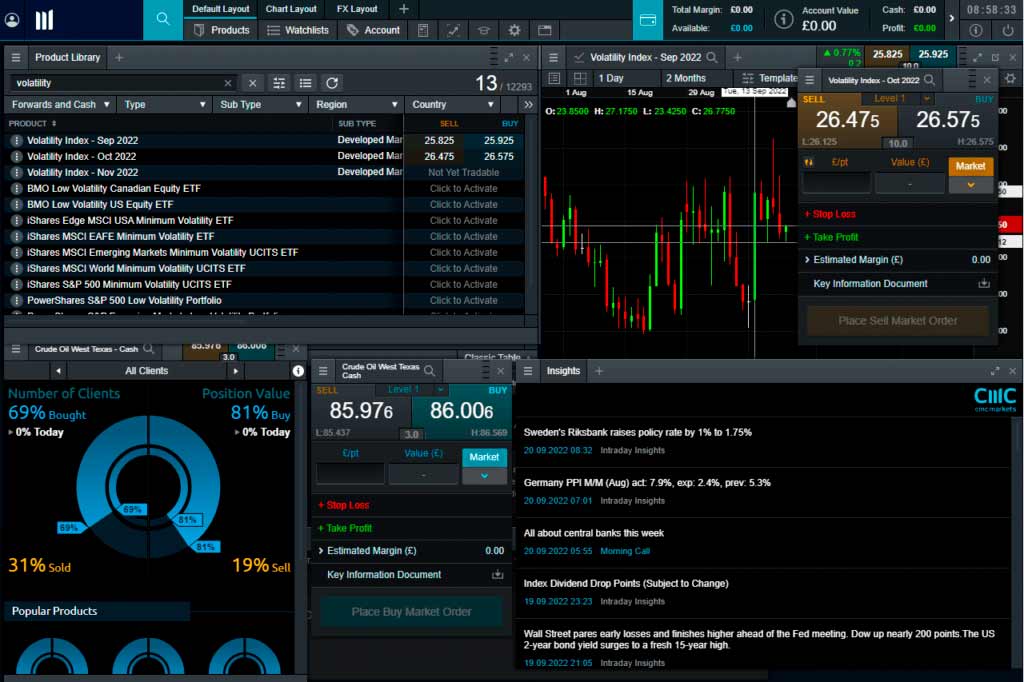
Our verdictCMC Markets started offering CFDs (Contracts for Difference) in the United Arab Emirates (UAE) in 2019. This allowed traders in the UAE to access a wide range of CFD products, including indices, commodities, forex, and more, through CMC Markets’ online trading platform. Is CFD trading allowed with CMC Markets in the UAE?Yes, it is fine to trade CFDs in the UAE with CMC Markets as they have a local office in Dubai and are regulated by the DFSA. DFSA Reference Number: F002740 CMC is a good CFD broker for traders who want a sophisticated and fast trading platform with unique sentiment trading tools. CMC Markets Connect, established its physical presence in the UAE in 2019 and rebranded in January 2021. With the expanded office, CMC Markets aims to continue building its reputation in the Middle East and support its existing clients in the region. Richard Elston, the Group Head of Institutional at CMC Markets Connect, expressed confidence in the new office, highlighting the UAE’s growth as a global financial hub. CMC Markets UAE Address: CMC Markets Middle East Limited. Unit 2903, Level 29, ICD Brookfield Place, DIFC, PO Box 507183, Dubai, UAE
|
|
 |
CFD Markets 17,000 |
Min Deposit $250 |
GMG Rating |
Customer Reviews |
Visit Platform 70% of retail investor accounts lose money |
Account Types:
|
IG UAE CFD Trading Expert ratingOur expert rating is the average of the areas listed here, each scored out of 5 by our team.4.7Excellent Our experts have rated IG UAE CFD Trading across five key areas of our review framework.
Pros
Cons
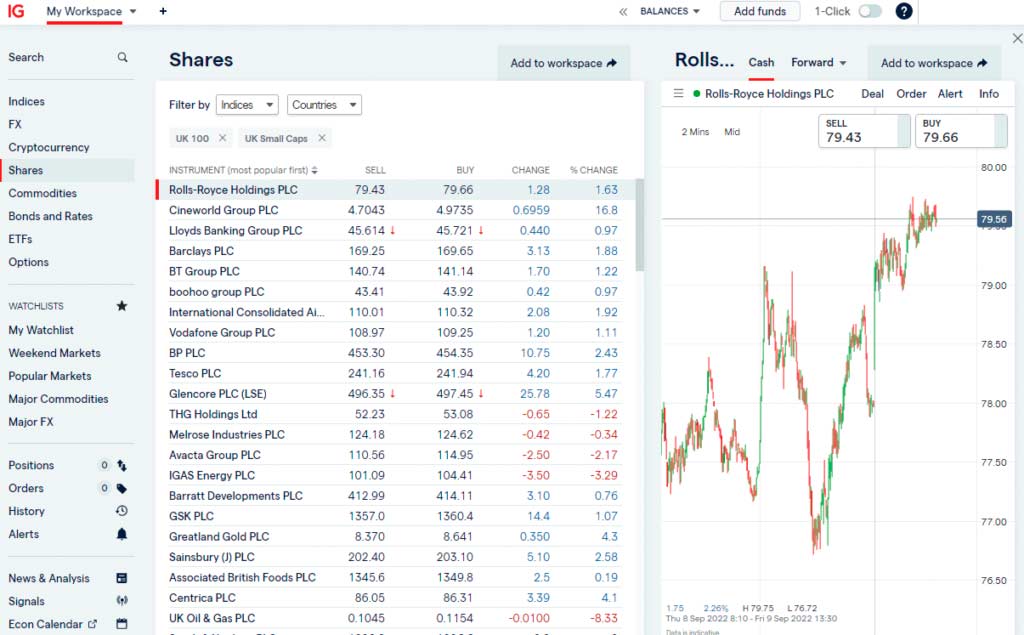
Our verdictIG, a global provider of CFD trading services, opened an office in Dubai in 2008. This expansion allowed IG to establish a physical presence in the region and cater to the needs of traders and investors in Dubai and the wider Middle East. With the Dubai office, IG can provide local support to CFD traders, personalized service, and tailored contracts-for-difference trading solutions to clients in the region. Is CFD trading with IG allowed in the UAE?Yes, you can trade CFDs in the UAE with IG as they are regulated by the DFSA and have a local office in Dubai. DFSA Reference Number: F001780 Overall, IG is a good CFD broker for UAE traders who want deep liquidity on a wide range of markets. Plus their expansion into the UAE demonstrated IG’s commitment to serving the growing demand for online trading services in Dubai and further solidified its position as a leading broker in the industry. IG UAE Address: IG Limited – Level 27, Currency House – Tower 2, Dubai International Financial Centre, Dubai, 506968, United Arab Emirates
|
|
 |
CFD Markets 7,000 |
Min Deposit $10 |
GMG Rating |
Customer Reviews |
Visit Platform Capital at risk |
Account Types:
|
|
What Is The Best UAE CFD Broker For Low Spreads?
Good Money Guide currently rates Capital.com as the best CFD broker for low spreads in the UAE, as then were voted “Best Trading Platform in the UAE” in the Good Money Guide Awards, are regulated in by the CMA, have tight pricing as well as easy to use and advanced features for all standard for traders.
Capital Com MENA Securities Trading LLC is authorised by the Capital Market Authority (CMA) under licence number 20200000176 and provides CFD trading services to UAE residents.
How To Choose A Broker With Low Spreads In The UAE
When choosing a broker in the UAE, many traders focus on spreads because they are one of the most significant trading costs. A lower spread means less cost when entering and exiting a trade, which can make a substantial difference over time, particularly for active traders, scalpers and day traders.
However, the broker with the lowest advertised spread is not always the cheapest broker overall. Traders should consider all trading costs, including overnight financing charges, currency conversion fees and any additional trading costs.
What Is The Spread In CFD Trading?
The spread is the difference between the buy price (bid) and the sell price (offer) of a financial instrument. When you go long you buy at the offer (the higher price) and sell at the bid (the lower price).
For example:
- Buy price: 12,476 offered
- Sell price: 12,475 bid
- Spread: 1 point
The spread represents the primary cost of opening a CFD trade and is one of the main ways brokers generate revenue.
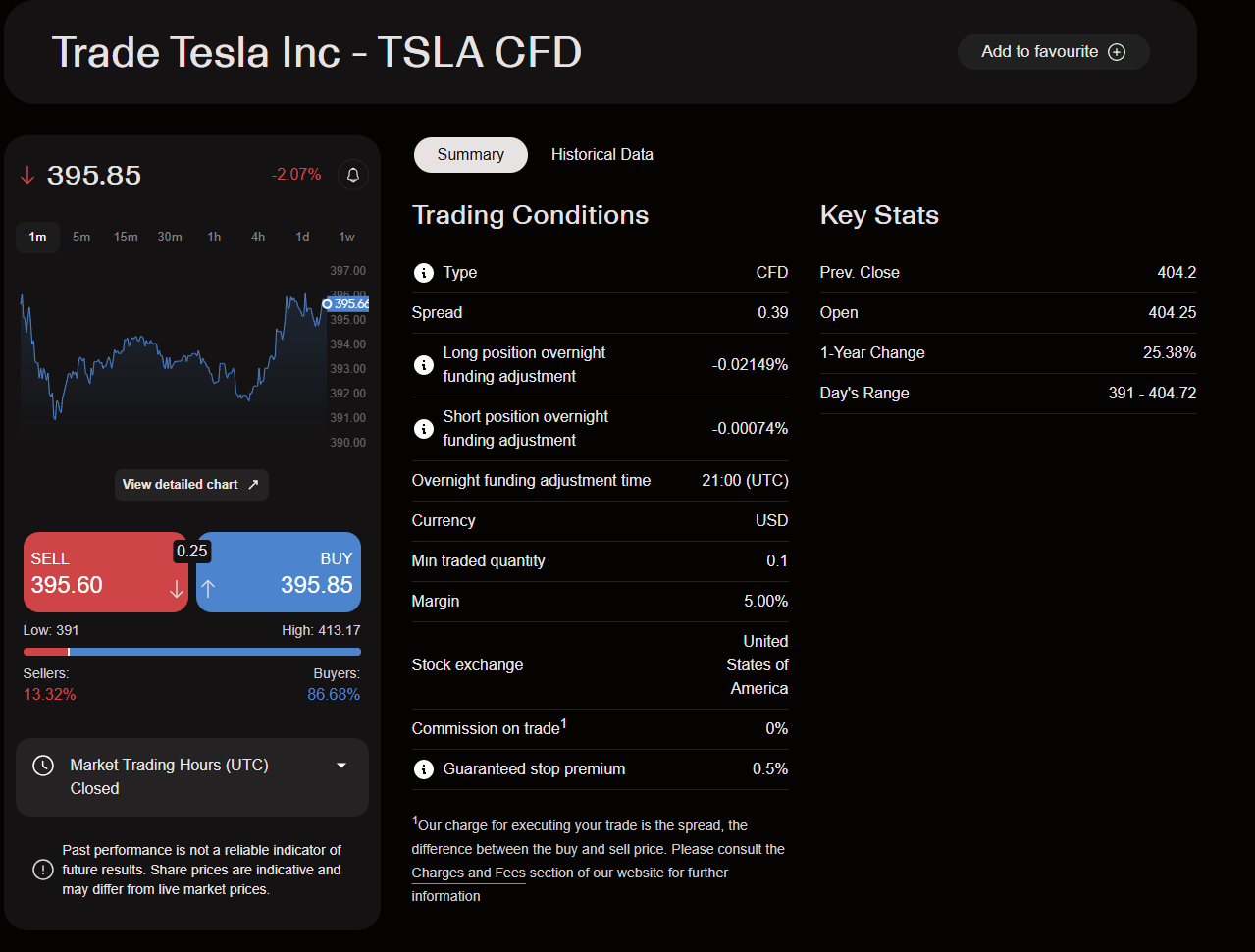
At Capital.com for example, the spread is displayed directly on the deal ticket before a position is opened, allowing traders to see the exact cost before committing to a trade. See the example below where you can see the spread on trading Tesla stock as a CFD is 0.39.
Why Are Low Spreads Important When Trading CFDs?
Every trade begins with a small loss equal to the spread.
The narrower the spread, tThe lower your trading costs which means the easier it is to reach profitability. CFD brokers with low spreads are more suitable for active trading as the more efficient short-term strategies become.
This is particularly important for:
- Scalpers
- Day traders
- High-frequency traders
- Forex traders
- Index traders
Even small differences in spreads can add up significantly over hundreds of trades.
Which CFD Markets Typically Have The Lowest Spreads?
Spreads are usually lowest in highly liquid markets where there are large numbers of buyers and sellers like:
- EUR/USD
- Gold
- Major stock indices
- Large-cap shares
- Popular commodities
According to Capital.com, highly liquid markets generally offer lower spreads than less liquid markets, where wider spreads and greater volatility are common.
Don’t Just Compare The Minimum Spread
Many brokers advertise “spreads from” a certain level.
The problem is that:
- Minimum spreads may only occur briefly
- Market conditions change constantly
- Actual spreads can be wider during volatility
- Liquidity affects pricing
When comparing brokers, always check the live dealing ticket for the current spread. A broker that consistently provides competitive pricing can often be more valuable than one advertising extremely low minimum spreads.
Consider The Total Cost Of CFD Trading
A low spread is only one part of the overall cost.
When evaluating a broker, check for:
Overnight Funding Charges
CFD positions held overnight may incur financing charges.
These costs vary depending on:
- Asset class
- Market interest rates
- Position size
- Holding period
For active traders who close positions before the end of the day, these costs may be minimal. Longer-term traders should pay close attention to them.
Currency Conversion Fees
If you trade assets priced in a different currency from your account, conversion fees may apply.
For example:
- Trading US shares with an AED account
- Trading European shares with a USD account
Capital.com applies a 0.7% mark-up on currency conversions, which is incorporated into the exchange rate rather than charged separately.
Guaranteed Stop-Loss Fees
Some brokers charge additional fees for guaranteed stop-loss orders.
A guaranteed stop-loss ensures a position closes at the exact level specified, even during market gaps or periods of extreme volatility.
These can be useful for risk management but may increase trading costs if triggered.
Check The Broker’s Pricing Transparency
A good broker should clearly explain:
- How spreads work
- When fees apply
- Financing charges
- Currency conversion costs
- Risk management costs
Avoid brokers that make pricing difficult to understand.
Capital.com provides detailed explanations of its business model and pricing structure, helping traders understand exactly how costs are calculated before they place a trade.
Why Regulation Matters More Than A Tiny Spread Difference
Many traders focus on saving a fraction of a point on spreads while overlooking regulation.
A regulated broker can offer:
- Greater transparency
- Client fund protections
- Regulatory oversight
- Formal complaints procedures
- Clear operating standards
In the UAE, traders should prioritise brokers that operate under recognised regulatory frameworks.
Methodology: How We Choose The Best UAE CFD Brokers For Low Trading Costs
We base our recommendations and ratings for the best CFD brokers for low spreads in the UAE on a set methodology for rating accounts, as well as over 40,000 votes and reviews submitted by traders in the annual Good Money Guide awards.
Plus, for every CFD broker we include we include our team’s experiences testing the UAE CFD trading platforms with real money. An, in-depth comparison of the features that make these Dubai CFD brokers the best. Plus, we make sure that when comparing and test UAE trading platforms we interview the CEOs and senior management.